He signed for Salford in December 1930, aged twenty, walking straight into one of the greatest club sides English rugby league has known, built by the legendary Lance Todd around players like Gus Risman and Barney Hudson. He made his debut on 6 December 1930 against Dewsbury, and did not really stop for eight years.
Career Record: The Willows, 1930–1938
- Games for Salford
- 245
- Career tries
- 113
- Best season
- 27 tries, 1932–33
- Wales caps
- 4
- GB Test appearances
- 16
- Transfer to Wigan, 1938
- £700
- Honours
- 3× Championship · 4× Lancashire Cup · 4× Lancashire League · Ashes-winning tourist, 1933, 1936, 1937–38 · beat New Zealand 2–0, 1936
His partnership at half-back with fellow Welshman Billy Watkins became one of the most feared in the English game: together they lost only one of the seven Tests they played between 1933 and 1937. In 1934 he toured France with the Salford side that so dazzled their hosts they were nicknamed Les Diables Rouges, the Red Devils, a name the club still carries. It is a name with a longer reach than most. Three decades later, Manchester United adopted the same nickname for themselves, reportedly drawn from Salford's own, when Sir Matt Busby wanted a fiercer identity for his rebuilt side after the Munich air disaster.
Source: Salford RLFC club history, Wikipedia, "Salford RLFC"
The club were not the only ones to come home from France with a nickname. In November 1934, on Salford's own tour of the country, the French crowds gave Emlyn one of his own. Harry Sunderland, the Australian journalist who travelled with the side, wrote it down three times over the next four years, and his fullest account is the plainest: Emlyn was such a dazzling star against the scattered French defenders that the crowds christened him Chèvre Montaigne, the mountain goat. His sidestepping, Sunderland wrote, reminded them of the chamois of the Alps. A Brisbane paper later placed the christening at Béziers, on one November afternoon, with Emlyn skipping in and out of the French lines like a chamois from crag to crag. The name followed him around the world, and two years later it was still doing duty in Australian headlines.
Sources: Manchester Evening News, 19 November 1938; The Labor Daily, 26 May 1936; The Courier-Mail, 13 July 1936. All three in the Archive.
Paris, April 1934: the hand-ball king
Earlier that same year, on 15 April 1934, Emlyn played at the Stade Buffalo in Paris in what turned out to be a landmark fixture: France's very first international rugby league match. The visitors won 32 points to 21. The official attendance was put at twenty thousand, though French writers reporting afterwards reckoned the true figure closer to twenty-five or thirty thousand, and hailed the day as a great date in the game's history.
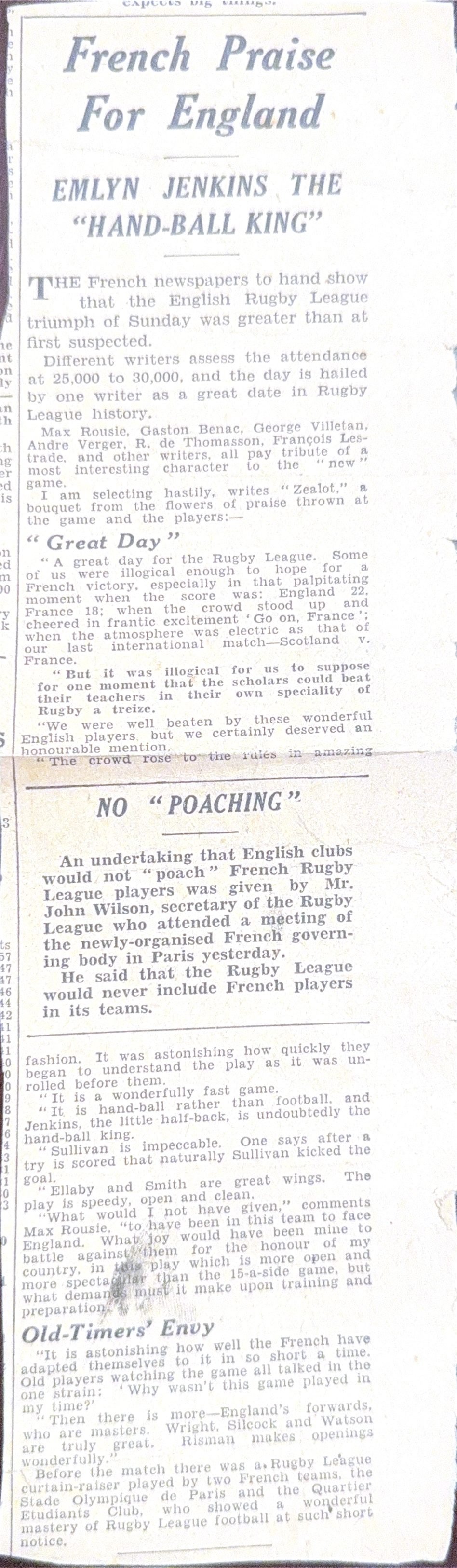
The cutting kept by the family. Click to read the full column.
The French press was captivated. Their reports described a wonderfully fast game, and an audience that grasped the unfamiliar thirteen-a-side rules with startling speed, rising to its feet and roaring the home side on when the score stood at 22 to 18. Amid the praise thrown at the players, one line singled out Emlyn above everyone. The game, the writer said, was hand-ball rather than football, and Jenkins, the little half-back, was undoubtedly the "hand-ball king."
One note for anyone puzzled by the headline: the side Emlyn played in that day was billed as England, and he was, of course, a Welshman from the Rhondda. That was entirely normal at the time. From 1924 the professional game's Test team was officially named England, and it was routinely made up of the best players from both countries, captained more than once by Welshmen. Gus Risman, another Welshman and Emlyn's Salford teammate, is praised in the same column.
An Australian report of the same match, printed in Sydney seven weeks later, records what he actually did that afternoon. The great try of the match, it says, was scored by the young Salford five-eighth who came from Wales: an attractive artist in an attacking game, able to step around off both feet like a dancer. He began the run on his own side of half-way and beat at least eight Frenchmen before scoring under the bar. England in fact scored one try fewer than France; the eleven-point margin came from Jim Sullivan's seven goals. Harry Sunderland, watching from the stand, still ranked that try among the finest football feats he had seen when he wrote about it four years later.
Sources: The Rugby League News (Sydney), 4 June 1934, and Manchester Evening News, 19 November 1938, both in the Archive.
Sources: match record, France national rugby league team results · on the naming of the Test side, rugby league historian Tony Collins, "England, Great Britain, Northern Union"
Crowd rose to a dazzling try that beat their own side
Two minutes to go, Salford trailing Warrington 12–9 at Wilderspool, and even the most rabid Salford supporter was resigned to defeat. Then a light-haired figure pounced on a loose ball near the halfway line, tucked it under his arm, and was off, swerving, side-stepping, dummying his way clear with only the Warrington full-back left to beat. He went round him too, and scored near the posts. Warrington's own supporters rose to their feet for the man who'd just beaten their own certain victory.
"I, for one, shall never forget it," wrote a Salford supporter who had travelled to the match, sending the story in years afterward for the paper's "My Most Dramatic Sporting Moment" feature.
What his absence was worth can be measured from the day he came back. In late November 1933, with Emlyn fit again for the first time since September, Salford put ten tries and eight goals past Widnes and won 46 points to 5. The reporter opened by asking what on earth could be said about a score like that. Emlyn scored one of the tries and was in most of the other movements, and the local paper's verdict was that the crowd had been reminded what the club and the country had been missing while he was out.
Source: Runcorn Weekly News, 1 December 1933, in the Archive.
The peak of it all came in 1936, when Salford supplied five of the backs on the Great Britain touring side to Australia and New Zealand: Emlyn among them, alongside Risman, Hudson, Watkins and Edwards. He was, by common agreement, the find of the tour, and the Australian press spent a winter telling its readers so. That story has grown large enough to need a chapter of its own: The Ashes.
"I feel I have been victimised"
The parting was not amicable, and it began a year before the transfer. In late September 1937 Salford dropped him for the match against Castleford and put him in the A team. He had played for the club without a break for seven years, toured Australia with five of its players the season before, and been beaten in a cup-tie at Widnes. He responded by asking for a transfer, and by writing to a Welsh newspaper to say why.
His own words, and the only ones of his that survive in print: he did not consider the directors had treated him fairly, and "I feel I have been victimised or that it is a case of the blame being put on me for our defeat in the Widnes cup-tie."
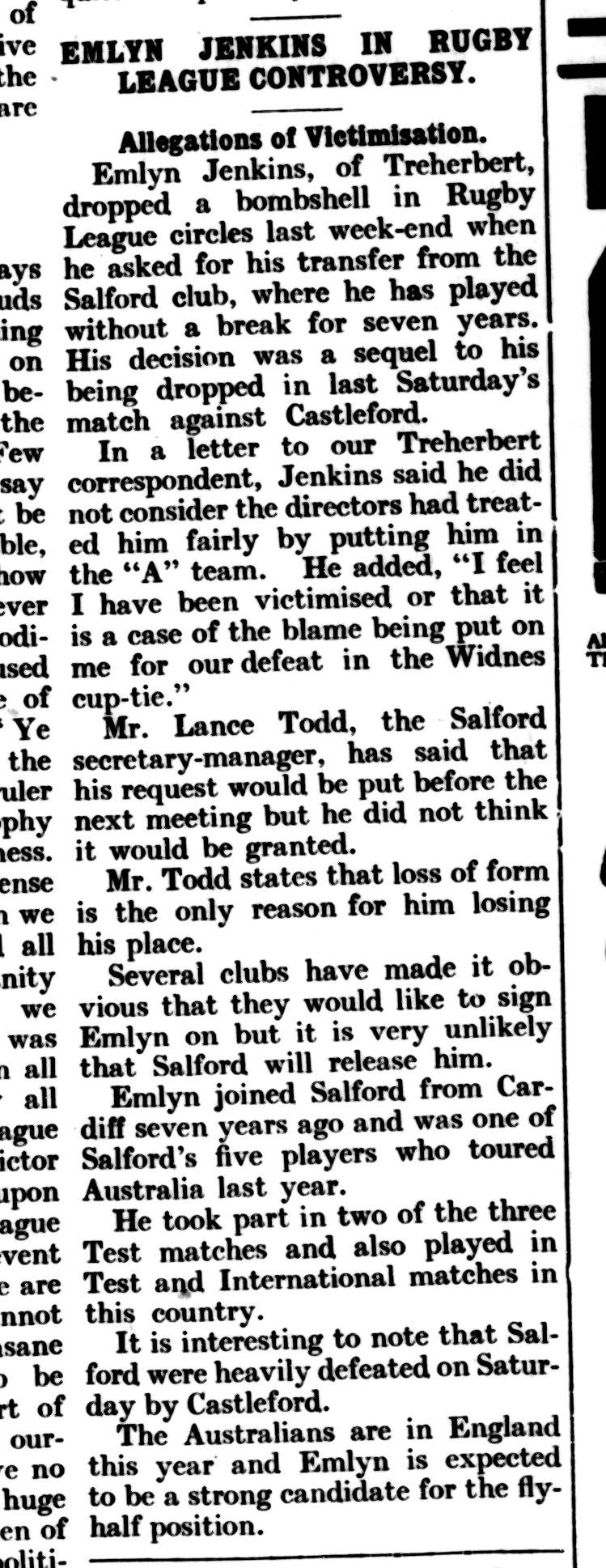
Caerphilly Journal, 2 October 1937. The transfer request, and Emlyn's letter, reported in the valley he came from.
Lance Todd, the man who had brought him north seven years earlier, gave the club's answer: the request would go before the next meeting, but he did not think it would be granted, and loss of form was the only reason Jenkins had lost his place. Several clubs, the paper noted, had made it obvious they would like to sign him. Salford, heavily beaten by Castleford that Saturday, kept him.
Two weeks later the international selectors picked him to play for his country against Australia. The Treherbert column that carried the news put it plainly: many had thought he was losing his form when his club dropped him, and his recognition proved he was playing as well as ever. He scored the only try of the match and won it. What his club thought of him and what the game thought of him had come apart, and it took another five months to resolve.
Sources: Caerphilly Journal, 2 and 16 October 1937, in the Archive. The Test itself is in The Ashes.
It ended in March 1938, when Salford sold him to Wigan. What happened next, and how a career that should have run another decade was over inside a year, is told in The Long Goodbye. Two months after he left, Salford won the Challenge Cup for the first time in the club's history, the one honour that, in an otherwise glittering career, always eluded him.
1954: the all-time greatest team
Long after he had stopped playing, the game was still picking him. In July 1954, at the request of the Batley club, three of the most senior officials in English rugby league sat down as a selection committee to name the greatest side Great Britain could ever have fielded, drawing on every player from the code's whole history. They chose Emlyn at five-eighth.
England's all-time greatest team, as chosen in 1954
Full-back: Jim Sullivan. Three-quarters: Alf Ellaby, Harold Wagstaff, Jimmy Lomas, Alan Edwards. Five-eighth: Emlyn Jenkins. Half: Jonathan Parkin. Lock: Frank Gallagher. Second row: Martin Hodgson, Douglas Clark. Front row: Ken Gee, Joe Egan, Nat Silcock senior.
The selectors were John Wilson, for many years secretary of the English League and a tour manager to Australia, with Bob Anderton and Walter Popplewell, co-managers of the touring teams between 1932 and 1946. Every man named, the paper noted, had been an outstanding champion, and four of them had captained touring sides to Australia.
Two of those three selectors had watched him at close quarters for four months in 1936. Anderton and Popplewell managed that tour, and both went on the record about him in Sydney the day England kept the Ashes: Popplewell called him truly wonderful, and it was Anderton who let slip that he had played the deciding Test injured. Eighteen years later, with a whole century of players to choose from and no reason left to flatter anyone, they picked him again.
Source: The Rugby League News (Sydney), 17 July 1954, page 9, digitised by the National Library of Australia: nla.gov.au/nla.obj-631853877. In the Archive. On the 1936 verdicts, see The Ashes.
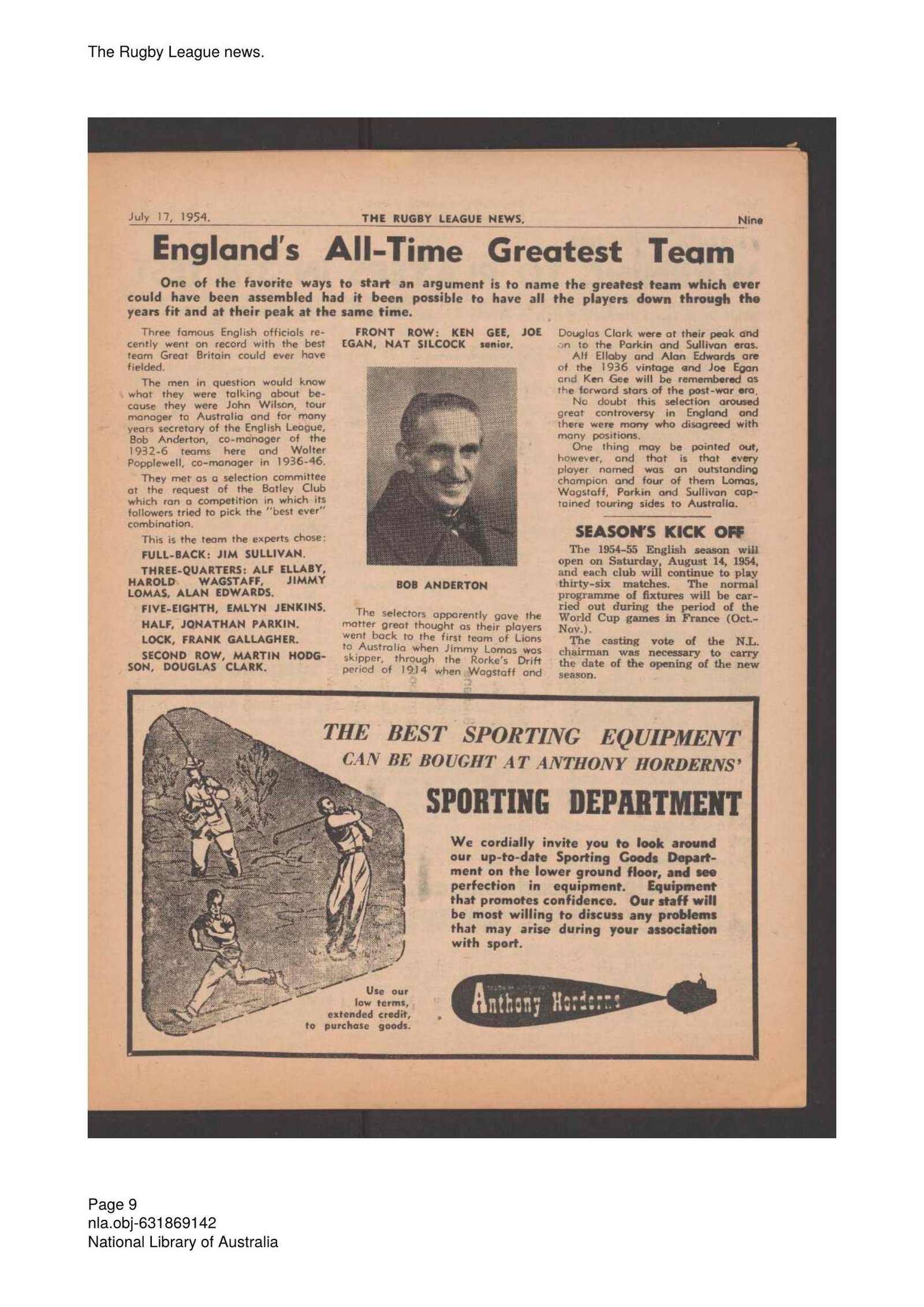
The Rugby League News, 17 July 1954. Click to read the full page.
The measurements of him
In September 1935, between the two Australian tours, the Manchester Evening News gave him a full column of its Sports Page Gallery, with an action photograph of him running. It is the closest thing to a physical description of him at his peak that survives. He stood 5ft 6½in. He had weighed 10st 8lb when he arrived at Salford and by 1935 was carrying nearly 12st, which the writer notes because an erroneous impression prevailed that he was light. When he first came to the club he had gone straight into the first team and, on account of his youth, was nursed between the wing and stand-off until he settled.
On how he played, the paper is better than most: one of the most unorthodox half-backs of the present generation, who does not himself know what his next move will be, awaiting his opportunity before deciding, which is always most disconcerting to the opposition. A quick thinker, and truly a brainy player. It also confirms the story the family always told about how he came north, that it was at Cardiff that he caught the eye of Mr L. B. Todd, the Salford manager, who was so impressed that he induced him to join the club.
Source: Manchester Evening News, 27 September 1935, in the Archive. The same profile says he was born at Treorchy; the 1911 census and his mother's memorial card both place the family at 73 Miskin Street, Treherbert.
The club never forgot him either. In 2001, supporters, board members, sports writers, and club historians together chose an all-time Salford XIII, drawing on a century of players since the ground first opened in 1901. Emlyn was named at number six: stand-off, the position he made his own.
Source: Salford RLFC club history, Wikipedia, "Salford RLFC"
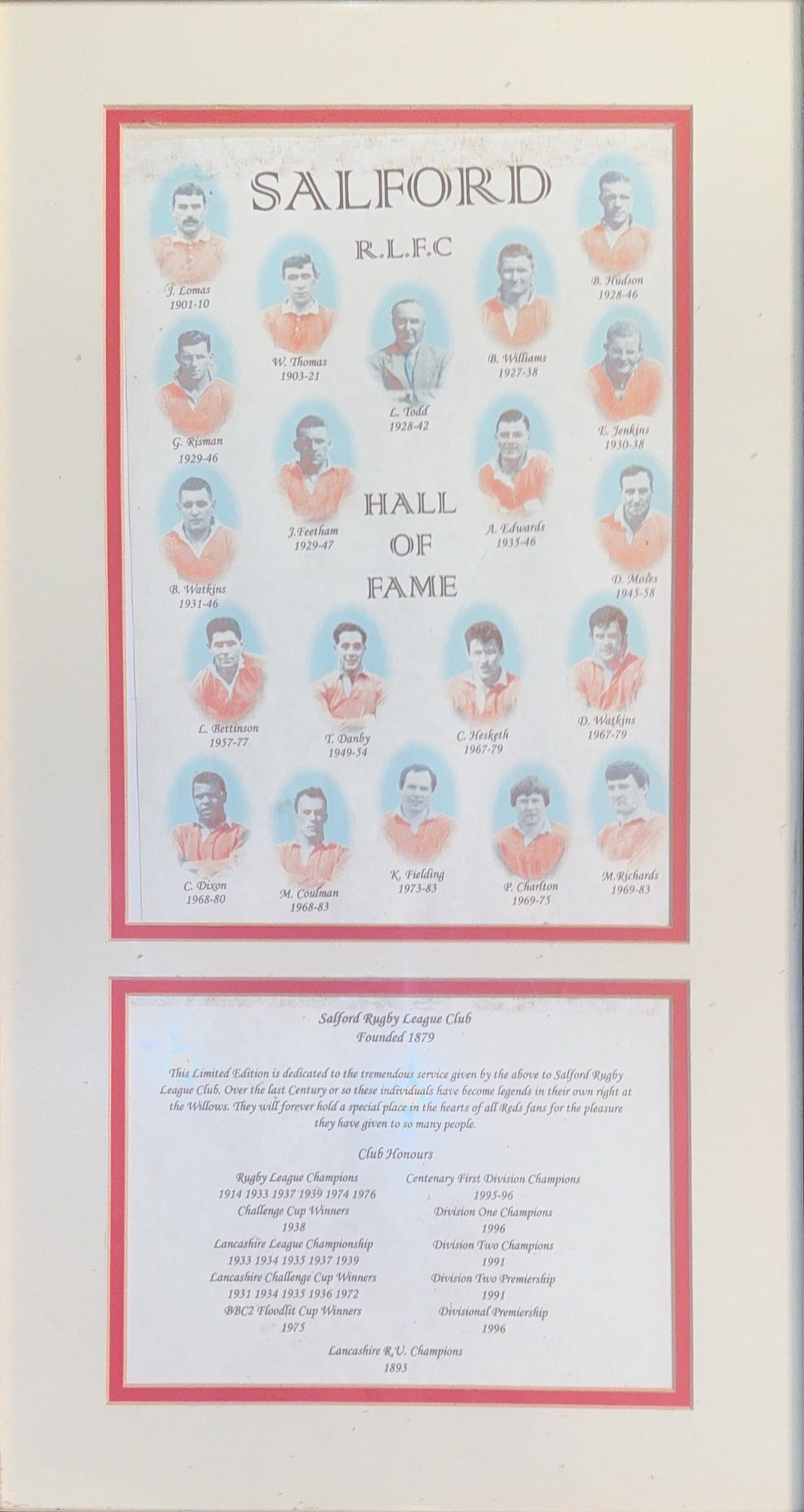
A Salford RLFC Hall of Fame print kept by the family, naming Emlyn among the club's greats, 1930–38, alongside Gus Risman, Barney Hudson and Lance Todd.
The centenary, 1979
In the autumn of 1979 Salford began its centenary celebrations with a buffet-dinner at The Willows, and before it a league match against Widnes, who had been the club's opponents in their first home fixture on 12 October 1879. Three of Salford's original pre-war Red Devils accepted invitations: Gus Risman, Cliff Evans, and Emlyn. He was sixty-eight and living in Hampshire, and forty-one years had passed since the club sold him. When Salford looked back over a hundred years, his was one of the three names it reached for first.
Source: Manchester Evening News, 29 September 1979, in the Archive.