In 1936 Salford supplied five of the backs on the Great Britain touring side to Australia and New Zealand: Emlyn among them, alongside Risman, Hudson, Watkins and Edwards. Twenty-five years old, at the height of his powers, he was by common agreement the find of the tour. His duels with the brilliant Australian five-eighth Vic Hey became the stuff of legend; one Australian critic wrote that Jenkins "rose to magnificent heights... I have never seen a finer display at off-half." This chapter follows him across the world and back, through the newspapers of the country he conquered. At home the Caerphilly Journal greeted the news by observing that his selection ranked him the best half-back in the North of England, and reminded its readers that the Treherbert boy had been lost to Welsh football when he received £400 to join Salford.
The album
Emlyn came home from Australia with a photograph album, bound in dark green, stamped in gold: English Rugby League, Australian Tour 1936, Photographs, with the crossed E and A shields of the two countries and, in the bottom corner, his own initials. Every page is captioned in his own hand in white ink. It is the only sustained piece of writing by him that the family has, and it is the reason so much of this chapter can be told from the inside. The pages photographed so far can be seen in The 1936 Album.
He begins it at home. The first photograph is of a front room in Salford, a wireless set in the corner, Kathleen on one side and Emlyn on the other, and between them their daughter Patricia, not yet one, reaching for a stuffed toy her father is holding up. Underneath, in his writing: The day we heard of my selection as a tourist.
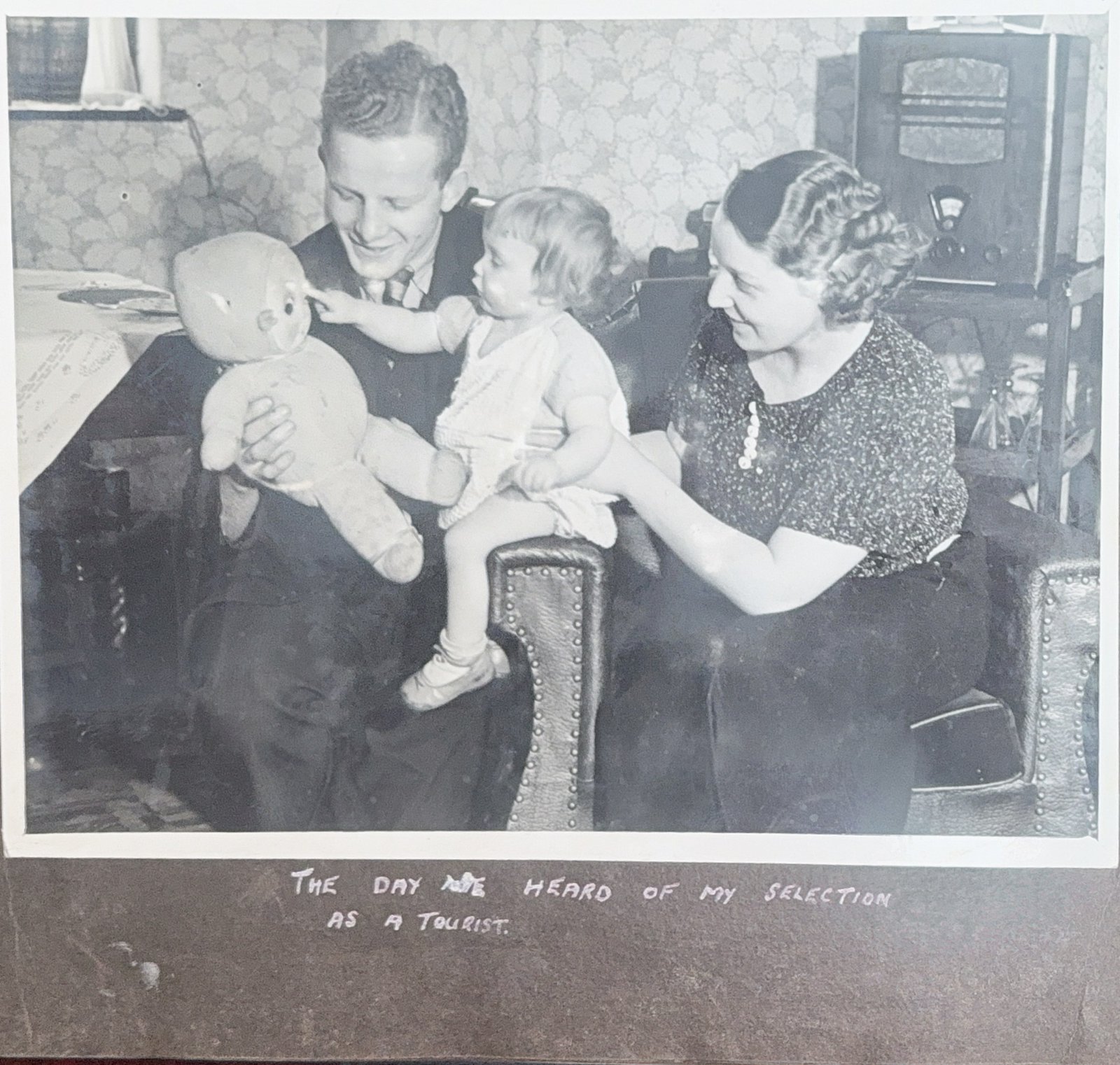
"The day we heard of my selection as a tourist." The first page of Emlyn's own album.
Most of the touring party sailed from Tilbury on 17 April 1936 aboard the P&O liner Cathay, a six-week voyage to the far side of the world. The album's second page opens with a P&O postcard of the ship, pasted in above his own snapshots of the voyage.
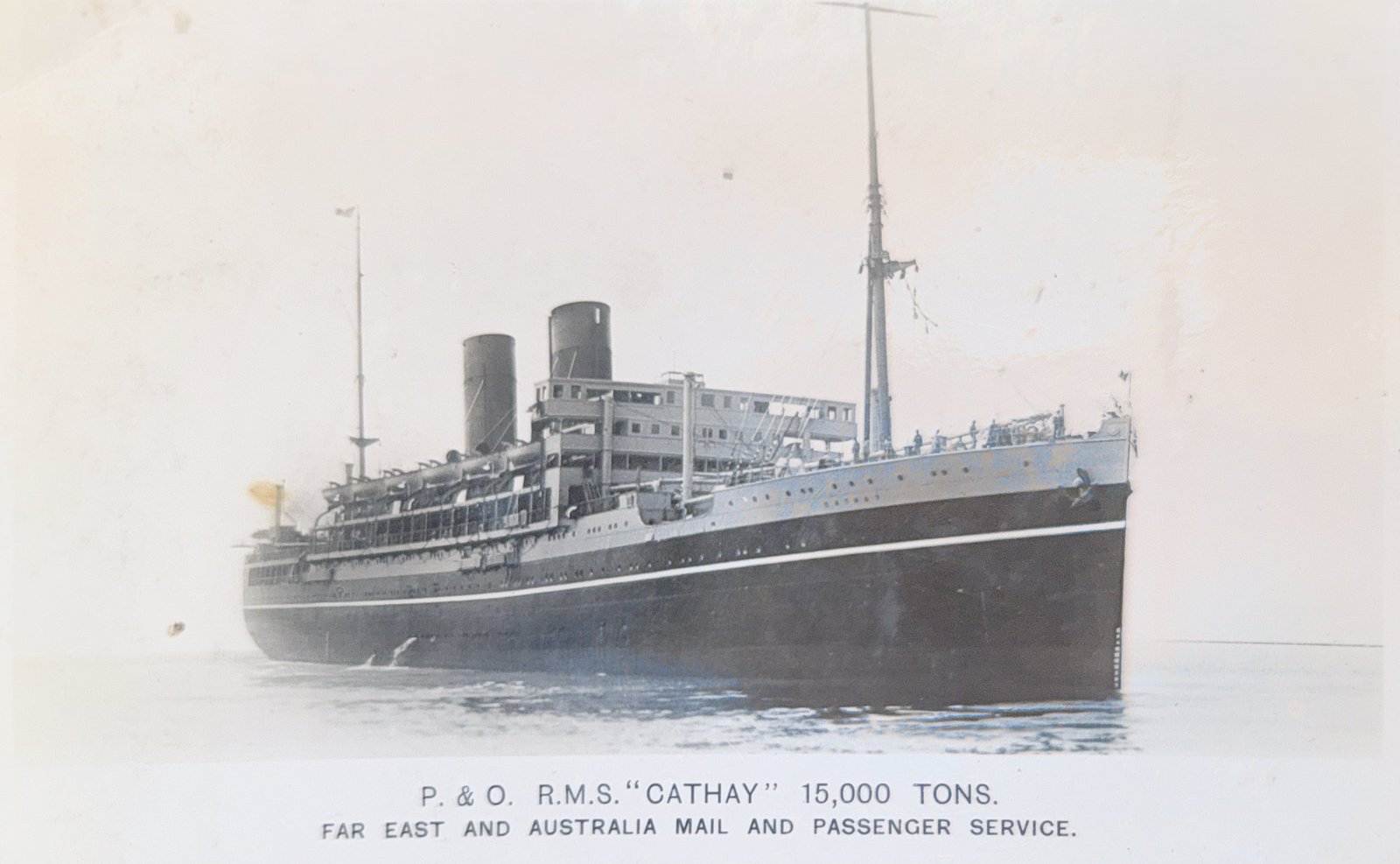
The ship itself: the R.M.S. Cathay, 15,000 tons, from the album.
Source: Wikipedia, "1936 Great Britain Lions tour"
Six weeks at sea with the same thirty men needs filling, and the tour manager Bob Anderton filmed a good deal of it. When he took the film round the northern clubs the following winter, showing the ports at Marseilles, Bombay and Colombo and the heat coming off the Suez Canal, one sequence always got a laugh. Emlyn had gone to a fancy dress ball on board as Mae West, and the impersonation was clever enough to win him first prize. A Treherbert news column had the story while the team was still in Australia, and the Rochdale paper thought it worth a paragraph of its own, a few lines above the sixteen-stone Widnes forward Nat Silcock launching himself into a rickshaw at Colombo and catapulting the astonished puller into mid-air.
Sources: Caerphilly Journal, 11 July 1936, and The Rochdale Observer, 20 February 1937, both in the Archive.
Tangier, Gibraltar, Marseilles
What follows is a young man's first sight of the world. Tangier is their first call, and he photographs the merchant boats rowing out to the ship, then goes ashore: a snake charmer, a man selling rugs under the caption "Very cheap." "How much?", and four teammates standing outside a police station beside a camel, named left to right as Tom Armitt, Martin Hodgson, Jack Morley and Hal Jones. Arthur Atkinson is photographed grinning on a donkey, under a caption that has not aged especially well.
Then Gibraltar ahoy, gliding in to Gib, and a picture of himself with Gus Risman and Alan Edwards after shopping there. At Marseilles he climbs to Notre-Dame de la Garde, photographs the funicular as the escalator to the church, and records the crew cleaning the Cathay's funnels and repainting them. Two of the party, Harry Field and a man he calls W. "Pip" Watkins, appear repeatedly. Pip was Billy Watkins, his half-back partner at Salford and for England, and the nickname is not recorded anywhere else.
And then, in the middle of a page of Marseilles views, one photograph of a small girl in a white sun hat, walking in a park with her mother. The caption reads: Thought of Pat and snapped the little lass. He was twenty-five, six weeks from Australia, and eleven months from seeing his daughter again.
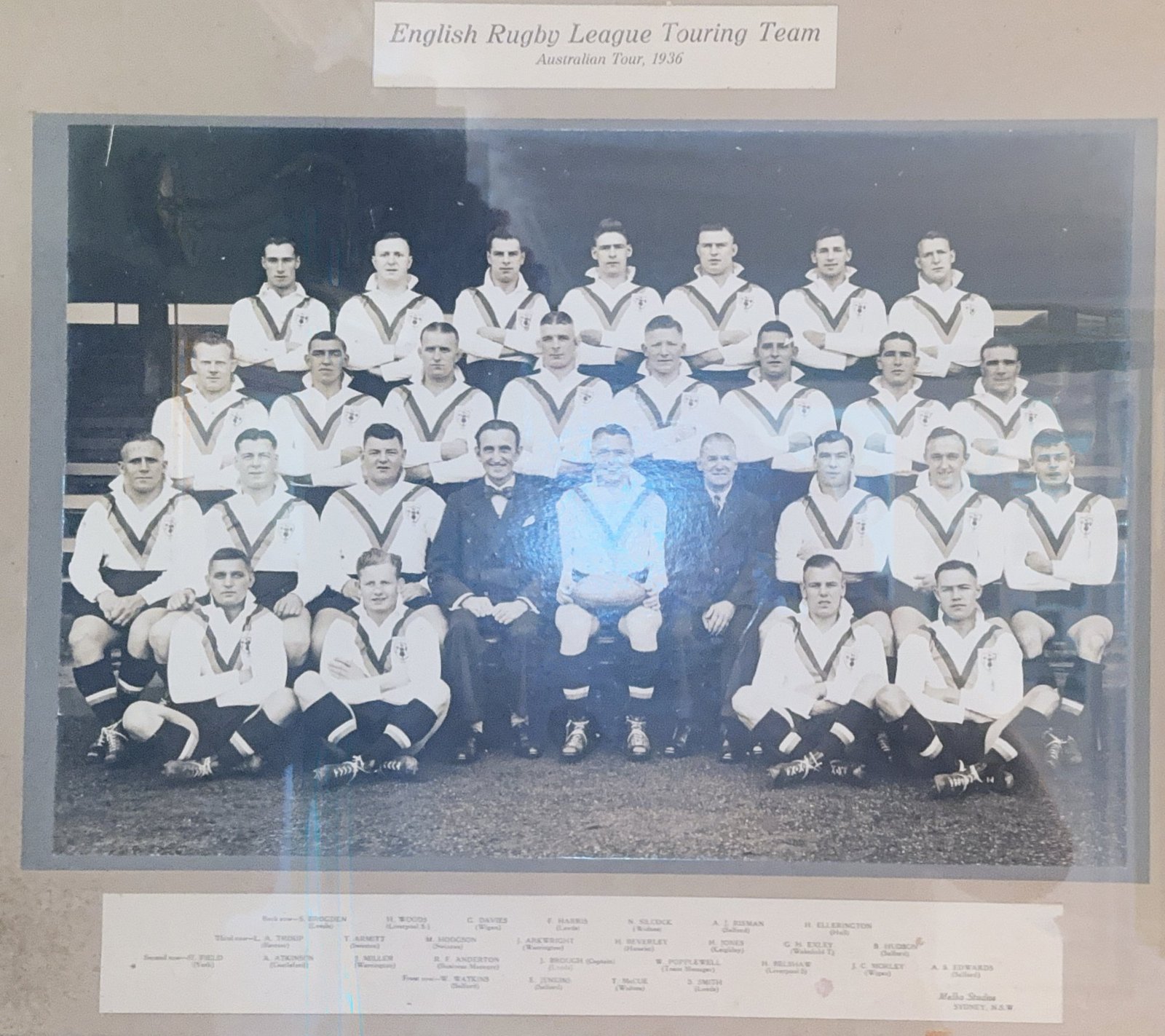
The official touring party, photographed in Sydney. Emlyn and his Salford half-back partner Billy Watkins sit together in the front row.
Melbourne, May 1936
The Cathay reached Melbourne on 25 May 1936, into a fog so thick on Hobson's Bay that she could not berth at Port Melbourne until after noon instead of eight in the morning. The planned training run had to be scrapped; instead the players were whisked from the ship to a Lord Mayor's reception at the Town Hall and then a second elaborate lunch at the Hotel Windsor, a day, one reporter wrote, of much Australian sparkling wine and two noon meals. Harry Sunderland, covering the arrival for Sydney's Labor Daily, sat with Emlyn through it and noticed how carefully he and the players near him passed dish after dish: an athlete at his top, Sunderland observed, has to be careful about diet, and they were all keen to get to a proper work-out on the Melbourne turf. Emlyn told him that very few of the players had put on weight on the six-week voyage.
Source: The Labor Daily (Sydney), 26 May 1936, page 3, digitised by the National Library of Australia: nla.gov.au/nla.news-page25588881. In the Archive.
Brisbane, 11 July 1936
By July the tour had reached its hardest stretch. Australia took the first Test in Sydney; England levelled the series in Brisbane. Then, a week before the decider, came the tourists' last match in Queensland, against the Brisbane district side at the Brisbane Cricket Ground, and it produced the most talked-about half of football of the whole tour. Brisbane led 8–5 at half time and held England to 8-all until the 52nd minute. Then, in a spell of 24 minutes, the tourists scored 27 points, and won 35–13.
The Courier-Mail's headline on the Monday told Queensland who had done it: "Brisbane Baffled When 'Mountain Goat' and Other Taffies Ran Riot." Sunderland, writing the match report, gave the credit to the four Welshmen of the side, Watkins, Jenkins, Risman and Edwards, who cut the holes in the Brisbane defence and, as he put it, made merry with all the clever tricks of the rugby trade. He singled out the moment Emlyn cut clean through the first line of defence, drew the full-back, and half-pivoted at pace to give a perfect pass to the flying Stan Brogden. On the same page Vic Hey, the great Australian five-eighth who would mark Emlyn in the deciding Test a week later, wrote his own signed column and called the second half the best he had seen from the tourists: Watkins and Jenkins, he wrote, figured as the ideal connecting links in a side of real eighteen-carat footballers.
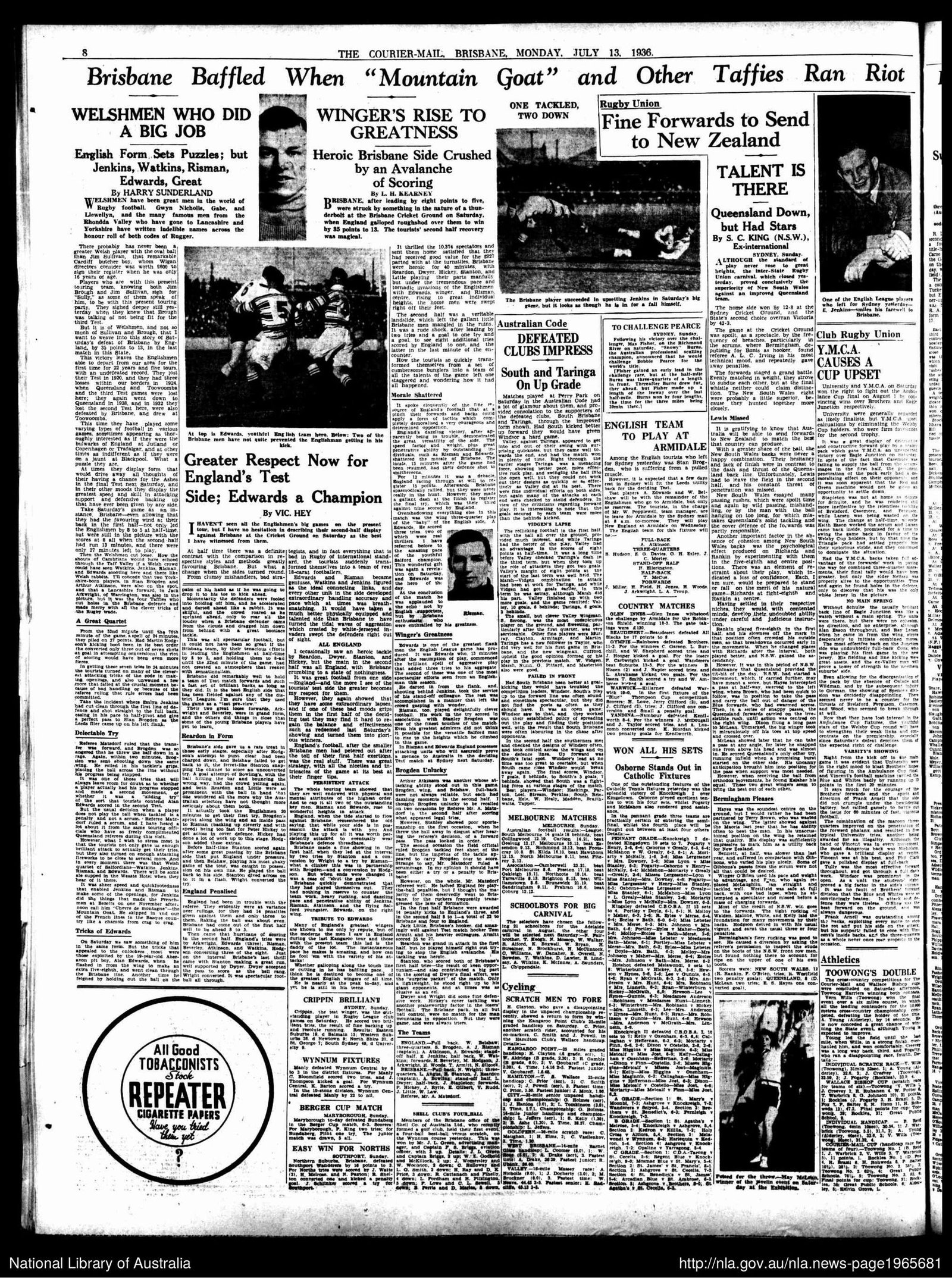
"One tackled, two down": Emlyn brought down in the Brisbane match, from the same page. Click for the full page.
Two photographs of Emlyn ran alongside the reports. One caught him mid-tackle, upset by a Brisbane defender who, the caption noted, looked to be in for a fall himself. The other was taken as the team left for Sydney and the deciding Test: Emlyn in his overcoat, smiling his farewell to Brisbane.
Source: The Courier-Mail (Brisbane), 13 July 1936, page 8, digitised by the National Library of Australia: nla.gov.au/nla.news-page1965681. In the Archive.
"E. Jenkins smiles his farewell to Brisbane." The Courier-Mail, 13 July 1936, as the team left for Sydney.
Sydney, 18 July 1936
The deciding Test came at the Sydney Cricket Ground on 18 July 1936. Australia had taken the first Test; England had levelled it in Brisbane. This was the one that mattered, and 53,546 people paid to watch it. England won 12 points to 7, tries from Hudson and Brogden with three goals from Marty Hodgson against a try from Vic Hey and two goals from Dave Brown. The Ashes stayed with England, and for Gus Risman, captaining his country for the first time in a Test, it could hardly have gone better.
The Sydney paper Truth devoted most of a page to it the following morning, and a striking amount of that page to Emlyn. Under the heading "A Prince," its match reporter called him the prince of stand-off halves and reached for the image the family would recognise instantly: that auburn head of his, shining out like a beacon on a dark and stormy night. He was, the paper said, "England's lighthouse, the devil in defence, the arch-fiend in attack," the man who drew the best out of Risman and the other backs and set the forwards loose. In the paper's list of the afternoon's decisive moments, one entry simply reads: Jenkins, Jenkins, Jenkins, he brought us down from everywhere when it seemed all over.
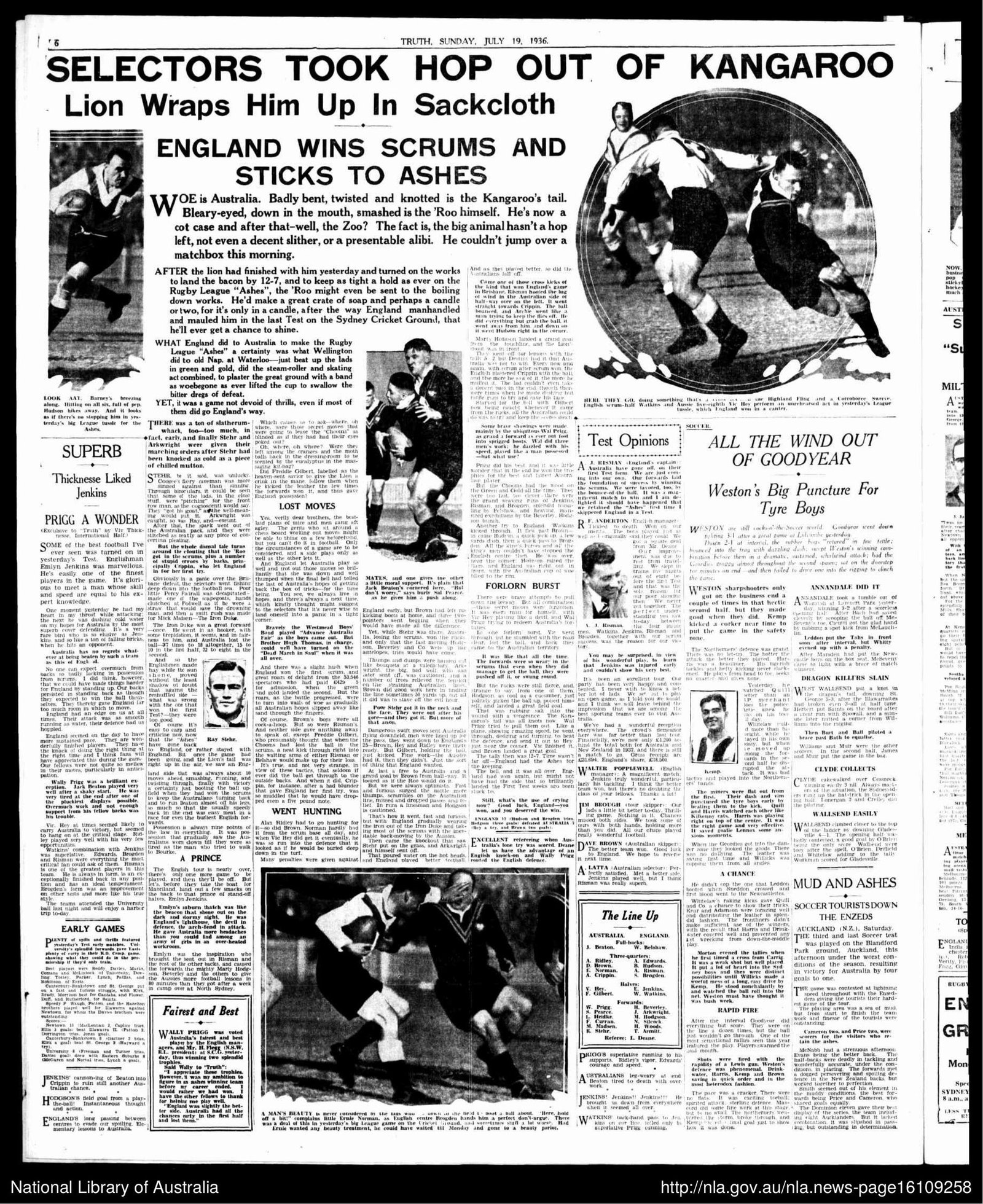
The full page, Truth (Sydney), 19 July 1936. Click to read it. Emlyn appears in the main report, in Viv Thicknesse's column at lower left, and in the players' and managers' verdicts on the right.
The Australian international half Viv Thicknesse, writing his own column for the paper, gave much of it to the same man. Some of the finest football he had ever seen, he wrote, and Emlyn Jenkins marvellous with it, easily one of the best players in the game, his skill and speed equal to his understanding of it. In one afternoon Emlyn had put Thicknesse's heart in his throat while attacking and then poured cold water on Australian hopes with his covering defence. Rare, he said, to meet a player "so elusive as Jenkins, and so like a ton of falling bricks" when he tackled. Australia, he concluded, had no regrets at being beaten by a team like that one. His verdict on the half-back pairing was blunter still: Watkins's combination with Jenkins was superlative.
Then there is the detail that changes how the whole afternoon reads. England's manager R. F. Anderton, asked afterwards for his verdict, named the understanding between his four inside men, Watkins, Jenkins, Risman and Brogden, as the reason England won. And then he added something almost in passing: that people might be surprised, given how well he played, to learn "that Jenkins was injured early and couldn't show his very best." The other English manager, Walter Popplewell, called him truly wonderful, singling out his tackling. Even the Australian selector A. Latta, conceding his side had met a better team, said Jenkins played well before giving his own vote to Risman.
Source: Truth (Sydney, NSW), Sunday 19 July 1936, pages 6 and 7, digitised by the National Library of Australia: nla.gov.au/nla.news-page16109258. Attendance and gate confirmed in the same report.
Truth was a Sunday tabloid, and tabloids reach for colour. So it matters that Sydney's broadsheet of record said the same thing in plainer language. The Sydney Morning Herald's Monday report carried Emlyn's name in its headline, "Great Display by Jenkins," and opened by stating flatly that England's five-eighth stood out as the finest player of the match, giving one of the finest displays ever seen from a five-eighth in Sydney. Under a section headed Superb Tackling, it described him time after time fearlessly dashing in to stop the man with the ball, his head bobbing up wherever his side was in trouble. Two papers, two registers, one verdict.
Source: The Sydney Morning Herald, 20 July 1936, page 15, digitised by the National Library of Australia: nla.gov.au/nla.news-page1190352. In the Archive.
Even from the far side of the world he thought of home. The match ball from the deciding Test, autographed by every player, went back to the boys' club in the Rhondda, along with a signed photograph of himself.
For years the family placed both at a Treherbert club. A contemporary report corrects it. In November 1936, home from the tour, Emlyn went to Treorchy Boys' Club and spoke for almost two hours to a hall of schoolboys and adults about the voyage out and the matches in Australia and New Zealand, so well that the chairman remarked that he might easily become a famous lecturer. Before he left he presented a signed photograph of himself to hang on the club walls, as a token of his gratitude for the benefit he had derived from the club when he was a member. Treorchy, then, and not Treherbert, and a club he had belonged to as a boy.
Source: Caerphilly Journal, 14 November 1936, in the Archive.
New Zealand, August 1936
The tour finished across the Tasman with two Tests against New Zealand. The first, at Auckland on 8 August, was a hard struggle: the New Zealand forwards held their own and England came through by 10 points to 8, which meant the Courtney Goodwill Trophy could no longer be lost. Sydney's Rugby League News reported that Emlyn, "who had performed brilliantly throughout, then scored a try with a brilliant solo effort," one of England's two tries alongside his Salford clubmate Alan Edwards. England won the second Test as well and sailed for home the same night, the Ashes and the Goodwill Trophy both kept.
Source: The Rugby League News (Sydney), 15 August 1936, pages 5 and 8, digitised by the National Library of Australia: nla.gov.au/nla.obj-648026239. In the Archive.
What Sunderland made of him
As the team sailed from Sydney for New Zealand, Harry Sunderland sat down to write a player-by-player review of the tour and posted it to England by air mail. His paragraph on Emlyn is the most considered verdict anyone gave him. Australian crowds had not known Emlyn Jenkins before this tour, he wrote, and now they would never forget him. He then set out the line of great stand-offs Australia had watched since 1910: Johnny Thomas, Billy Hall, Jonty Parkin, Billo Rees, Danny Hurcombe, Les Fairclough, Stanley Brogden. And then the judgement: Jenkins, as an off-half, will be remembered longer than any of them. He had impressed in every game, was superb in the last Test, and was the best player on the ground. Sunderland added, fairly, that he must thank his club half for the partnership.
Source: Yorkshire Evening Post, 7 August 1936, in the Archive.
Headingley, 16 October 1937
The Australians came to England the following year, and the story has a postscript that belongs here. In the first Test of the 1937 home series, at Headingley, England beat Australia by five points to four, and every one of England's five came from one passage of play. Sixteen minutes into the second half, with Australia leading 4-2, England won a scrum near the Australian 25. Tommy McCue sent out a quick pass, and, in the Western Mail's words, to Emlyn Jenkins fell the distinction of scoring the only try of a thrilling and pulsating struggle: he saw a gap, slipped through it, resisted the challenge of Ward the Australian full-back, and scored. The paper called it a glorious match-winning effort.
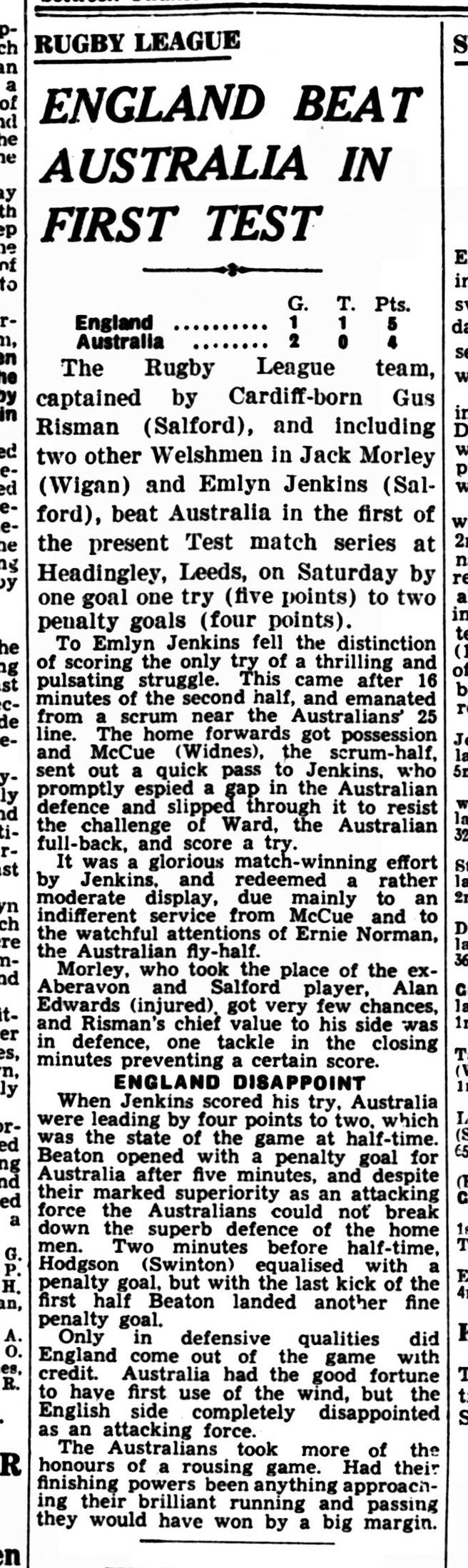
Western Mail, 18 October 1937. Click to read the full report.
Three Welshmen played that afternoon, captained by a fourth, the Cardiff-born Gus Risman. What makes it sweeter is what had happened a fortnight earlier, and that belongs to The Willows: Salford had dropped him to the A team, and he had written to a Welsh newspaper saying he believed he was being victimised. The selectors picked him for his country anyway, and he won them the match.
Source: Western Mail, 18 October 1937, in the Archive.
The tour that never was
His standing in Australia outlasted the tour by years. In March 1938, when the French League turned down an invitation to tour Australia, Sydney's Labor Daily urged the Australian authorities to bring out Salford instead, printed Emlyn's photograph under the heading May Tour Again, and set down in a single sentence where he now stood in the game: Risman was England's captain, and "Jenkins is the biggest attraction in Rugby League." The tour never happened, and by the time the idea faded, Emlyn was no longer a Salford player at all; how that came about closes the previous chapter.
Source: The Labor Daily (Sydney), 2 March 1938, page 3, digitised by the National Library of Australia: nla.gov.au/nla.news-page25565851. In the Archive.