He played first for Treorchy, then, as a teenager good enough to be capped a schoolboy international, for Bridgend, before moving on to Cardiff. A profile written while he was at Salford records that at both Welsh clubs he played scrum-half, and it was only later that he became the stand-off the game remembers. Getting there cost him something: he worked extra night shifts down Tydraw Colliery so he could be released to play, bathing in the morning and cooling off with a swim in the colliery feeder before heading back down the valley for training.
He rose high enough in the union game to represent his county, Glamorgan, the rung just below a full Welsh cap in the amateur game's hierarchy of the day. The family believes this studio portrait, taken in his county colours, dates from that period, in the last stretch of his career as an amateur before the offer that took him north.
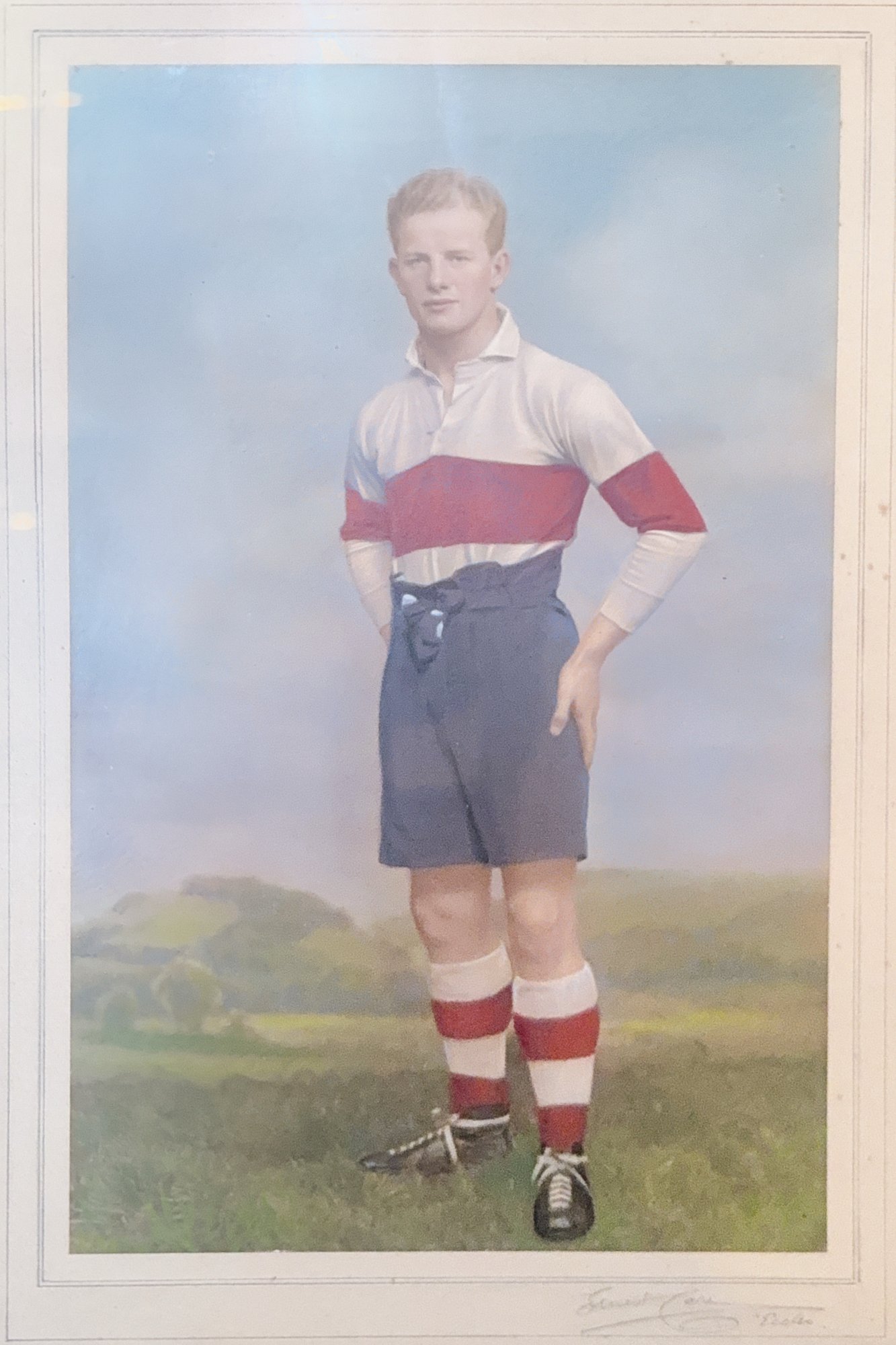
Believed to be Emlyn in Glamorgan county colours, shortly before he turned to rugby league.
Poole and Wimborne
Work in the coalfield was not steady enough to live on. With the Rhondda still reeling from the 1926 lockout and the pits offering only broken weeks, Emlyn went south to Poole and Wimborne in Dorset, one of the many South Wales men who went wherever work could be found in those years. Most of what he earned went straight home to his family. For pocket money, he turned to boxing, prizefighting in the ring rather than on the rugby field.
He kept a hand in rugby union too while he was there, turning out for the Bournemouth club: a selection card survives among his papers, calling him up for a Saturday fixture in November 1928. His niece Wendy remembers the family conviction that if he had chosen boxing as a career instead of rugby, he would undoubtedly have been a champion. A tough man, by every account, but one with a heart of gold.
Source: family recollection, Wendy Jenkins
Family legend traces the famous side-step back further still, to boyhood mornings spent dodging sheep on the hillsides above Treherbert, and to dustbins leapt at a run on the way home from school.
"I have stood with a stopwatch as he ran sixty yards straight, and as he did the same distance side-stepping twice on either side, we found he lost only a second."Tudor James, on Emlyn's side-step, contemporary press cutting
Bridgend, November 1929
The earliest report of him playing yet found is a single clause in a Birmingham paper. On Saturday 9 November 1929 Cheltenham paid their first visit to Bridgend and lost 13 points to nil in what the reporter calls a fast and exciting game, and among the scorers, tries were added by Emlyn Jenkins and G. J. Davies. He was eighteen, and it is the first time anyone recorded him scoring.
Source: Birmingham Weekly Mercury, 10 November 1929, in the Archive.
Two weeks later came a fuller account, printed in Devon. On Saturday 23 November 1929, Torquay travelled to Bridgend and lost by 14 points to 11, and the Torquay Herald Express called it one of the finest games seen at Bridgend that season, with the ball given plenty of air. Emlyn was eighteen, in his Bridgend season, and marking a man named Delahay whom the paper describes as the inspiration of the Torquay side. Its verdict on him is the first anyone has written down: he made a brave showing against Delahay and was often prominent.
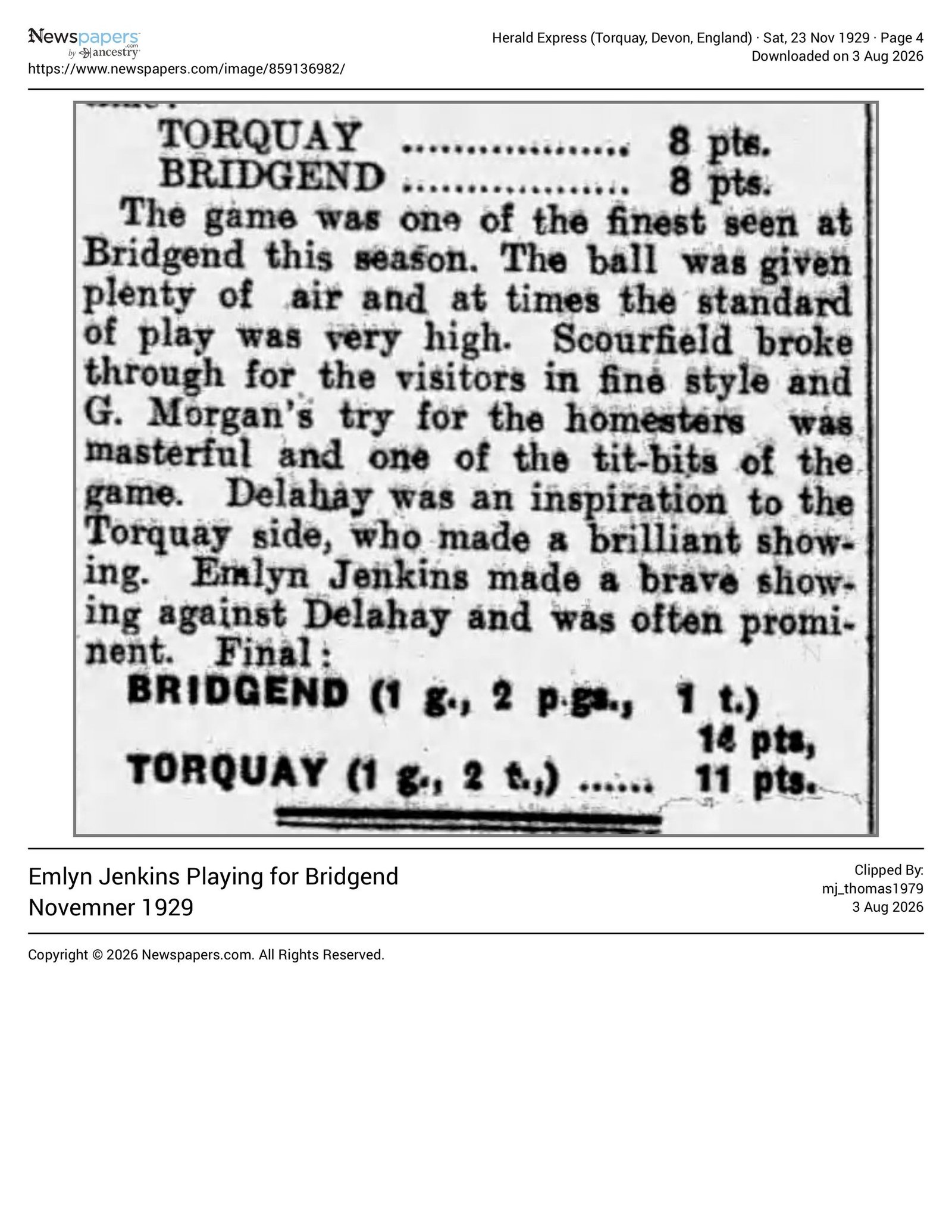
Herald Express (Torquay), 23 November 1929. The first known notice of him in print.
Brave and often prominent is not the language of a man being carried by his side, and it is a long way from what the Australian press would be writing about him seven years later. But the shape is already there: a small half-back given a bigger reputation to mark, who did not go missing.
Source: Herald Express (Torquay), 23 November 1929, page 4, in the Archive. Together with the Cheltenham report it fixes his Bridgend season as 1929-30.
The Cardiff season, 1930
Until recently that Cardiff season was known only in outline. Three newspapers now fill it in. On Saturday 20 September 1930 he was at half-back for Cardiff away to Pontypool, in a match the home side fought to a draw. The South Wales Football Argus, printing its report the same afternoon, opened by naming three players who had added to their reputations that day. One of them was Emlyn Jenkins, the Cardiff half-back.
Ten weeks later he was in a London paper. Cardiff went to the Rectory Field on 29 November and beat Blackheath by 25 points to nil, and the Daily Telegraph put his name in the headline over its report: "Blackheath Routed: Jenkins's Splendid Display for Cardiff." He was in splendid form, the paper said, showing a fine turn of speed and handling well, and he began most of the movements from which the tries came. Two of Cardiff's seven tries were his own. That report ran on Monday 1 December 1930, which was his twentieth birthday.
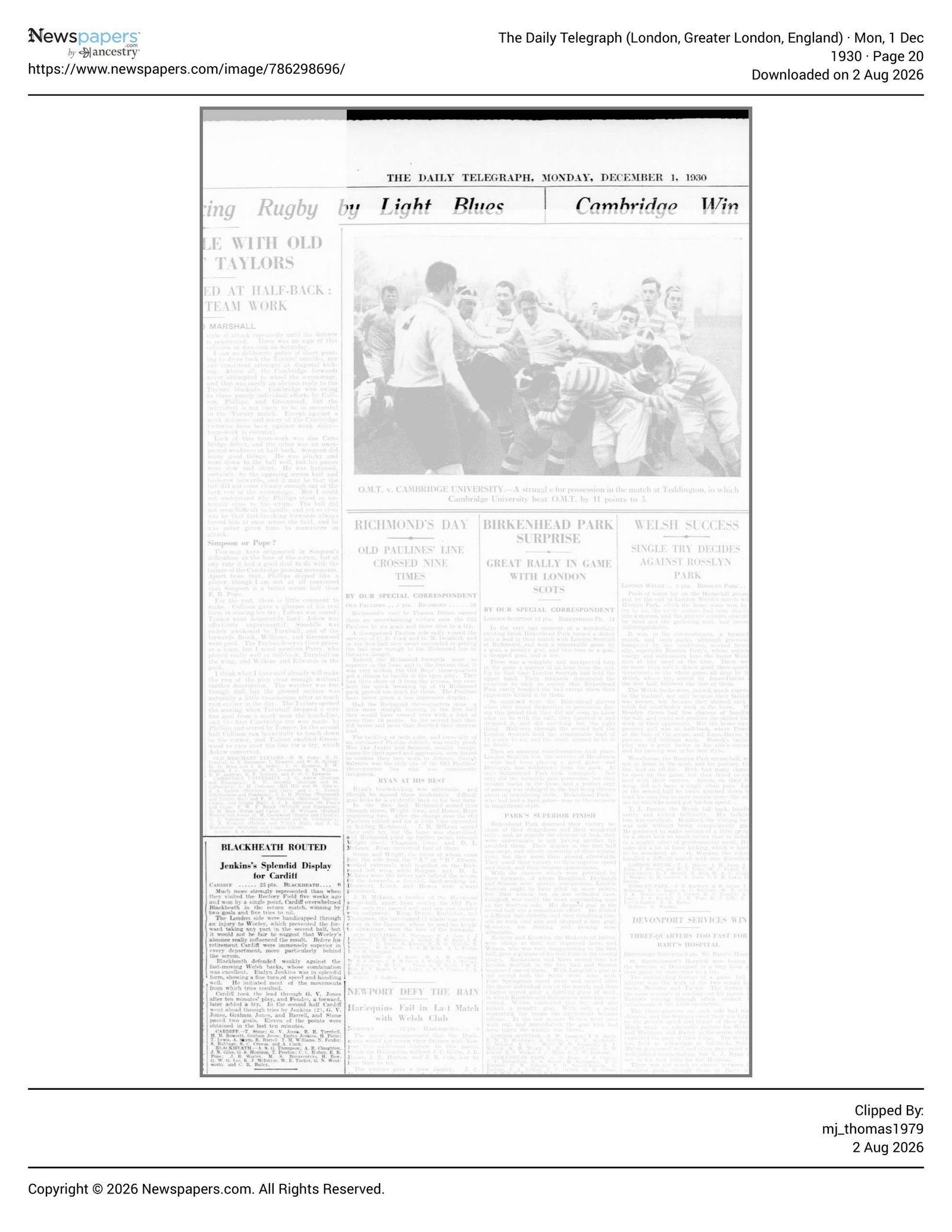
The Daily Telegraph, 1 December 1930. The Cardiff report is the boxed item at the foot of the left-hand column. Click to read the full page.
Sources: South Wales Football Argus, 20 September 1930, and The Daily Telegraph, 1 December 1930, both in the Archive.
His ambition, like every Rhondda boy's, was to play for Wales at Cardiff Arms Park. He was on the very edge of it: selected as reserve, regarded by good judges as a certainty for a full cap. Then Lance Todd came to Treherbert with an offer no collier's son could easily refuse: £400, and a good job, in Manchester. It was the depths of the Depression, and a cap is not a wage. As one writer of the day put it, plainly, the Rhondda's bread and butter came first. Union's loss was rugby league's gain.
6 December 1930
Five days after his birthday, it was done. The Western Mail carried the news in Wales on the morning it happened, under a heading that left no doubt how Cardiff felt about it: "Loss to Cardiff: Emlyn Jenkins Joins Rugby League." He had signed professional forms for Salford, left his home in Treherbert on the Friday, and would turn out against Dewsbury that same Saturday afternoon. The debut date the family always gave, 6 December 1930, is confirmed by a Welsh paper printed that morning.
The paper's columnist, writing as "Old Stager," spent most of a column weighing what Wales had lost. Emlyn had been the most discussed player of the season, he wrote, and the Rugby League had made "one of its greatest captures of recent years" in securing his signature. Where exactly he belonged among the modern half-backs was a matter for argument: the Cardiff crowd had made him their popular hero, while older players and students of the game thought him a natural footballer with room still to grow. His genius in attack was not in dispute, even if it was of the individual sort, because his sidestep and swerve let him play havoc with most defences. The criticisms were as revealing as the praise. His passing was faulted for length and accuracy, and he did the unexpected so successfully that his own centres could not always follow him, a fault the writer noted in Percy Bush and Arthur Young before him. It was those handling deficiencies, he wrote, that had caused Cardiff to move him from inside-half to outside-half about a month earlier, and it was in that position that he had caused so much argument since.
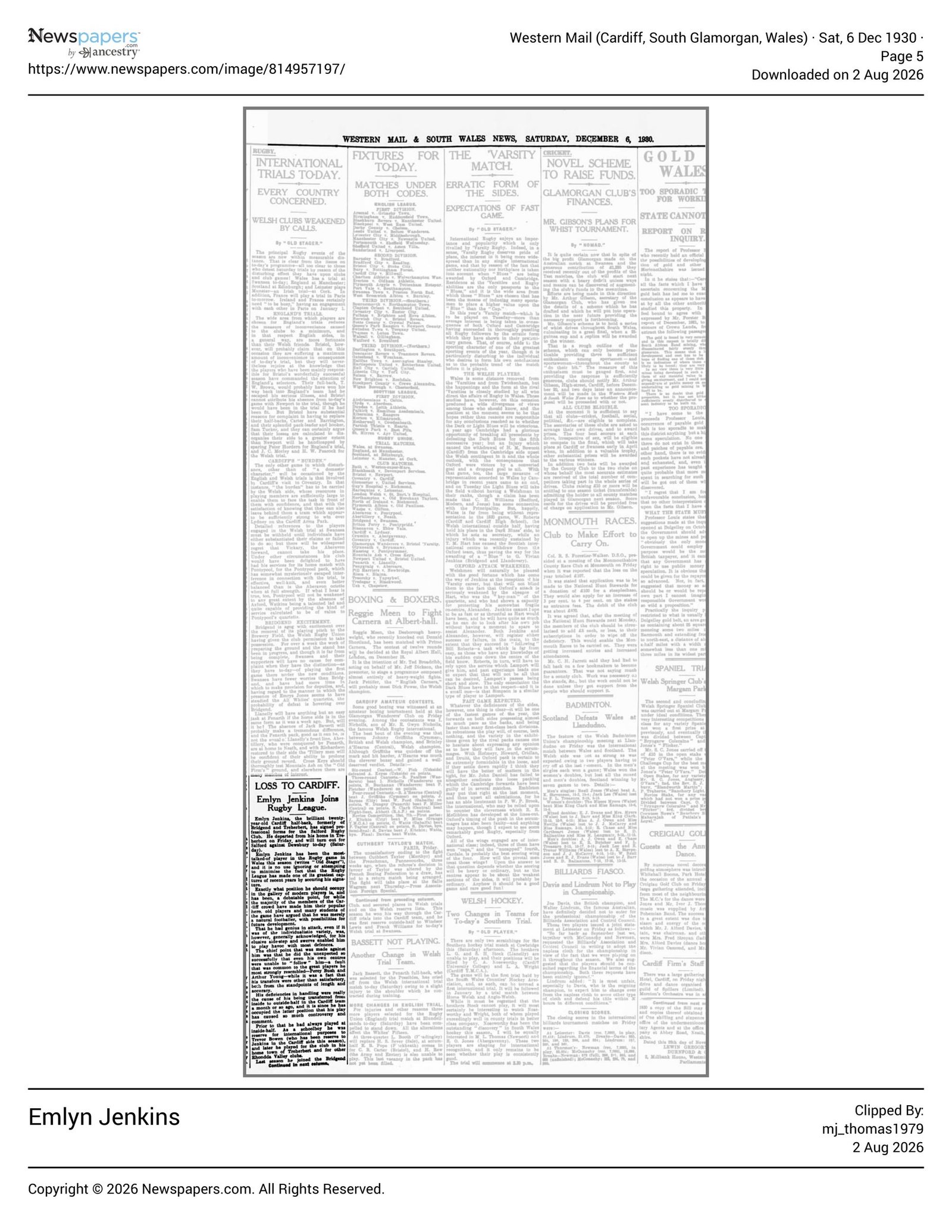
Western Mail, 6 December 1930. The boxed item runs down the left of the page. Click to read the full column.
The same column sets out the road that had brought him there: reserve for international purposes as a schoolboy, behind Trevor Bowen, who by 1930 was reserve to Emlyn in the Cardiff side; then Treherbert and other Rhondda Valley clubs; then Bridgend, and places in the Welsh trials; and then, that season, his way up through Cardiff into the first team.
And then the detail that gives the whole chapter its shape. Wales was playing an international trial at Swansea that very Saturday, and Emlyn had been picked for it. The Western Mail describes him as reserve outside-half; the Manchester Guardian and the Western Daily Press, carrying the signing the same morning, both say he had been selected to play, the Bristol paper naming him in the Probables, the stronger of the two trial sides. The English headline put it more bluntly than the Welsh one: a Welsh trial player joins Salford. So on the same afternoon that he could have been at St Helen's playing his way towards the cap he had wanted since boyhood, he was in Yorkshire in a Salford jersey, playing Dewsbury for money. He never did play for Wales at Cardiff Arms Park. Within three years he was an international anyway, in the other code, and the caps he won there are the ones his grandchildren have now.
Sources: Western Mail (Cardiff), The Manchester Guardian and Western Daily Press (Bristol), all 6 December 1930, in the Archive. His Salford career begins in The Willows.