Scans of the original material this site is built from: newspaper cuttings, letters, photographs, and documents kept by the family. Everything here is reproduced as found. Where a document is used in the written chapters, the link takes you to the relevant page.
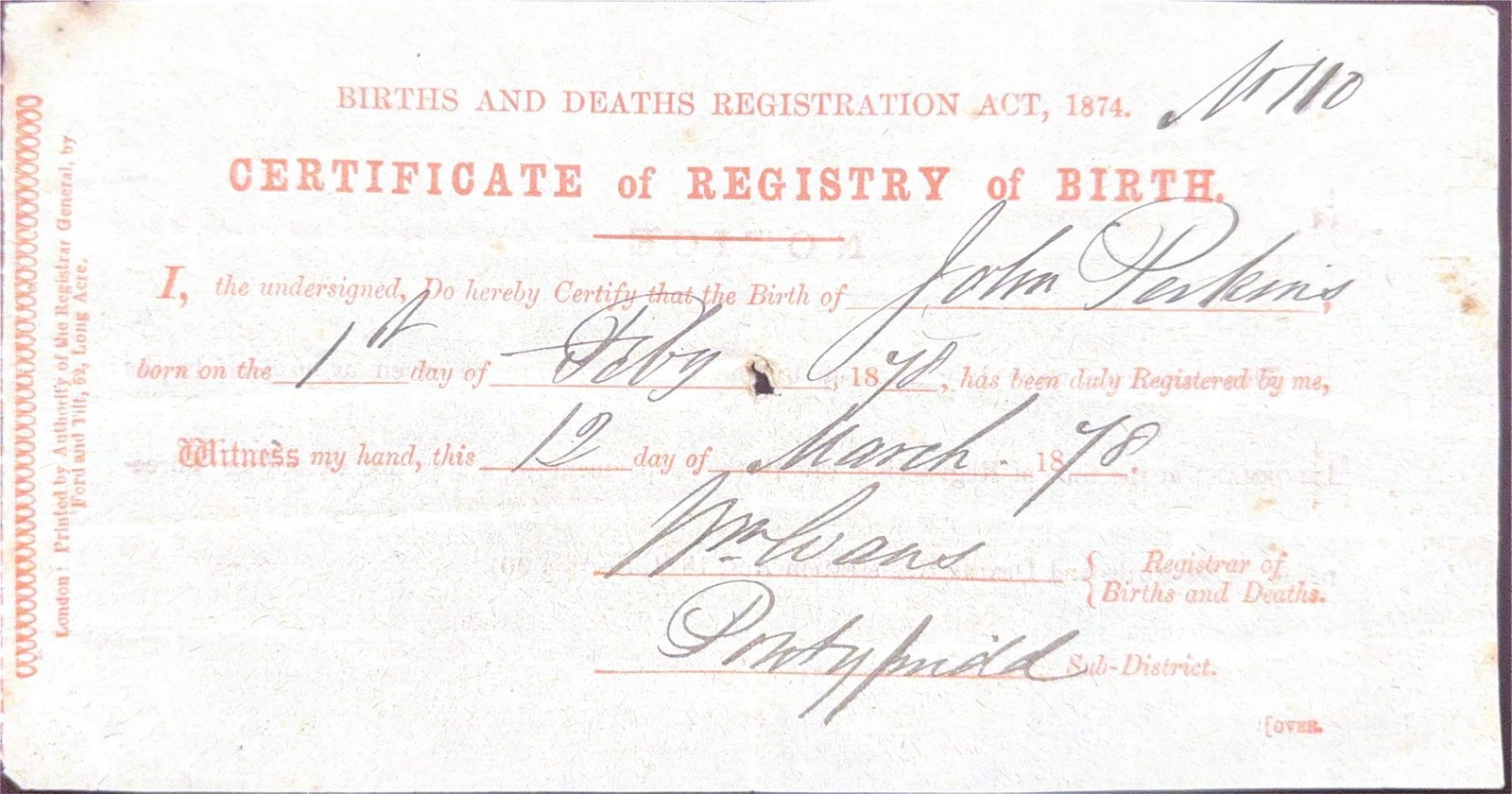
Birth of John Perkins
Read by the family as John Perkins, born 12 March 1878. The hand is faded and the name and date are not yet certain. If confirmed, he would be the eldest of the Perkins children and Bessie’s older brother.
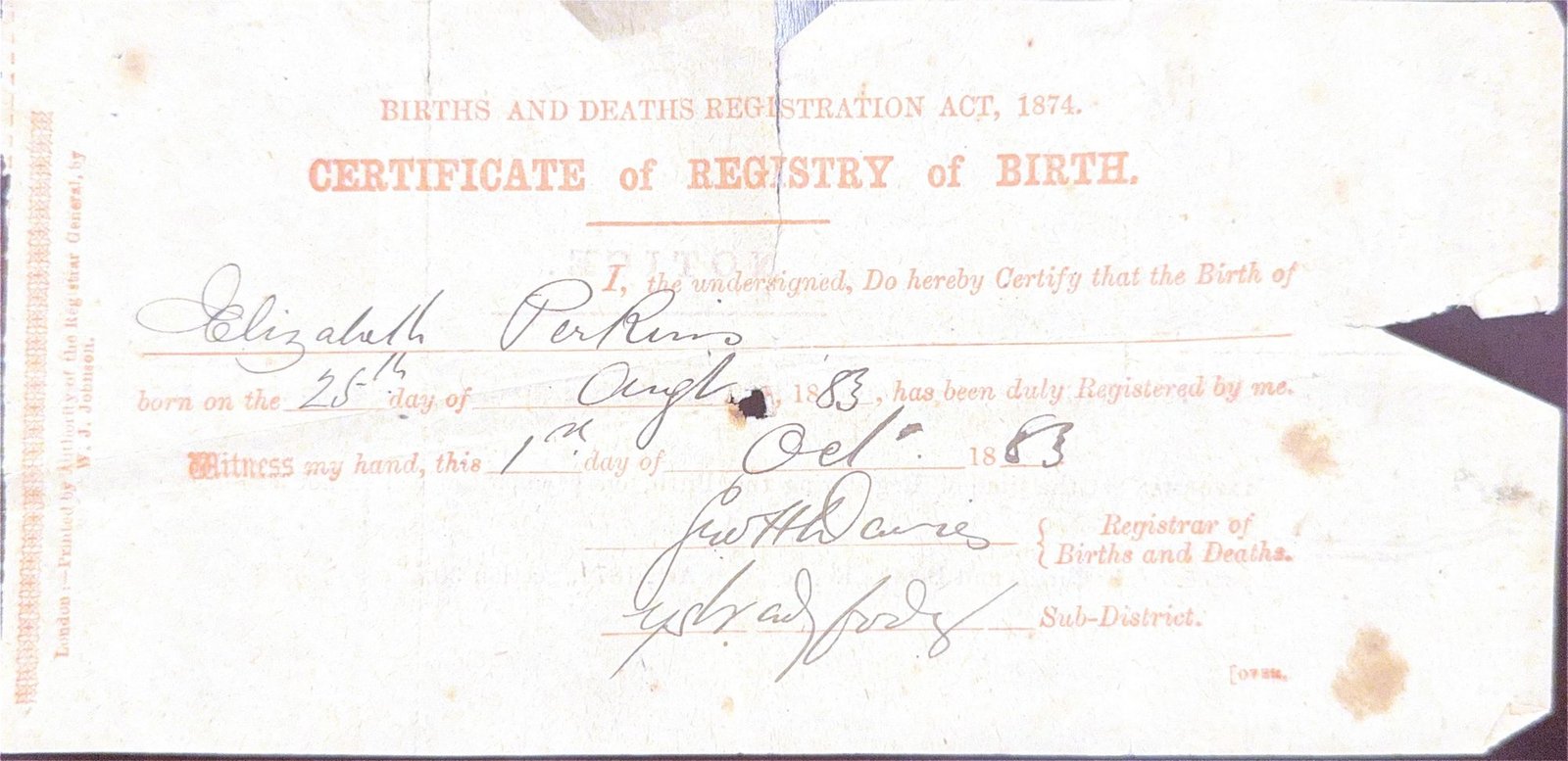
Birth of Elizabeth Perkins
Emlyn’s mother, known in the family as Bessie. Registered 1 October 1883. Her age matches both her marriage in 1907 and her death in 1956.
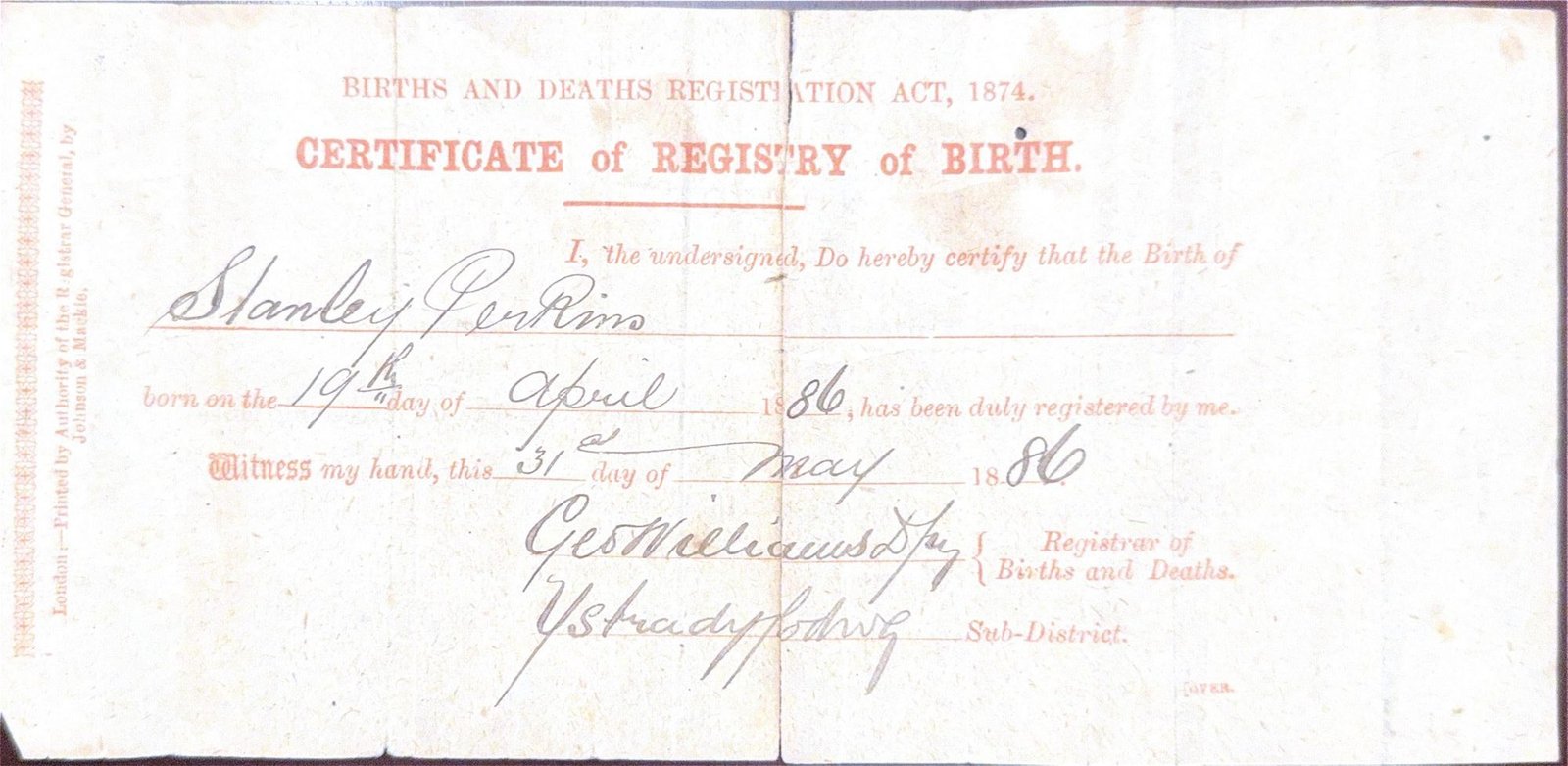
Birth of Stanley Perkins
Almost certainly Bessie’s younger brother, registered in the same sub-district three years after her.
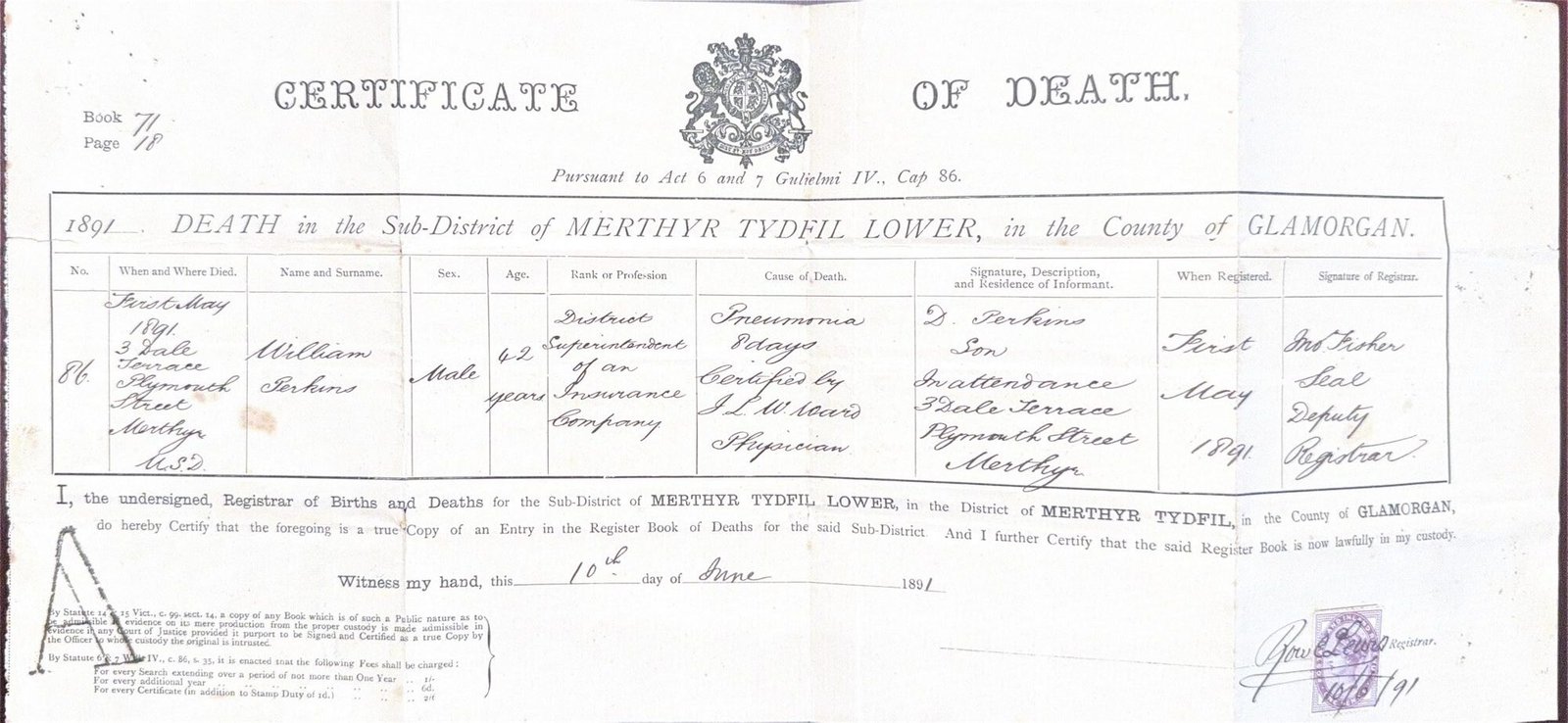
Death of William Perkins
Died at 3 Fothergill Terrace, Merthyr Tydfil, aged 42, of pneumonia. Recorded as a district superintendent of an insurance company. Named as Bessie’s father on her 1907 marriage record, though the link has not yet been proved. The informant was a son, initial read as D.
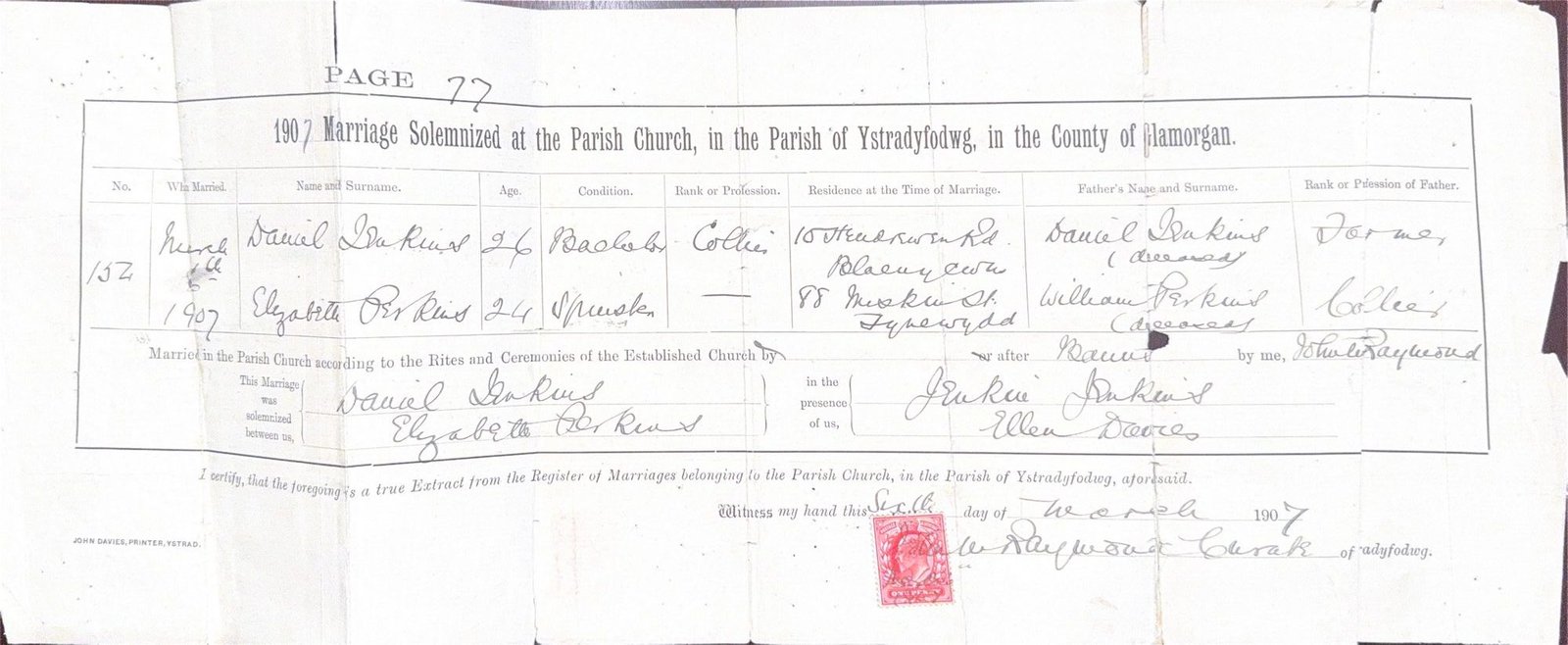
Marriage of Daniel Jenkins and Elizabeth Perkins
Emlyn’s parents. Daniel, a collier of Blaenrhondda, and Elizabeth Perkins of Miskin Street. The record names Daniel’s own father as Daniel Jenkins, a farmer, and Elizabeth’s as William Perkins. Two generations further back than the family could previously go.
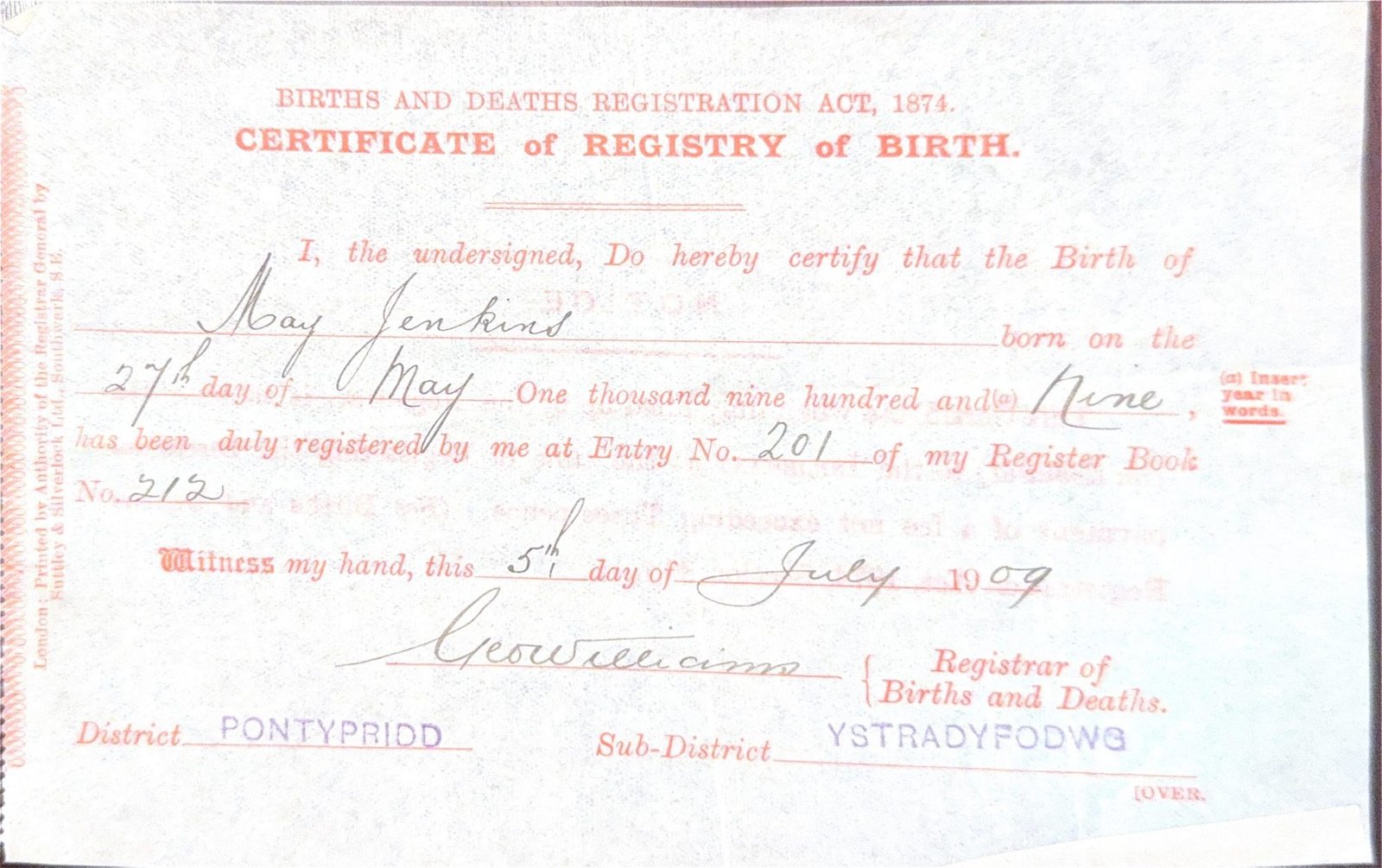
Birth of May Jenkins
Emlyn’s elder sister, who died of diphtheria a week or two before he was born. Her birth date shows she was around eighteen months old, a walking, talking toddler rather than a baby.
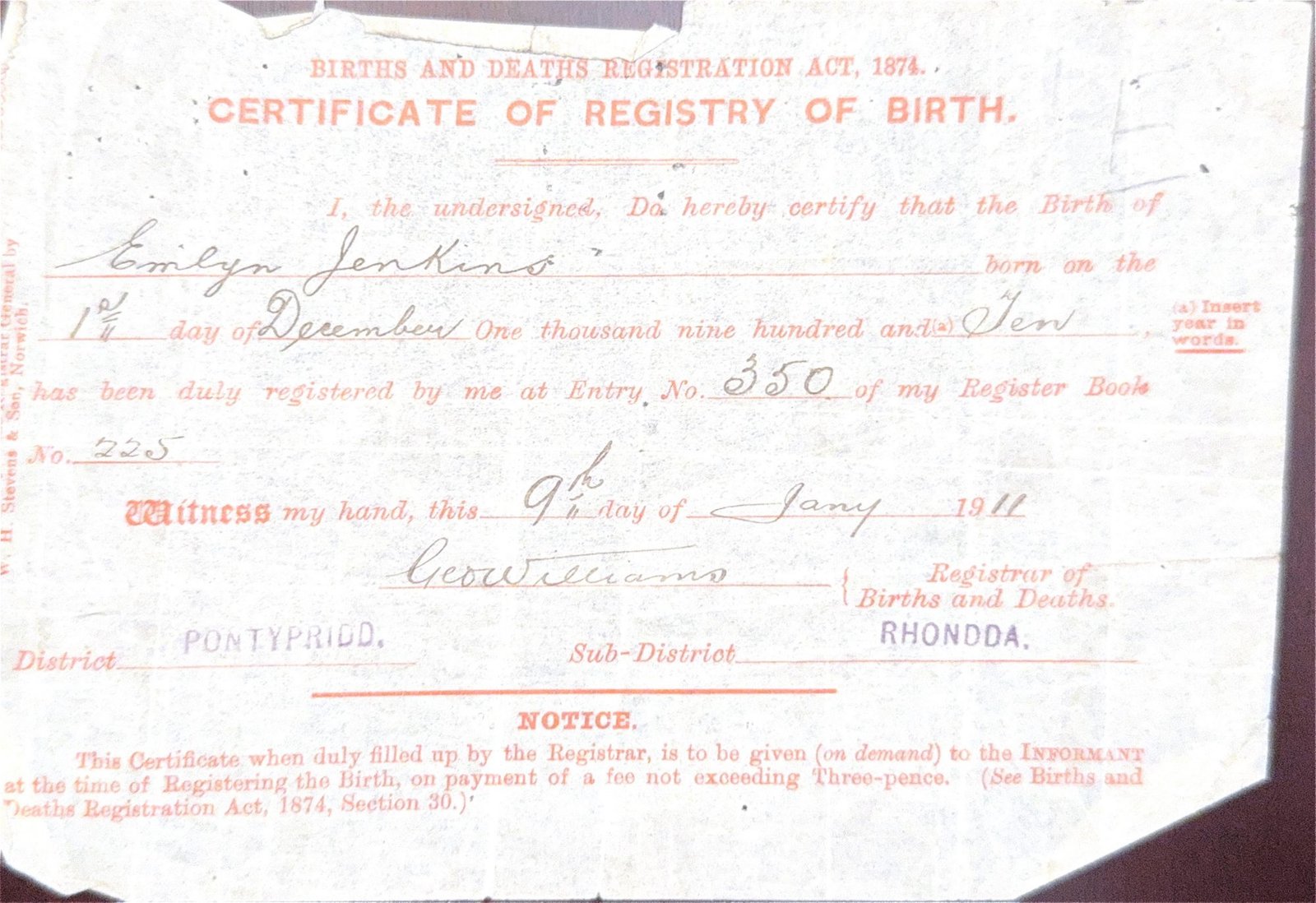
Birth of Emlyn Jenkins
The document at the root of everything on this site. Registered on 9 January 1911 at entry 350.
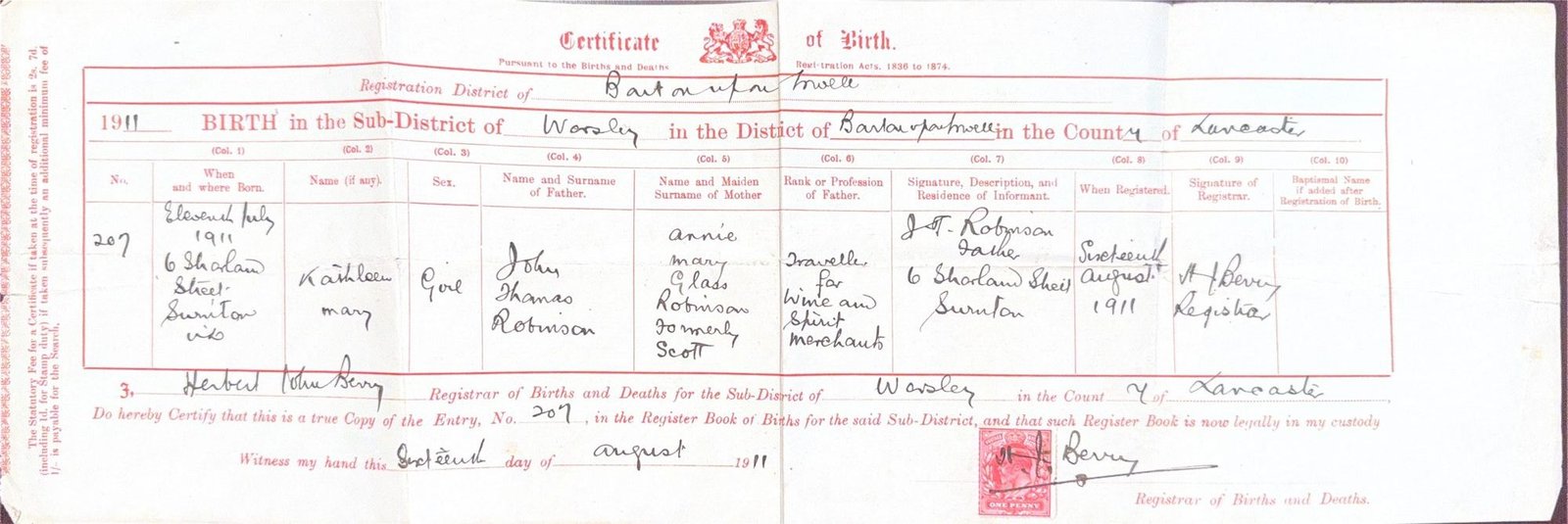
Birth of Kathleen Robinson
Emlyn’s future wife. Her parents are named as John Thomas Robinson, a traveller for a wine and spirit merchant, and Annie Mary Elias Robinson, formerly Scott. This opens the Robinson line, which had not been researched at all.
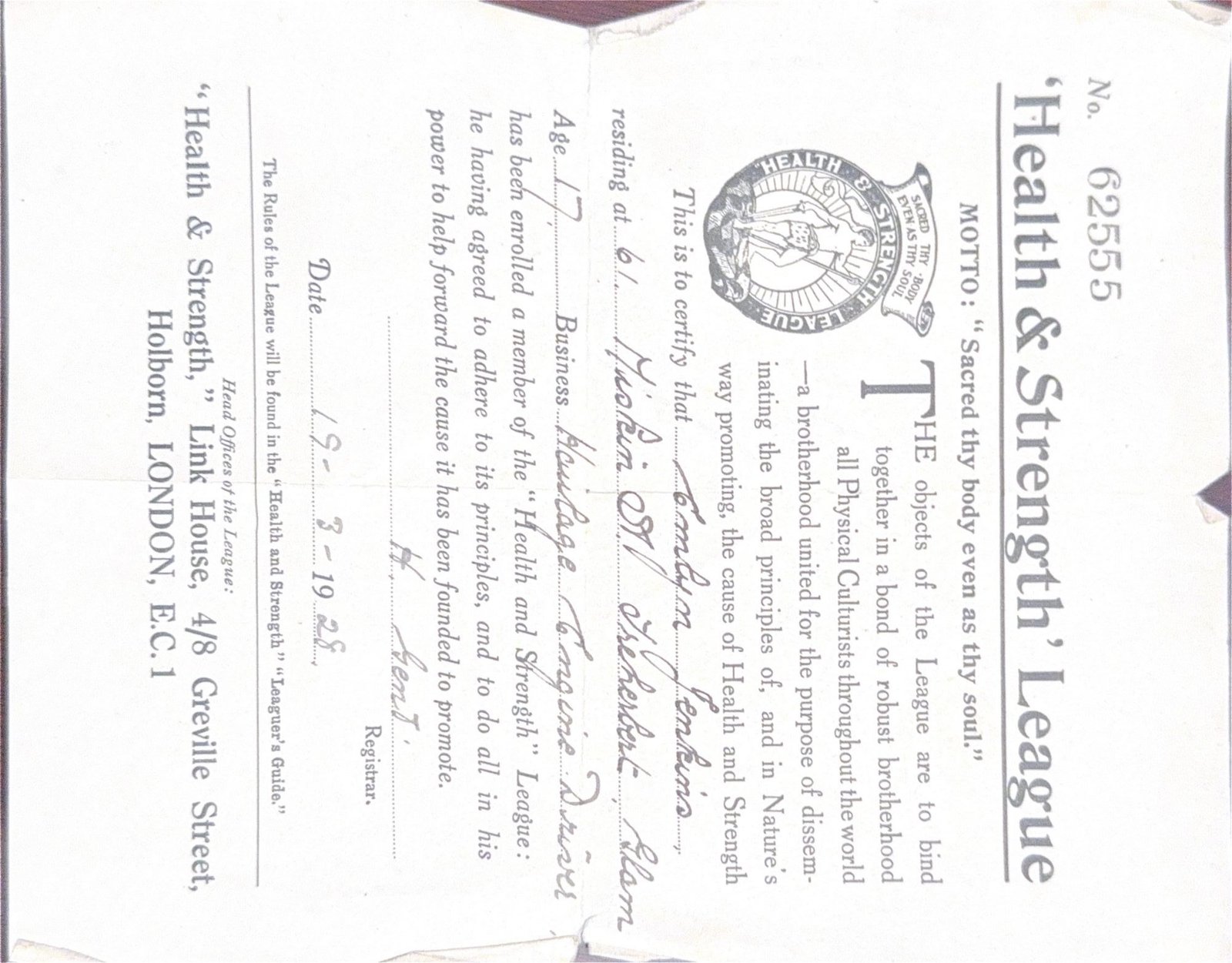
‘Health & Strength’ League membership
Emlyn at seventeen, living at 61 Miskin Street, with his occupation given as haulage engine driver. Documentary proof of the colliery work the family always described, and of a boy already taking his own physical training seriously. The League’s motto ran: sacred thy body even as thy soul.
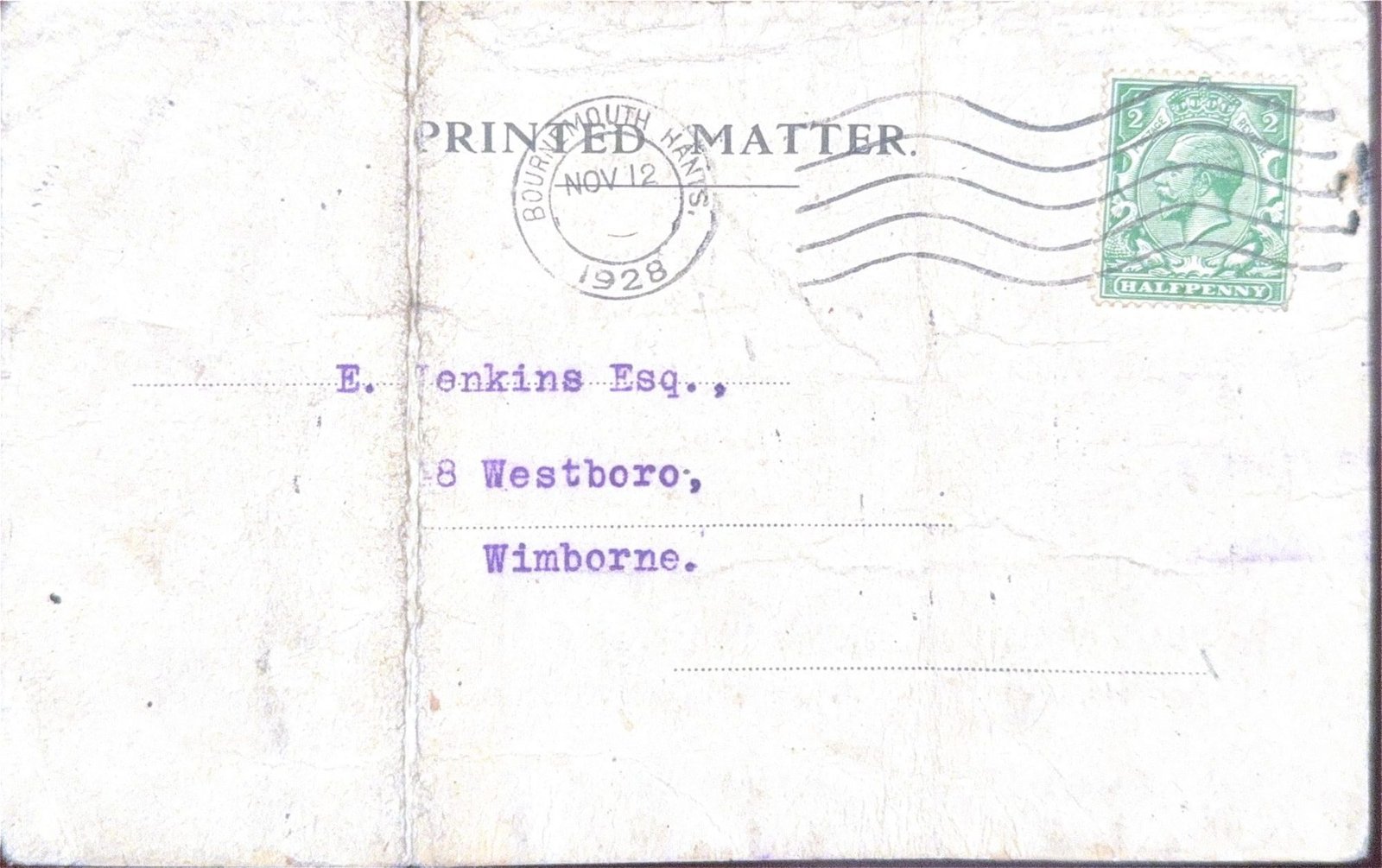
Bournemouth Rugby Club selection card
Notifies an E. Jenkins that he has been selected to play, with the first fifteen struck out and second written in, and the charabanc leaving the Square at 12.45. Confirmed by Wendy Jenkins in 2026: work in the Rhondda had dried up in the wake of the 1926 lockout, and Emlyn went to Poole and Wimborne for work, sending most of his wages home and boxing for pocket money, while keeping his hand in with the Bournemouth rugby club on the side.
View full scan Used in: Bread and Butter
Pages: p1 p2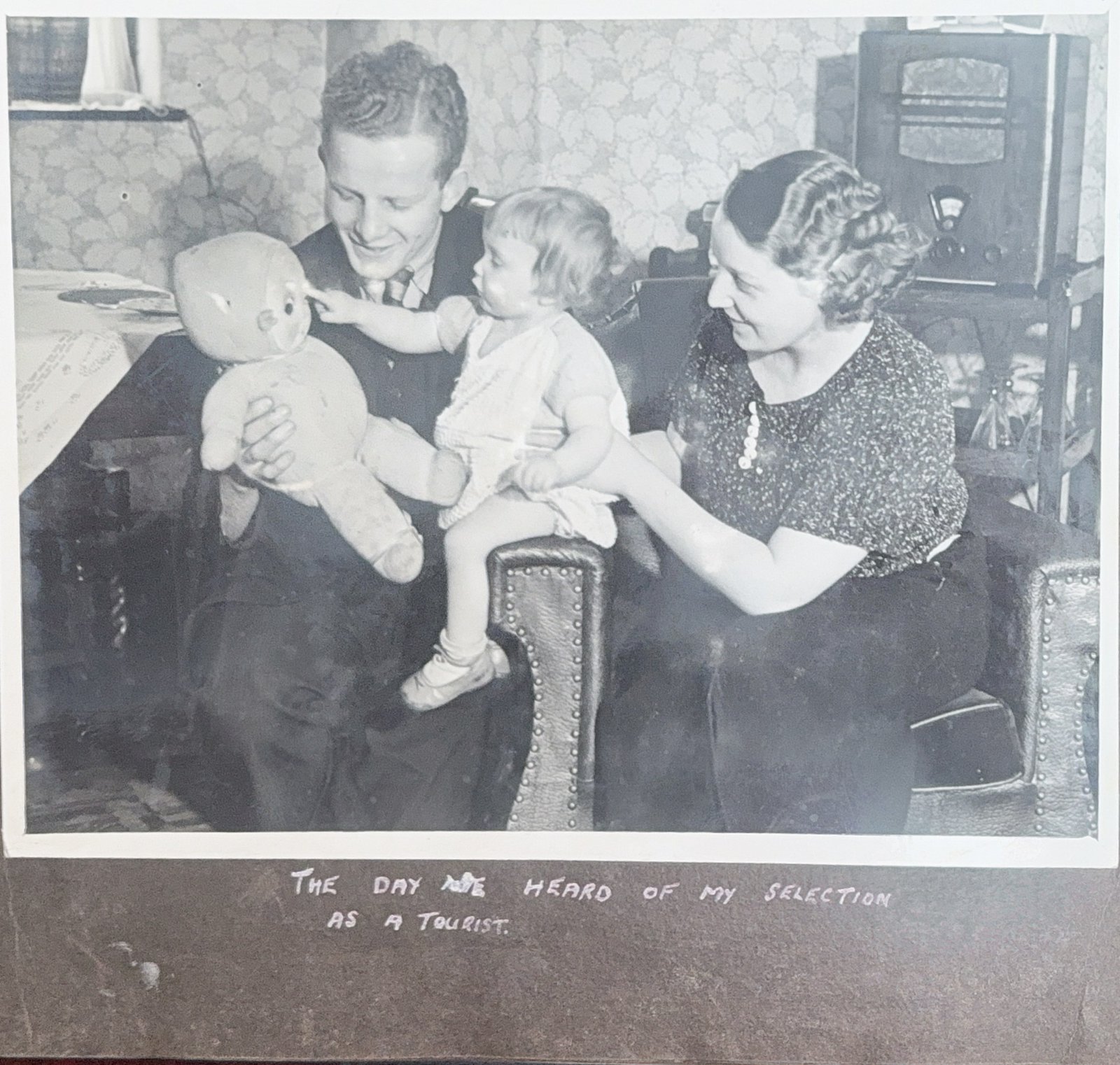
Emlyn's 1936 tour album
His own album of the tour, captioned throughout in his hand in white ink. It is the only sustained piece of writing by him the family holds, and the closest thing to a diary of the six months that made his name.
The first page is the day the news arrived: a front room in Salford with a wireless in the corner, Kathleen on one side, Emlyn on the other, and Patricia between them reaching for a toy he is holding up. His caption: "The day we heard of my selection as a tourist."
The voyage pages follow the ship out. A P&O postcard of the Cathay, then Tangier, their first call, with merchant boats rowing out, a snake charmer, a rug seller captioned "Very cheap." "How much?", and four teammates by a camel outside a police station, named as T. Armitt, M. Hodgson, J. Morley and H. Jones. Then Gibraltar, where he photographs himself with Gus Risman and Alan Edwards after shopping, and Marseilles, with the funicular up to Notre-Dame de la Garde, the crew cleaning and repainting the Cathay's funnels, and a group named as H. Field, B. Hudson, A. Edwards, N. Exley and R. F. Anderton.
Two captions are worth singling out. He calls his half-back partner W. "Pip" Watkins, a nickname recorded nowhere else in this archive. And among the Marseilles views is a photograph of a small girl in a sun hat walking with her mother, captioned "Thought of Pat and snapped the little lass."
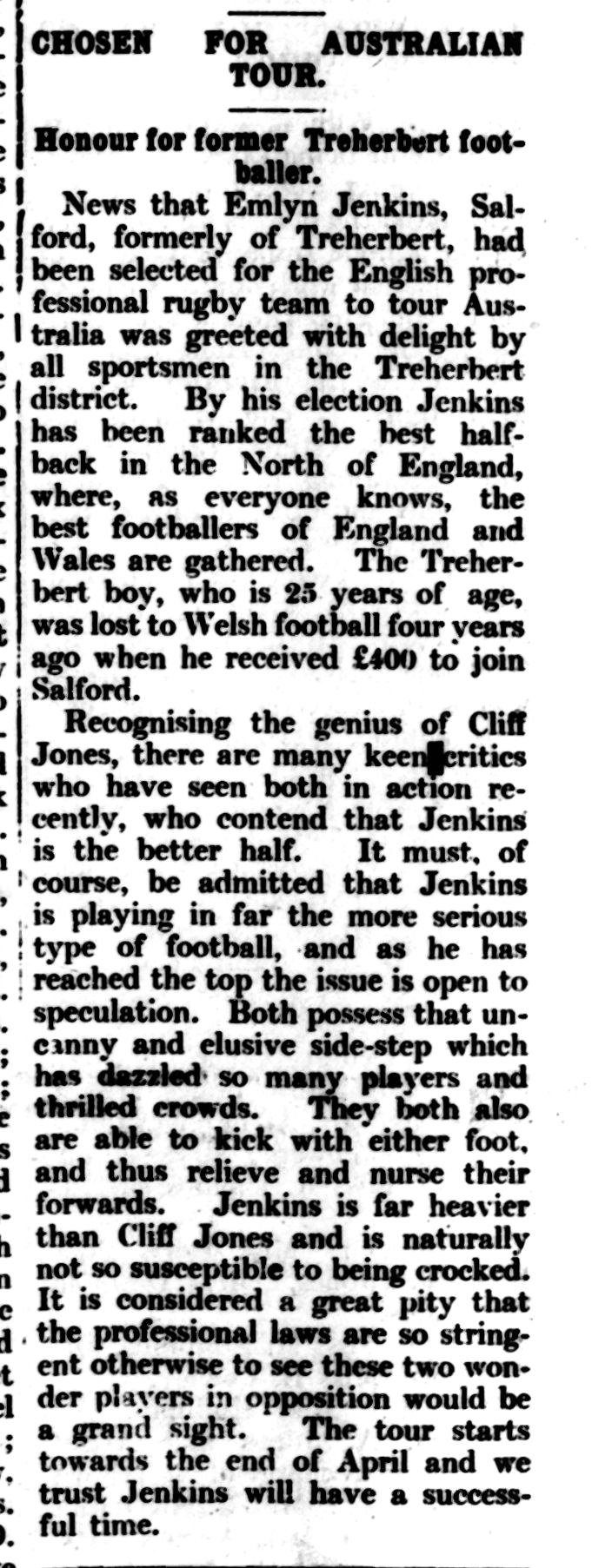
"Chosen for Australian Tour": honour for a former Treherbert footballer
The Rhondda hearing that one of its own had been picked for Australia. His selection, the paper says, ranks him the best half-back in the North of England, where the best footballers of England and Wales are gathered. It gives his age as 25 and states that the Treherbert boy was lost to Welsh football when he received £400 to join Salford, independently confirming the figure the family always gave for Lance Todd’s offer.
It then compares him at length with Cliff Jones, the Cardiff and Wales union fly-half of the day, and reports that many keen critics who have seen both contend that Jenkins is the better half. Both possessed the uncanny elusive side-step and could kick with either foot; Jenkins was the heavier and less easily crocked. That the two could never meet, the writer says, because of the stringency of the professional laws, was a great pity.
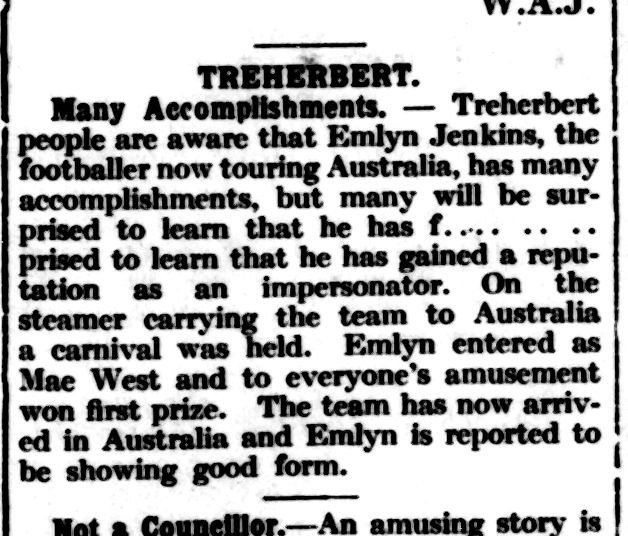
Mae West, reported in Wales
A Treherbert news column, printed while the tour was still in progress. Treherbert people knew Emlyn had many accomplishments, it says, but many would be surprised to learn that he had gained a reputation as an impersonator: on the steamer carrying the team to Australia a carnival was held, Emlyn entered as Mae West and to everyone’s amusement won first prize.
This is seven months earlier than the Rochdale report of the same episode, and shows the story travelled home to the Rhondda while the team was still in Australia.
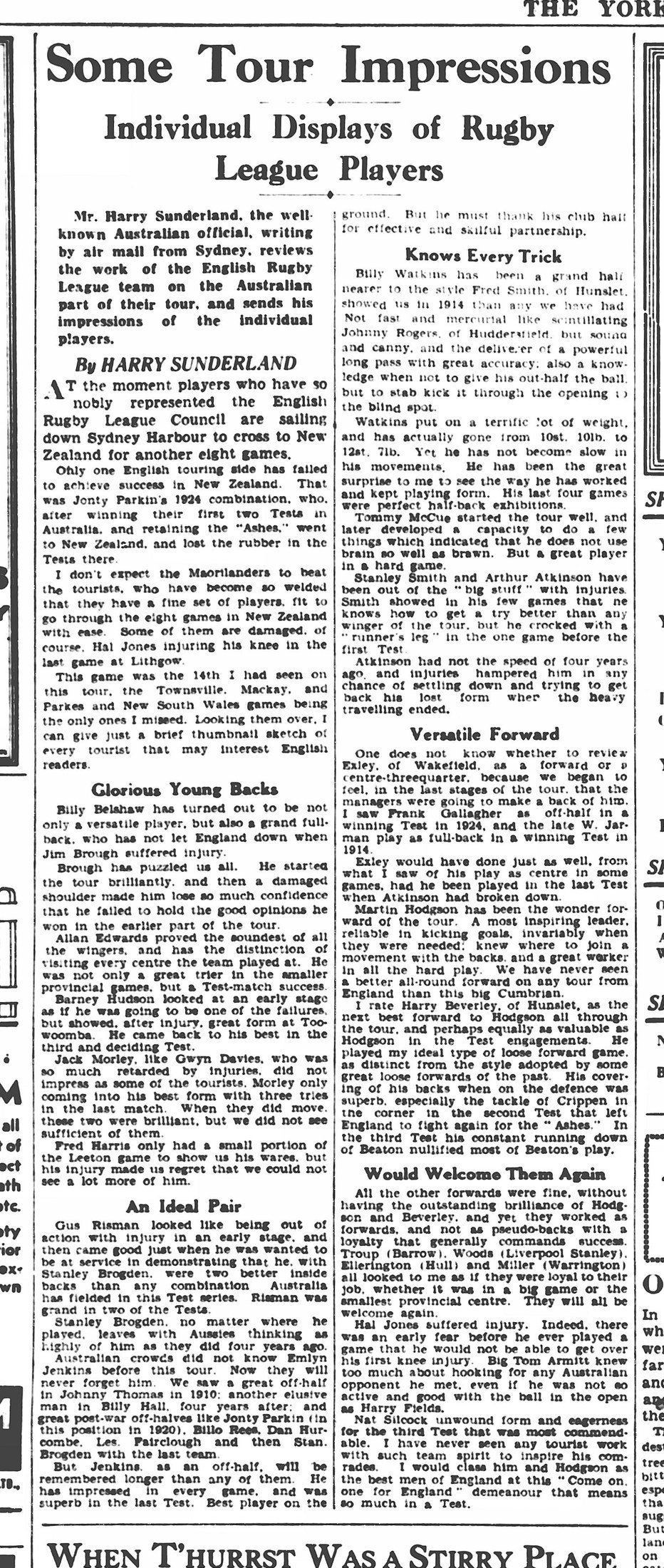
"Jenkins will be remembered longer than any of them"
Harry Sunderland’s player-by-player review of the tour, written by air mail from Sydney as the team sailed for New Zealand. His paragraph on Emlyn is the most considered verdict anyone gave him.
Australian crowds did not know Emlyn Jenkins before this tour, he writes, and now they will never forget him. He then lists the great stand-offs Australia had seen since 1910, Johnny Thomas, Billy Hall, Jonty Parkin, Billo Rees, Danny Hurcombe, Les Fairclough and Stanley Brogden, and concludes that Jenkins, as an off-half, will be remembered longer than any of them. He had impressed in every game, was superb in the last Test, and was the best player on the ground, though Sunderland adds that he must thank his club half for an effective and skilful partnership.
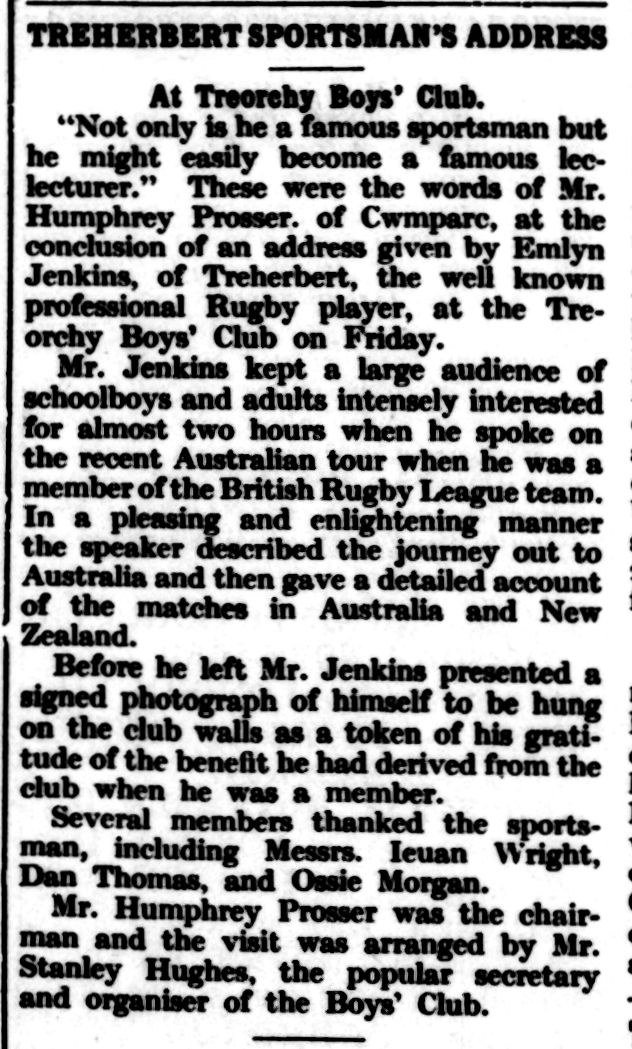
The address at Treorchy Boys' Club
Home from Australia, Emlyn went back to the boys’ club he had belonged to as a boy and talked for almost two hours to an audience of schoolboys and adults about the tour, describing the journey out and giving a detailed account of the matches in Australia and New Zealand. Humphrey Prosser of Cwmparc, in the chair, said that not only was he a famous sportsman, he might easily become a famous lecturer. The visit was arranged by Stanley Hughes, the club’s secretary and organiser.
Then the detail that corrects this site. Before he left, Mr Jenkins presented a signed photograph of himself to be hung on the club walls as a token of his gratitude for the benefit he had derived from the club when he was a member. The club is named as Treorchy Boys’ Club, not Treherbert, and he had been a member of it in boyhood. Earlier versions of this site placed the signed photograph, and the 1936 Test match ball, at a Treherbert club. The photograph at least went to Treorchy.
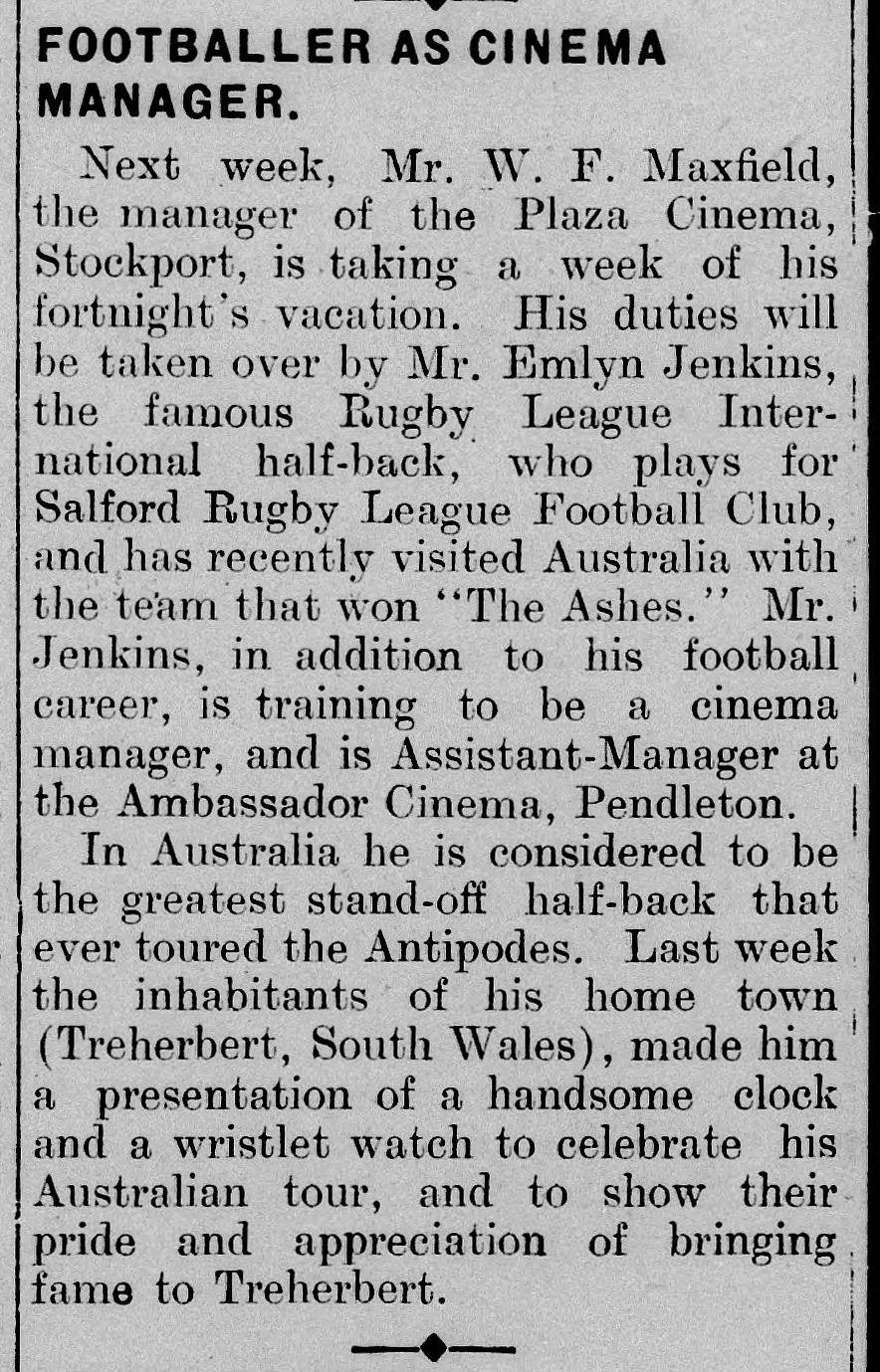
"Footballer as Cinema Manager"
The single most useful document for understanding what happened in 1938. Eighteen months before he announced his retirement to go and manage a cinema, Emlyn was already doing it. The Plaza Cinema in Stockport reports that while its manager W. F. Maxfield takes a week’s holiday, his duties will be taken over by Mr Emlyn Jenkins, the famous Rugby League international half-back who plays for Salford and has recently visited Australia with the team that won the Ashes.
It states plainly that in addition to his football career he is training to be a cinema manager, and is Assistant-Manager at the Ambassador Cinema, Pendleton. The retirement of November 1938 was therefore not a whim but the completion of a second career he had been building for at least a year and a half while still playing Test rugby.
The same paragraph records that in Australia he is considered the greatest stand-off half-back that ever toured the Antipodes, and that the previous week the people of Treherbert presented him with a handsome clock and a wristlet watch to celebrate the tour and to show their pride at his bringing fame to the town.
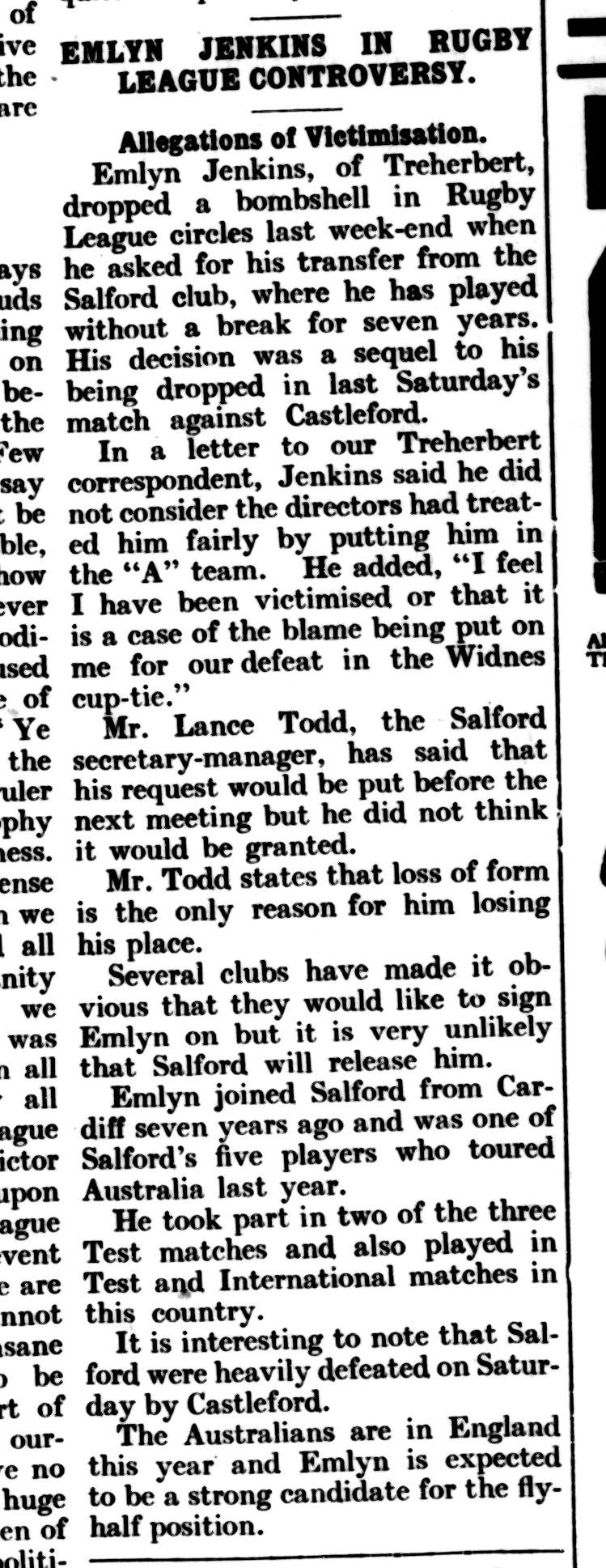
"Allegations of Victimisation": the transfer request
The beginning of the end at Salford, five months before the sale, and the only place in this archive where Emlyn speaks in his own words. He had been dropped for the match against Castleford and put in the A team, and he responded by asking for a transfer from the club where he had played without a break for seven years.
In a letter to the paper’s Treherbert correspondent, he wrote that he did not consider the directors had treated him fairly, and added: "I feel I have been victimised or that it is a case of the blame being put on me for our defeat in the Widnes cup-tie."
Lance Todd, the Salford secretary-manager, said the request would go before the next meeting but he did not think it would be granted, and that loss of form was the only reason for Jenkins losing his place. Several clubs had made it obvious they would like to sign him. The paper notes drily that Salford were heavily beaten by Castleford on the Saturday in question. It also records that of the 1936 tour he took part in two of the three Tests.
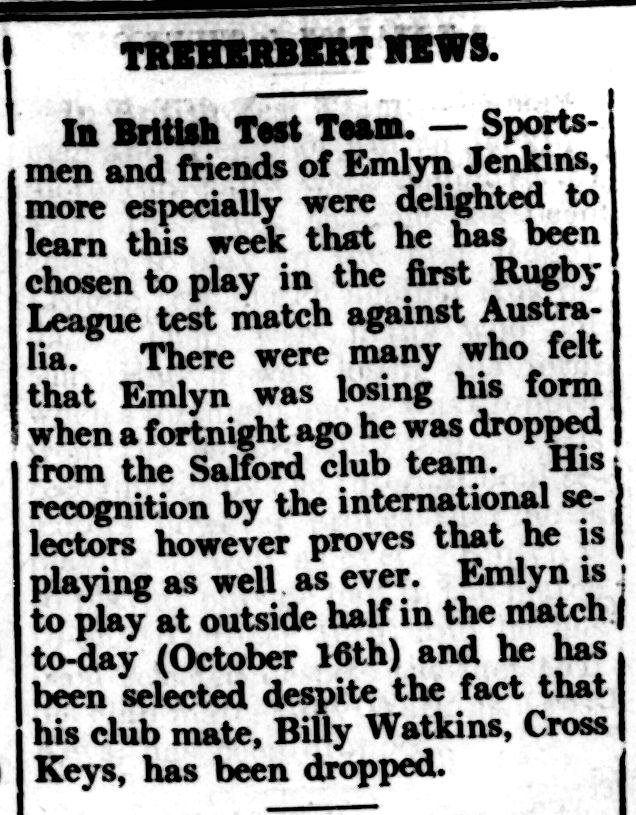
"In British Test Team": the answer to the selectors
Printed on the morning of the first Test, two weeks after the transfer row. Sportsmen and friends of Emlyn Jenkins, the Treherbert column reports, were delighted to learn that he had been chosen to play in the first Rugby League Test match against Australia. Many had felt he was losing his form when he was dropped from the Salford club team a fortnight earlier; his recognition by the international selectors proves that he is playing as well as ever. He was to play at outside half that afternoon, and had been selected even though his club half-back partner Billy Watkins had been dropped.
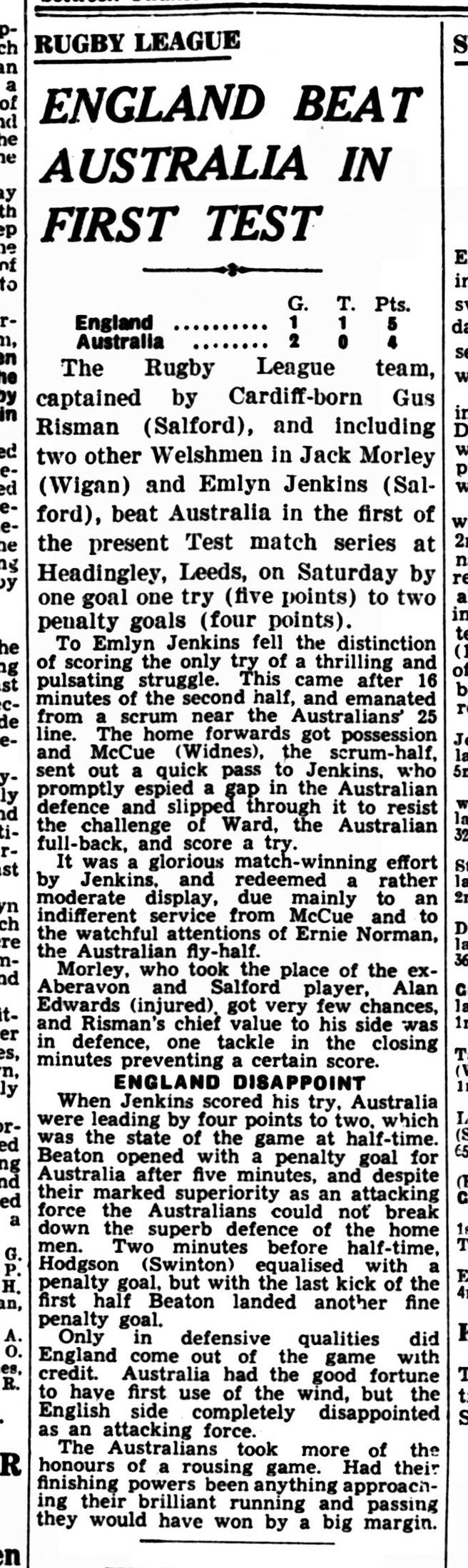
The winning try at Headingley
England beat Australia in the first Test of the 1937 home series at Headingley on Saturday 16 October 1937, by one goal and one try, five points, to two penalty goals, four. The side was captained by the Cardiff-born Gus Risman and included two other Welshmen, Jack Morley of Wigan and Emlyn.
The report’s second paragraph: to Emlyn Jenkins fell the distinction of scoring the only try of a thrilling and pulsating struggle. It came sixteen minutes into the second half from a scrum near the Australian 25. The forwards won possession, the Widnes scrum-half McCue sent out a quick pass, and Jenkins promptly espied a gap in the Australian defence, slipped through it, resisted the challenge of Ward the Australian full-back, and scored. The paper calls it a glorious match-winning effort, which redeemed an otherwise moderate display in the face of indifferent service from McCue and the watchful attentions of Ernie Norman, the Australian fly-half.
Australia had led 4-2 at the time. It was the only try of the match, and it won it.
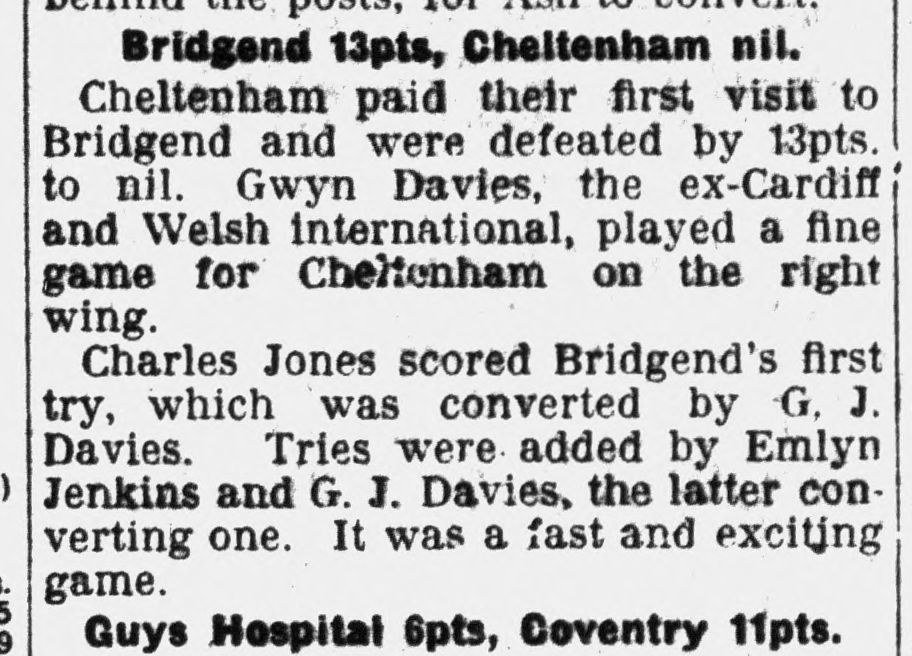
Bridgend 13, Cheltenham nil: his first recorded try
Cheltenham paid their first visit to Bridgend and lost 13 points to nil, in what the paper calls a fast and exciting game. Charles Jones scored Bridgend’s first try, converted by G. J. Davies, and then, in the words of the report, tries were added by Emlyn Jenkins and G. J. Davies.
This is now the earliest dated report of him playing that has been found, two weeks before the Torquay match, and the first time he is recorded scoring. He was eighteen.
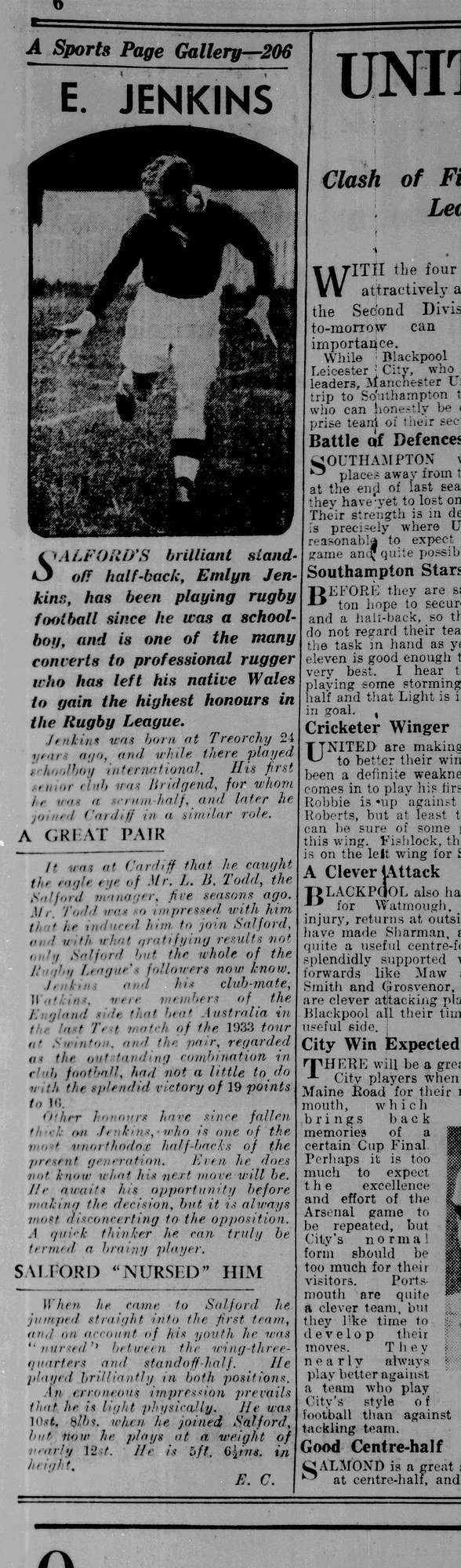
"A Sports Page Gallery": the fullest profile of him as a player
A full-column illustrated profile of Emlyn at the height of his Salford career, with an action photograph, published between the 1933 and 1936 tours. It is the most detailed physical and stylistic description of him yet found.
It records that his first senior club was Bridgend, for whom he played scrum-half, and that he joined Cardiff in the same role, which refines the position history the site had. It confirms the family account of his recruitment: it was at Cardiff that he caught the eye of Mr L. B. Todd, the Salford manager, who induced him to join the club. It notes that Jenkins and Watkins were in the England side that beat Australia in the last Test of the 1933 tour at Swinton, 19 points to 16, and calls the pair the outstanding combination in club football.
On the man himself: one of the most unorthodox half-backs of the generation, who does not know what his next move will be, awaiting his opportunity before deciding, which the paper says is always most disconcerting to the opposition. A quick thinker, and truly a brainy player. When he arrived at Salford he went straight into the first team and, on account of his youth, was nursed between wing three-quarter and stand-off. His measurements are given: 5ft 6½in, and 10st 8lb when he joined Salford, by 1935 nearly 12st.
One detail conflicts with the documentary record. The profile says he was born at Treorchy, where the 1911 census and his mother’s memorial card both place the family at 73 Miskin Street, Treherbert. Treorchy is the neighbouring village, and the error is the paper’s.
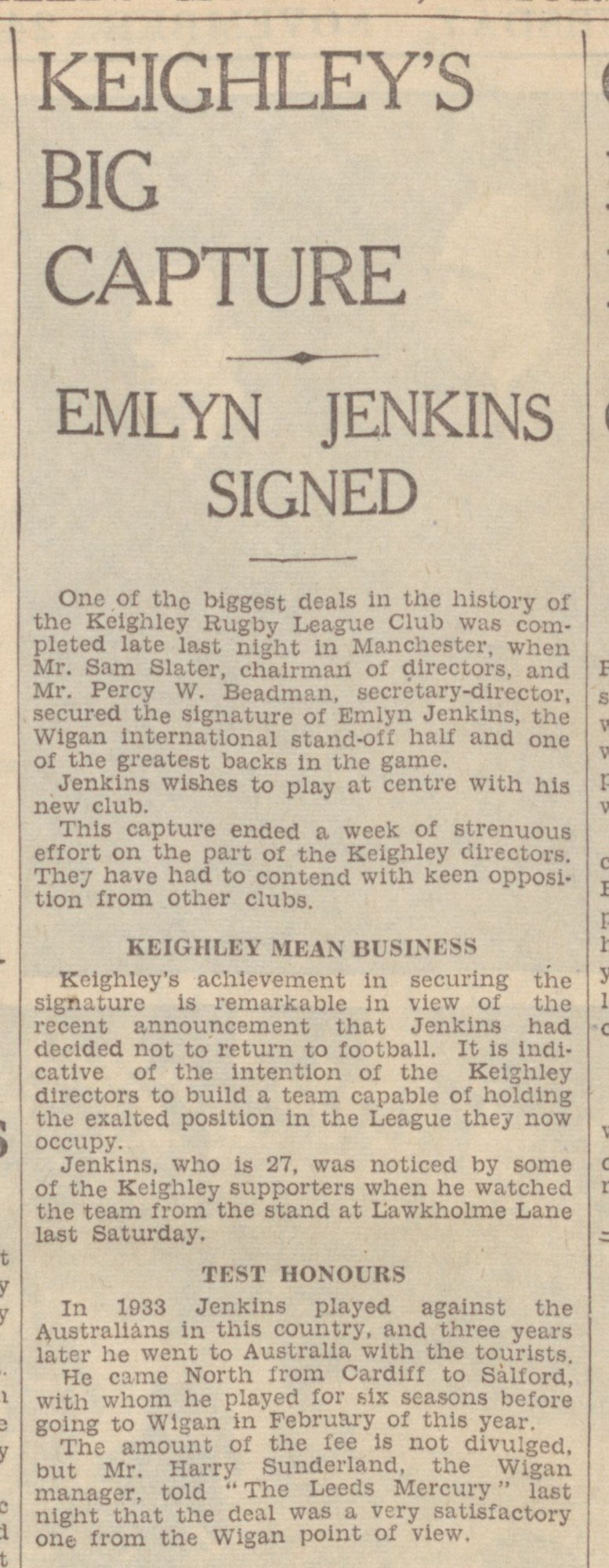
"Keighley's Big Capture": the retirement that lasted five days
One of the biggest deals in the history of the Keighley club, completed late the previous night in Manchester, when the chairman Sam Slater and the secretary-director Percy W. Beadman secured the signature of Emlyn Jenkins, described as the Wigan international stand-off half and one of the greatest backs in the game.
The significance is the date. Emlyn had announced his retirement to Harry Sunderland in the week of 18 November, and Sunderland’s appeal to him appeared on the 19th. This report is dated the 24th. The paper notes the achievement is remarkable in view of the recent announcement that Jenkins had decided not to return to football, and mentions that he had been spotted watching Keighley from the stand at Lawkholme Lane the previous Saturday. He wished to play at centre for his new club.
It also gives his Salford career as six seasons before going to Wigan in February of that year, which supports the Widnes paper against the March date reported elsewhere, and quotes Sunderland saying the deal was very satisfactory from Wigan’s point of view. The fee was not disclosed.
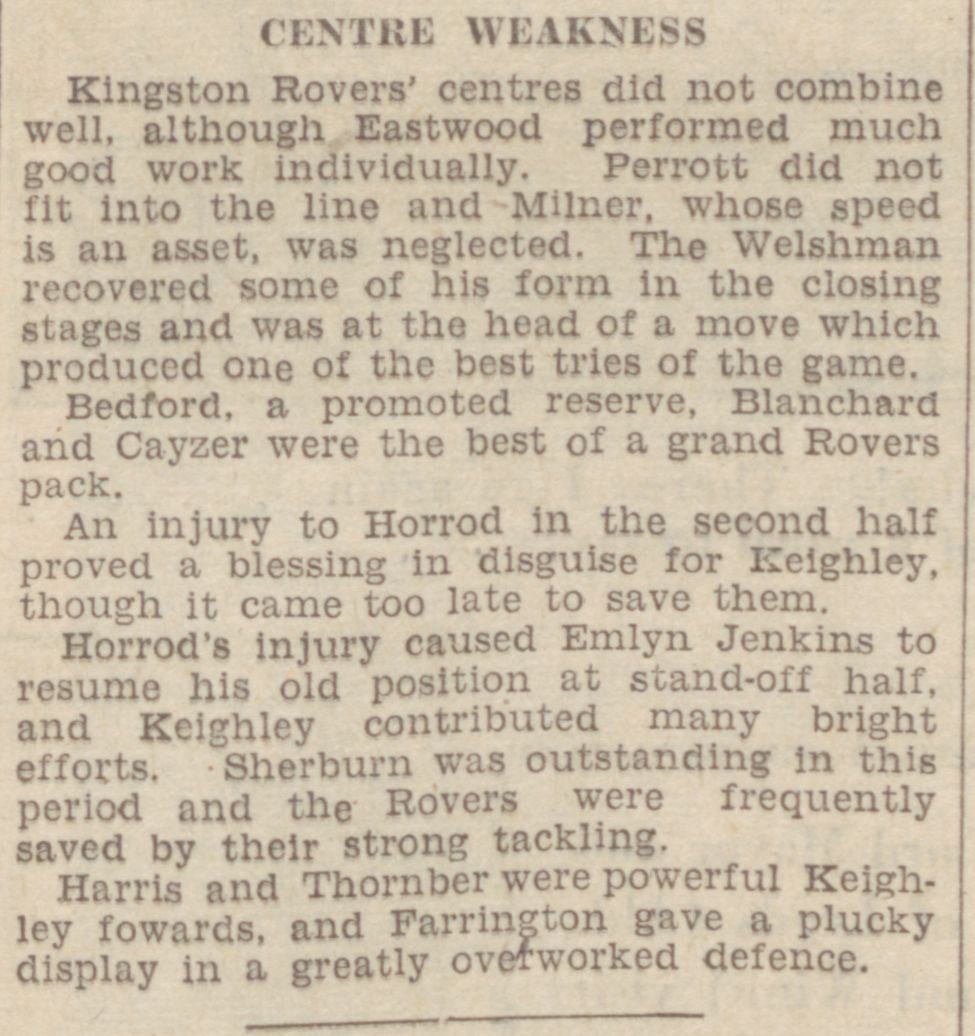
Keighley against Hull Kingston Rovers
A match report that catches him mid-career at his fourth club. Playing in the centre, he had a quiet afternoon until an injury to Horrod forced a reshuffle: the report records that Horrod’s injury caused Emlyn Jenkins to resume his old position at stand-off half, after which Keighley contributed many bright efforts.
Earlier it notes that the Welshman recovered some of his form in the closing stages and was at the head of a move which produced one of the best tries of the game. It is the latest dated match report of him playing found so far before the war.
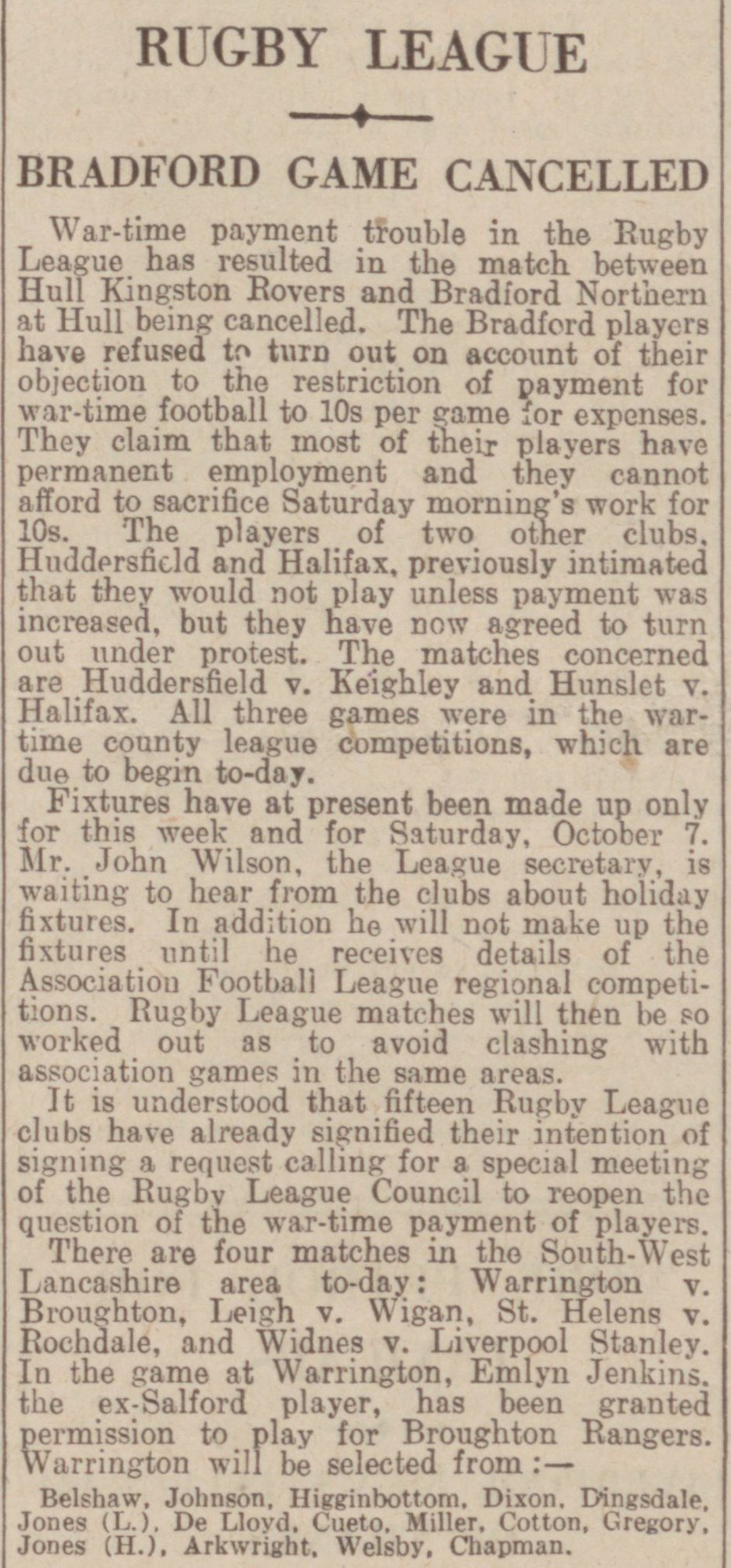
Wartime permission to play for Broughton Rangers
A report on the chaos of the first weeks of wartime rugby league, when Bradford Northern refused to play over the restriction of match payments to ten shillings, and fixtures were being made up a week at a time. Buried in the list of South-West Lancashire matches is a single line: in the game at Warrington, Emlyn Jenkins, the ex-Salford player, has been granted permission to play for Broughton Rangers.
This is the first documentary evidence of the wartime guest appearances that other sources hint at. It is dated the day after the 1939 Register recorded him at home in Salford as a cinema manager and Police War Reserve.
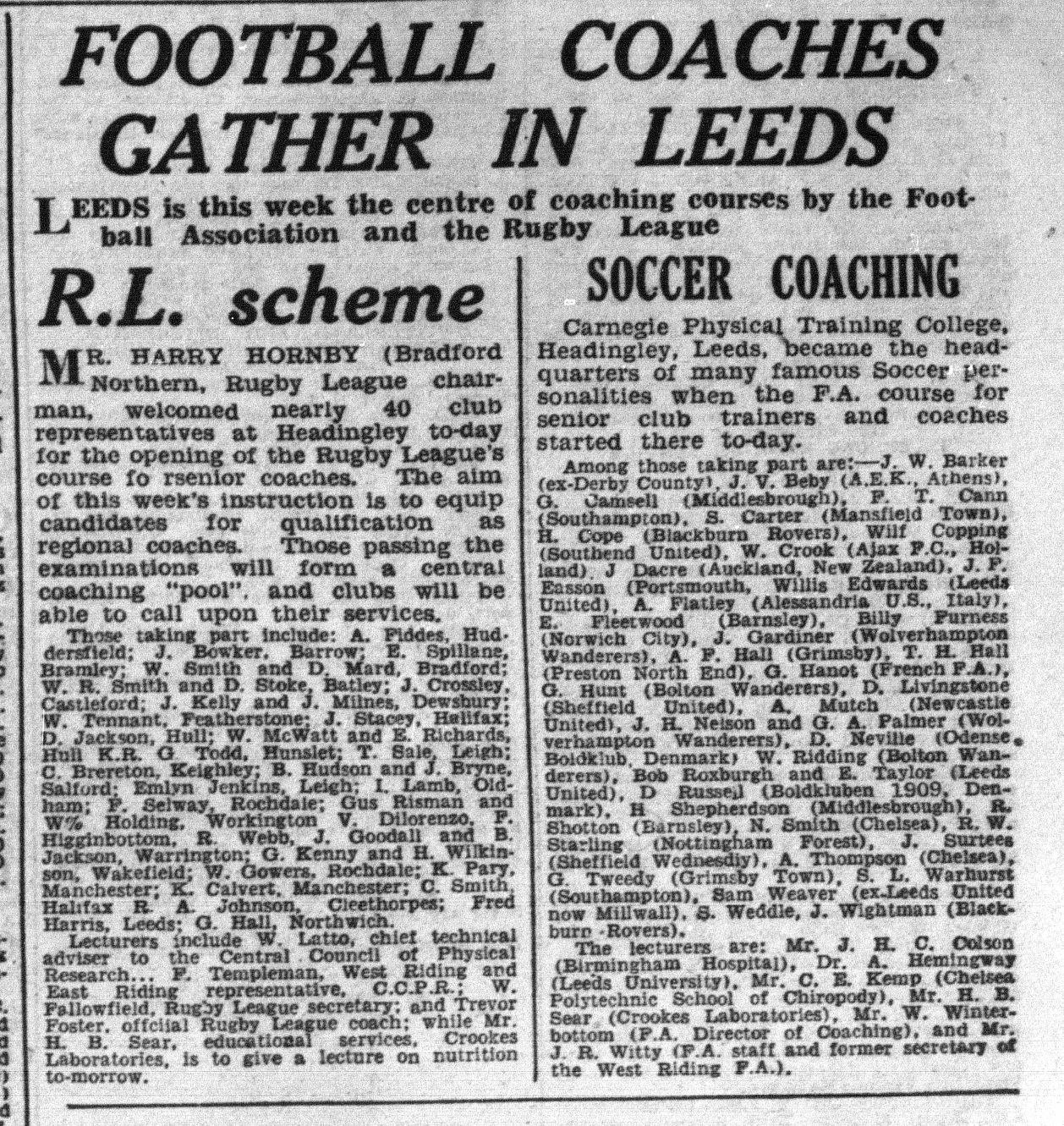
The Rugby League coaching course at Headingley
Nearly forty club representatives gathered at Headingley for the opening of the Rugby League’s course for senior coaches, welcomed by the Bradford Northern chairman Harry Hornby. The aim was to qualify candidates as regional coaches, those passing the examinations forming a central coaching pool on which clubs could call.
In the list of those taking part: Emlyn Jenkins, Leigh. Gus Risman appears two names later, for Workington. It shows that his coaching was a deliberate professional undertaking rather than a job he drifted into, and it places him among the first generation of formally qualified coaches in the game.
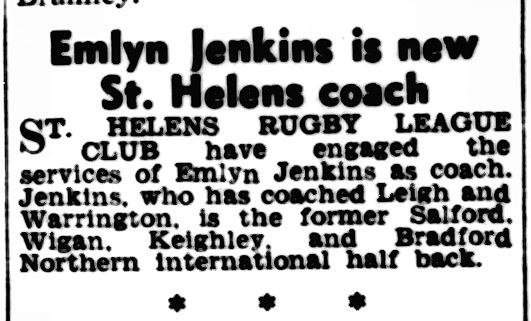
"Emlyn Jenkins is new St Helens coach"
St Helens engaged him as coach in January 1951. The value of this short notice is the career summary it gives: Jenkins, who has coached Leigh and Warrington, is described as the former Salford, Wigan, Keighley and Bradford Northern international half back.
Keighley is confirmed elsewhere. Bradford Northern is new, and is not yet corroborated by any other source in this archive; it would most likely belong to the wartime years, when players guested widely.
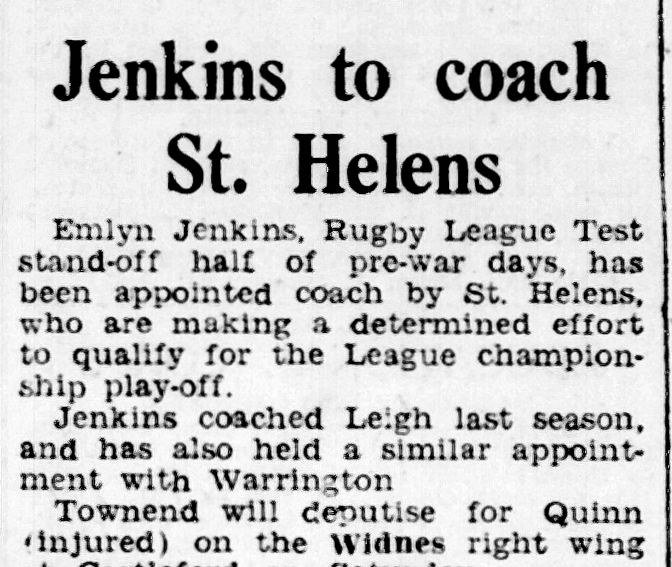
"Jenkins to coach St Helens"
The same appointment reported the same day, describing him as the Rugby League Test stand-off half of pre-war days, appointed coach by a St Helens side making a determined effort to qualify for the Championship play-off. It confirms he had coached Leigh the previous season and held a similar appointment with Warrington.
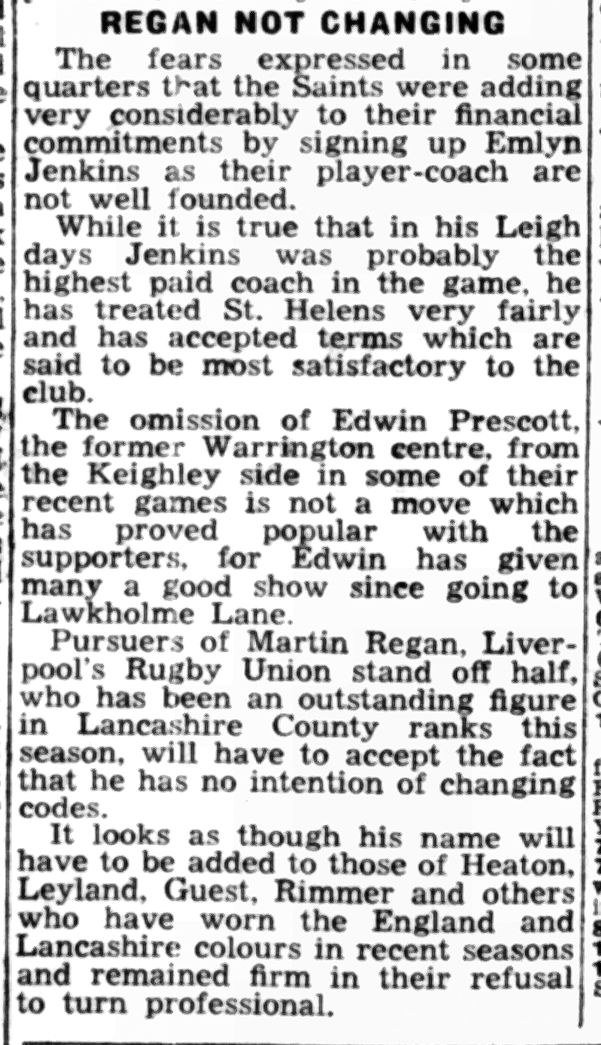
"Player-coach": what he was worth
Three days after the appointment, a Liverpool columnist addresses local anxiety about the cost of it, and in doing so records two things found nowhere else.
First, the job title: St Helens had signed him as their player-coach, at forty years of age. Second, his standing in the profession: while it is true that in his Leigh days Jenkins was probably the highest paid coach in the game, the paper writes, he has treated St Helens very fairly and accepted terms said to be most satisfactory to the club.
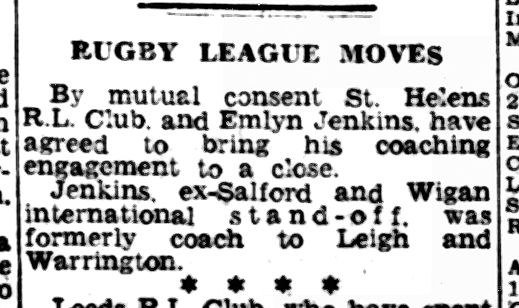
Leaving St Helens
By mutual consent, St Helens and Emlyn Jenkins agreed to bring his coaching engagement to a close, a year and a day after it began. He is described as the ex-Salford and Wigan international stand-off, formerly coach to Leigh and Warrington. It was his last club appointment in the game.
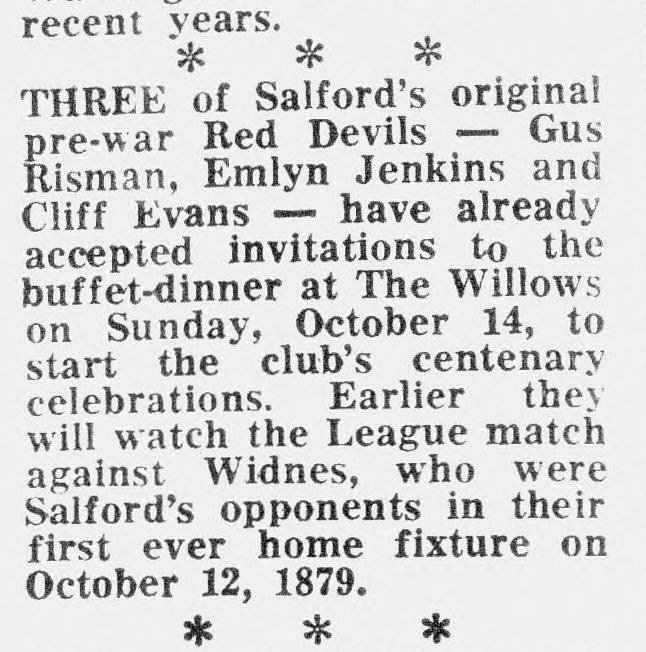
Back at The Willows for the centenary, 1979
Forty-one years after Salford sold him, the club invited him back. Three of Salford’s original pre-war Red Devils, Gus Risman, Emlyn Jenkins and Cliff Evans, had accepted invitations to the buffet-dinner at The Willows on Sunday 14 October 1979 to begin the club’s centenary celebrations. Beforehand they would watch the league match against Widnes, who had been Salford’s opponents in their first ever home fixture on 12 October 1879.
He was sixty-eight, living in Hampshire, and still one of the three men the club named first when it looked back over a hundred years.
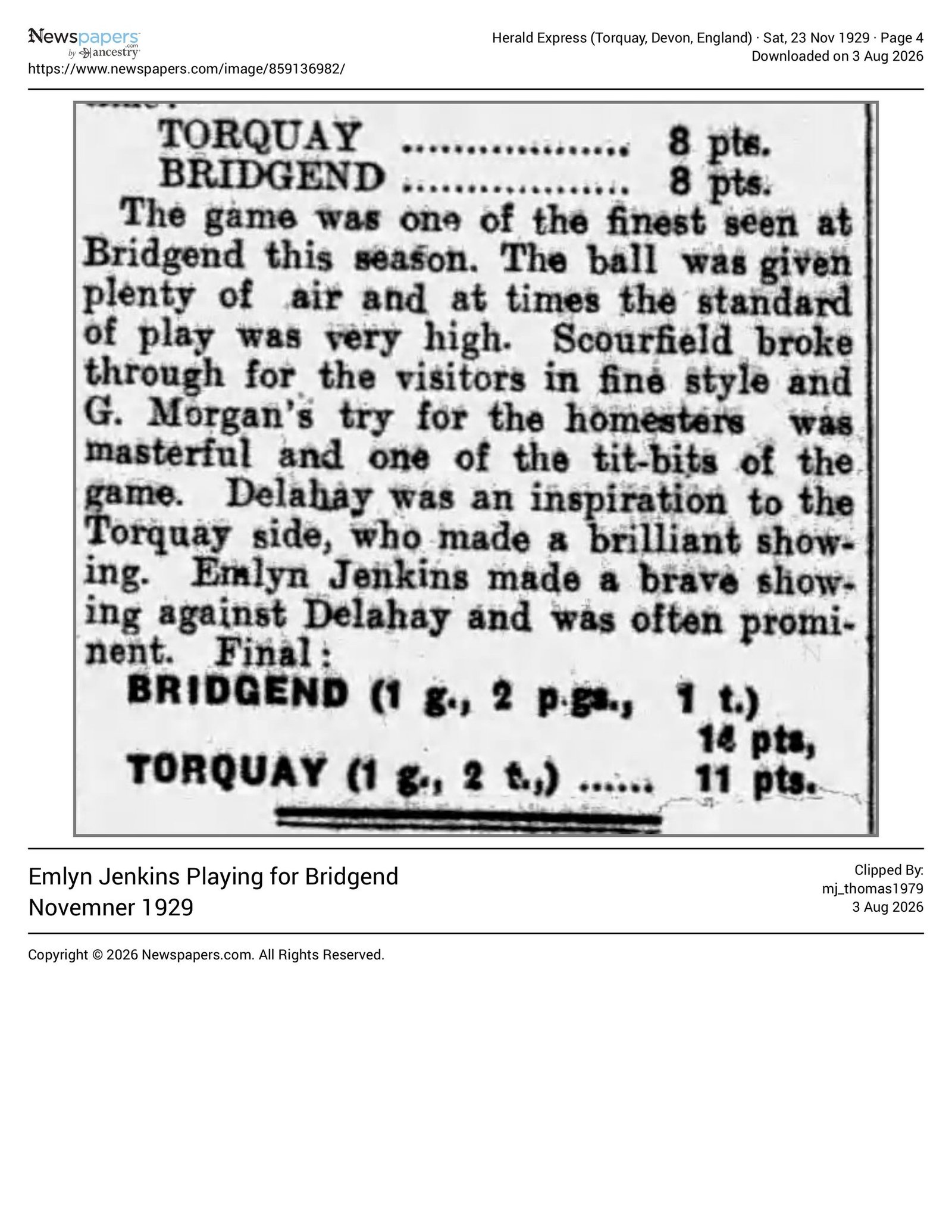
Bridgend 14, Torquay 11: the earliest match report
The earliest dated report of Emlyn playing that has yet been found, and the only evidence so far of his Bridgend season beyond the Western Mail's later summary of it. Torquay travelled to Bridgend and lost 14 points to 11, Bridgend scoring a converted try, two penalty goals and a try against a converted try and two tries. The Devon paper thought it one of the finest games seen at Bridgend that season, with the ball given plenty of air.
Emlyn was marking a man named Delahay, whom the report calls the inspiration of the Torquay side, and the verdict on him is that he made a brave showing against Delahay and was often prominent. He was eighteen years old, three years from Salford and seven from the Sydney Cricket Ground.
The find also dates the Bridgend season firmly to 1929-30, which fits the Western Mail's account of his progression from Treherbert and the valley clubs to Bridgend, then Cardiff.
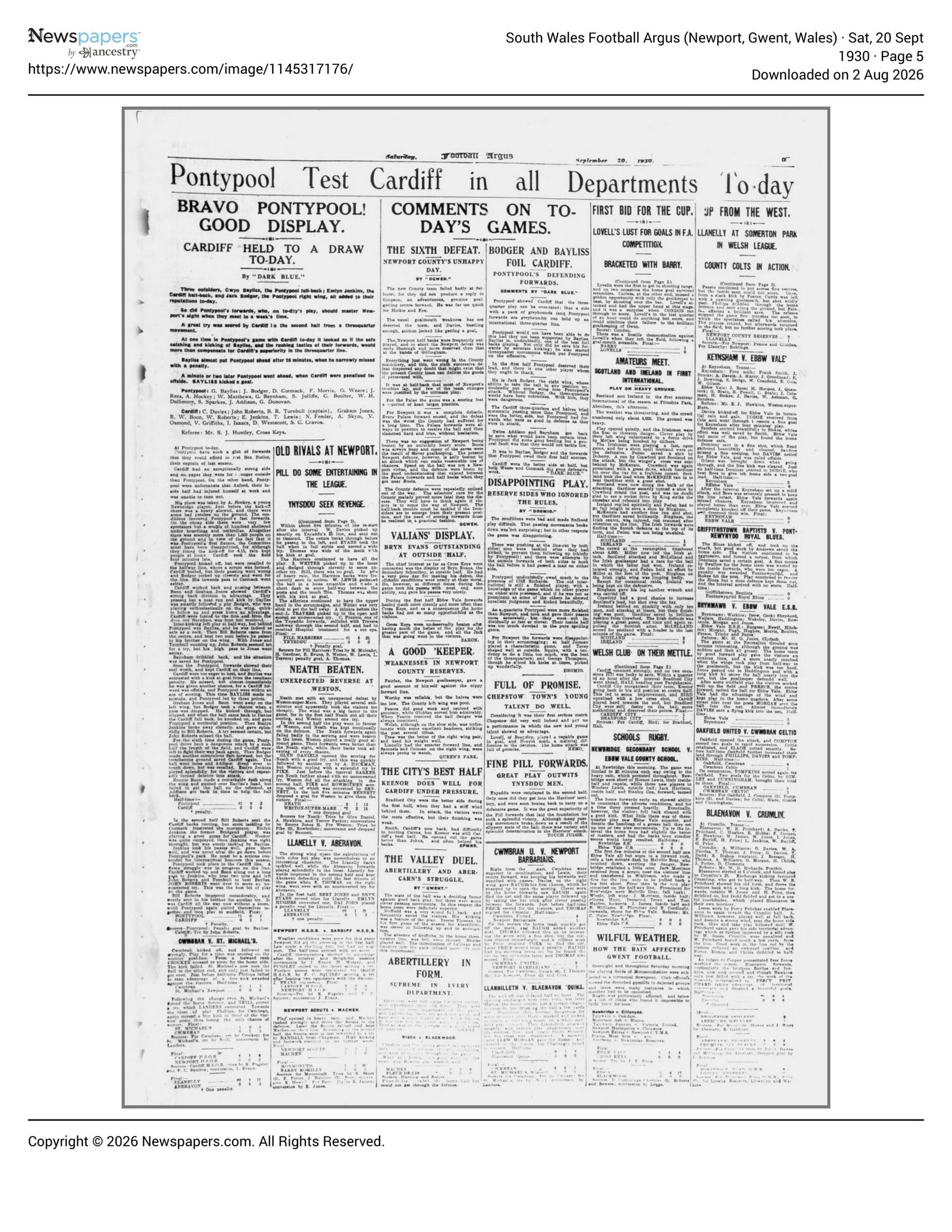
"Bravo Pontypool!": Cardiff held to a draw
A Saturday football paper's running report on Pontypool against Cardiff, which finished level. Emlyn is named in the Cardiff line-up at half-back as E. Jenkins, and singled out in the opening line: three outsiders, the paper wrote, all added to their reputations that day, and Emlyn Jenkins, the Cardiff half-back, was one of them. For a year the earliest dated match report of his career, until the Torquay clipping of November 1929 turned up.
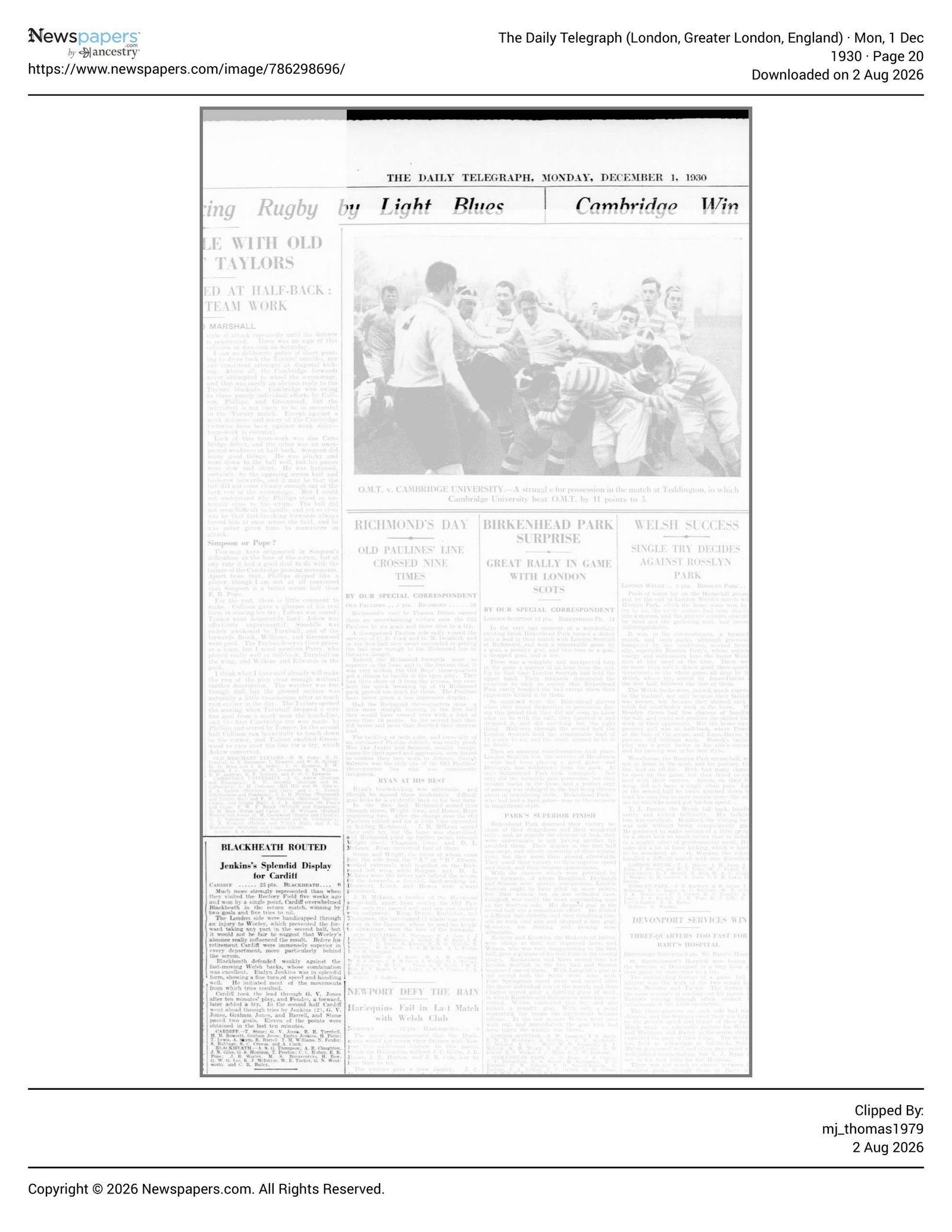
"Blackheath Routed: Jenkins's Splendid Display for Cardiff"
A London paper reporting Cardiff's 25 points to nil defeat of Blackheath at the Rectory Field, with Emlyn's name in the headline. The report describes him in splendid form, showing a fine turn of speed and handling well, and credits him with starting most of the movements from which tries came. He scored two of Cardiff's seven tries himself. The match was played on Saturday 29 November 1930; this report appeared on Monday 1 December, his twentieth birthday. Five days later he signed for Salford.
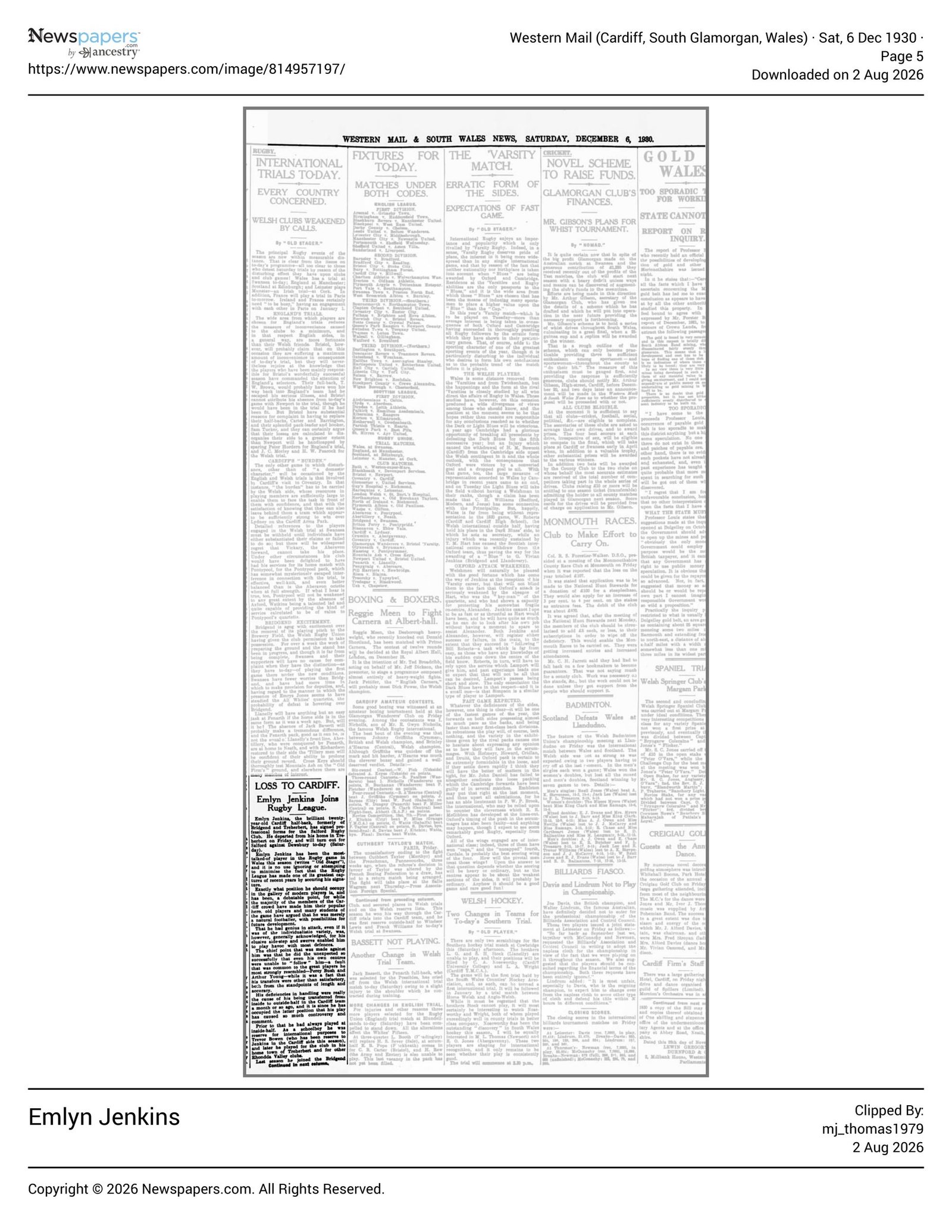
"Loss to Cardiff: Emlyn Jenkins Joins Rugby League"
The moment he went north, reported in Wales the morning it happened. The paper records that Emlyn, the brilliant twenty-year-old half of Cardiff and Treherbert, had signed professional forms for the Salford club, left his home in Treherbert on the Friday, and would turn out against Dewsbury that same Saturday. This confirms his Salford debut date of 6 December 1930 from a contemporary Welsh source. The columnist "Old Stager" weighs his loss to the union game at length: the most discussed player of the season, whose elusive sidestep and swerve let him play havoc with most defences, though his passing drew criticism and his habit of doing the unexpected sometimes left his own centres unable to follow him, a fault shared with Percy Bush and Arthur Young before him. It also records that he had been moved from inside-half to outside-half in the Cardiff side about a month earlier, that as a schoolboy he was reserve for international purposes to Trevor Bowen, that he played for Treherbert and other Rhondda Valley clubs and then Bridgend, and, most strikingly, that he was named reserve outside-half for the Welsh international trial at Swansea being played that very day.
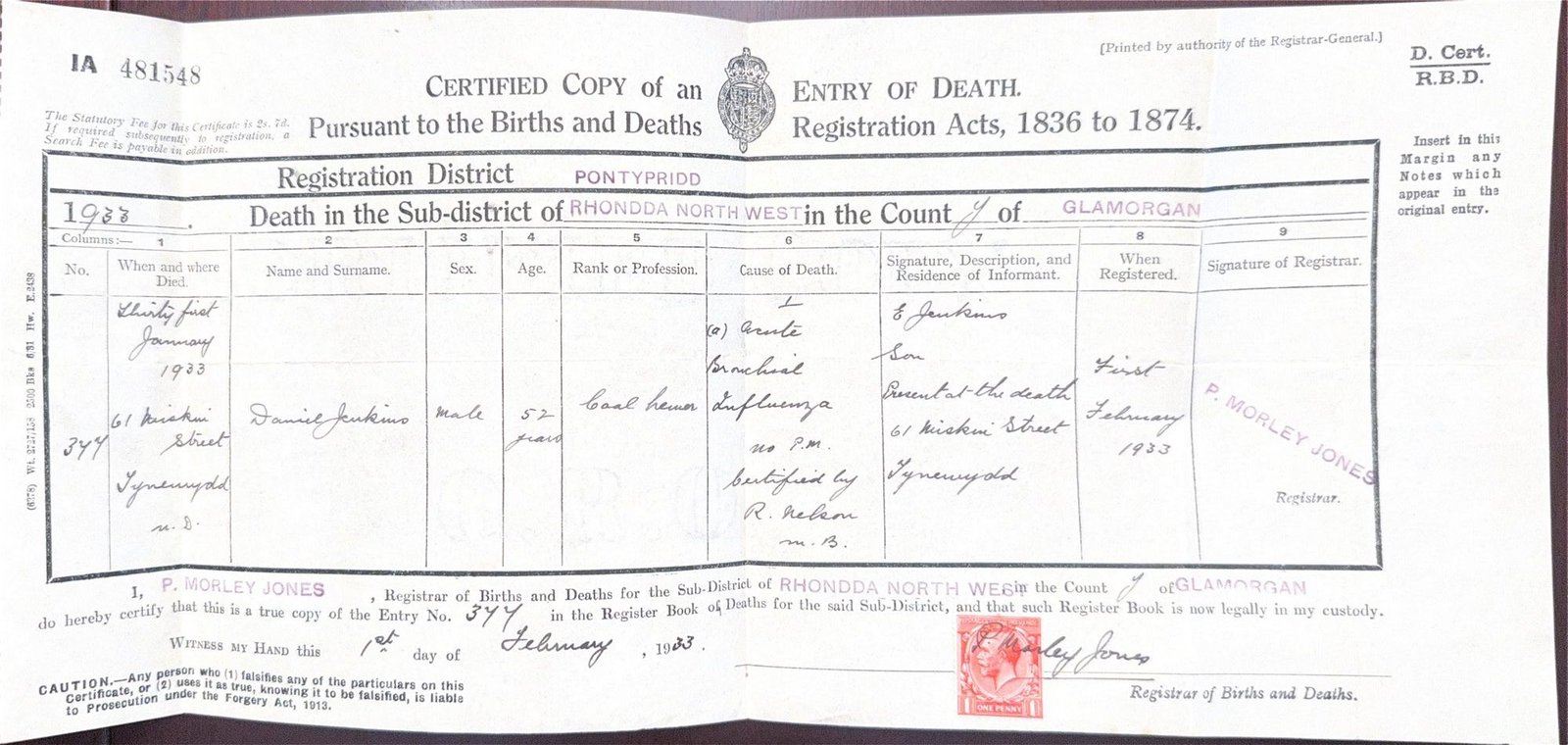
Death of Daniel Jenkins
Emlyn’s father, a coal hewer, died at home aged fifty-two. Emlyn was present at the death and registered it himself. It fell in the middle of his greatest season at Salford, the year he scored twenty-seven tries. He was twenty-two.
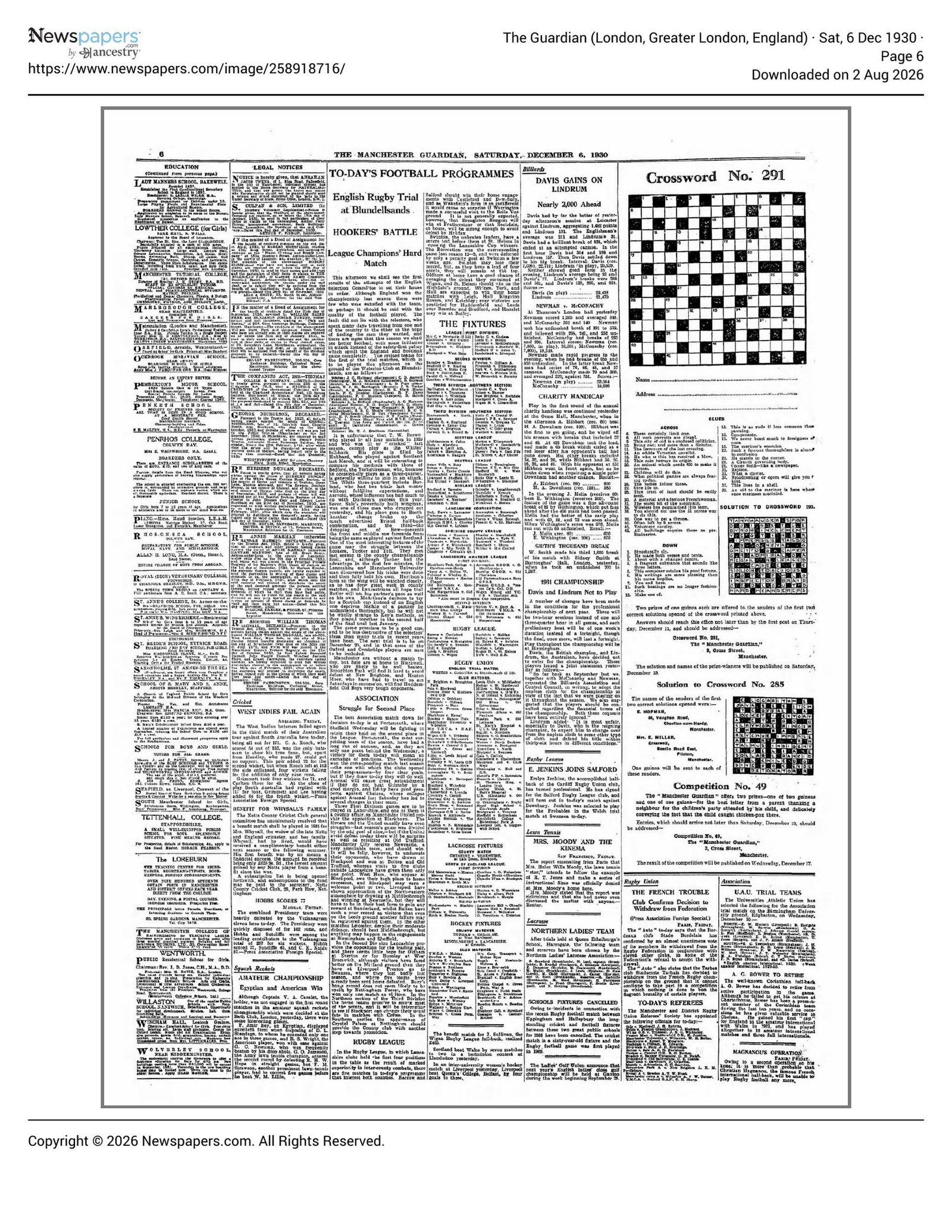
"E. Jenkins Joins Salford"
The signing as it reached Manchester, in a few lines: the accomplished half-back of the Cardiff Rugby Union club had turned professional, signed for Salford, and would play in that day's match against Dewsbury. It closes by noting he had been selected to play in the Welsh trial the same afternoon.
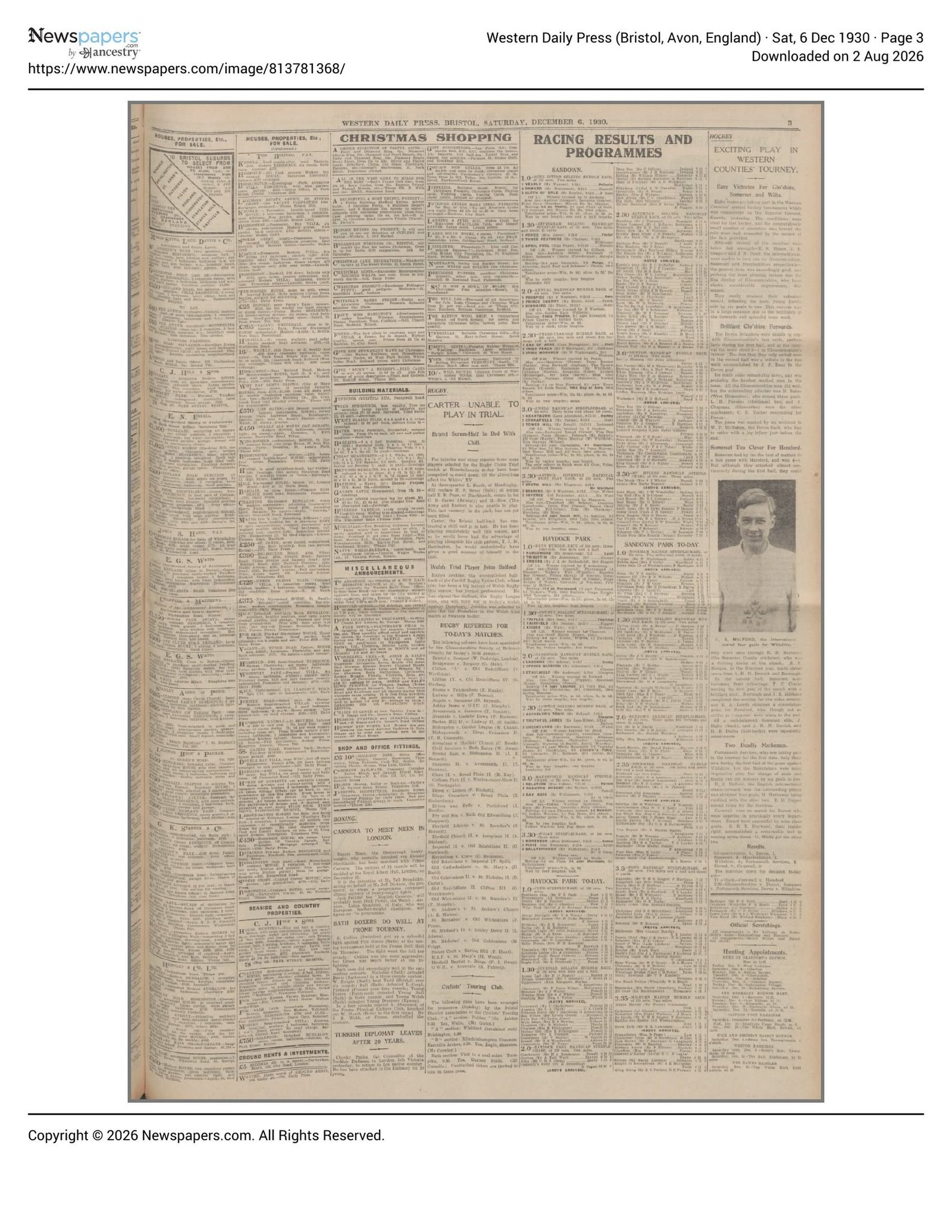
"Welsh Trial Player Joins Salford"
The same news in the West Country, under a headline that says what was being given up. The report describes him as the accomplished half-back of the Cardiff club whose play had been a big feature of Welsh rugby that season, and ends with the sentence that matters most: he had been selected to play for the Probables in the Welsh trial match at Swansea that day. Where the Western Mail describes him as reserve outside-half for the trial, this and the Manchester Guardian have him picked to play.
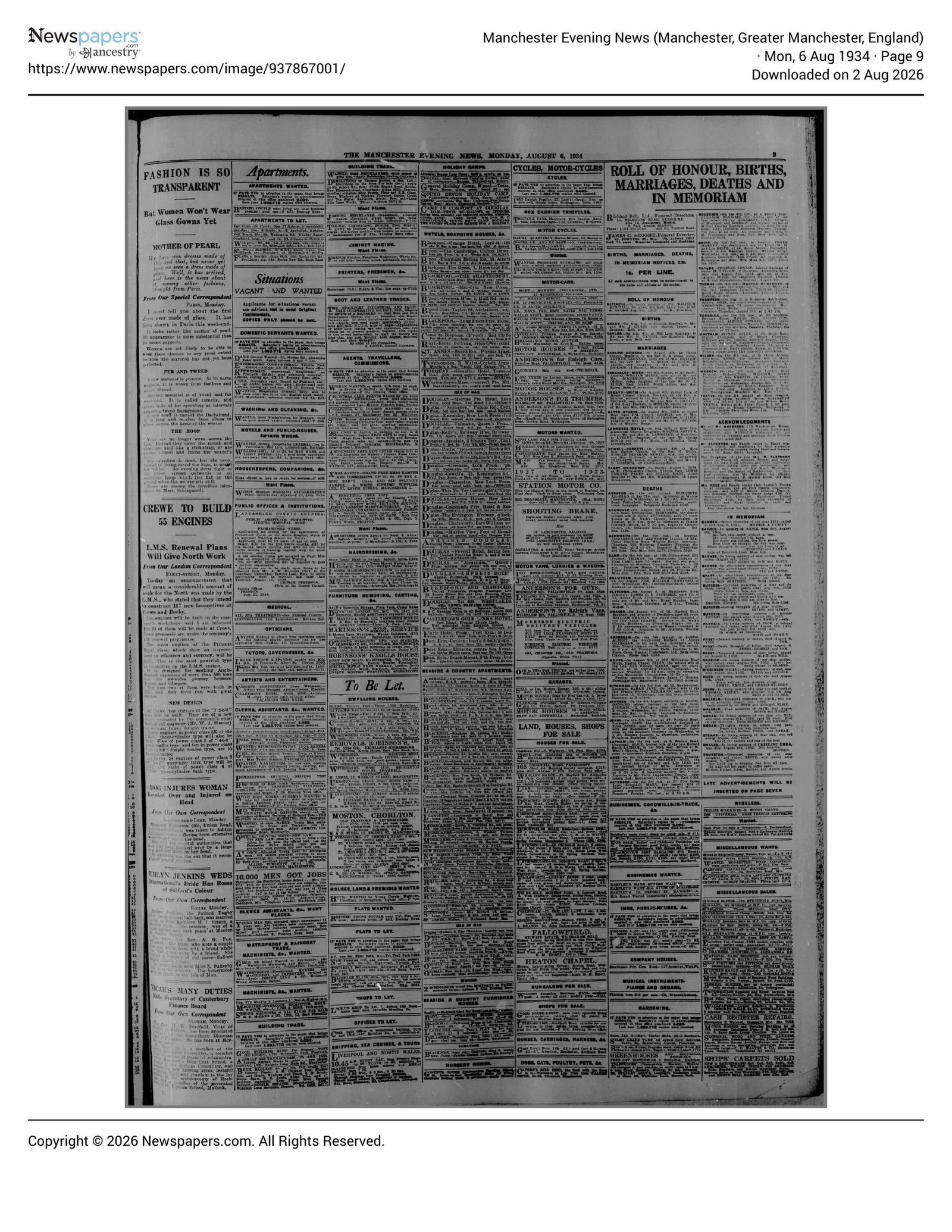
"Emlyn Jenkins Weds"
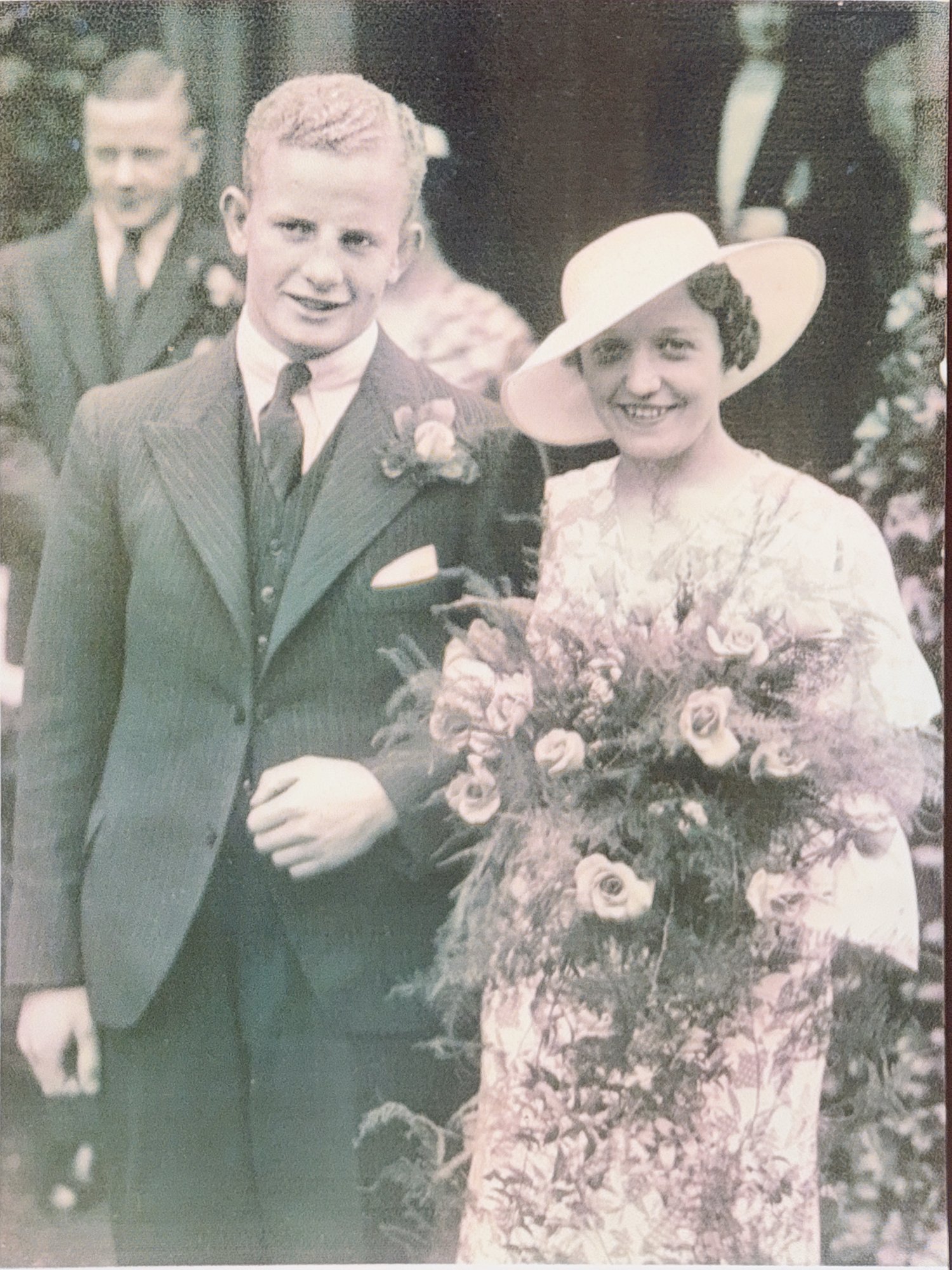
A short notice of Emlyn's marriage to Kathleen M. Robinson, under a headline about the Rhondda man's bride carrying roses in Salford's colour: the bride wore a simple gown and carried red roses. The officiating minister is named as the Rev. A. G. Fox and the bridesmaid as a Miss Satterby. Two details here do not match what the family has always given. The report is datelined Eccles on the Monday, which is 6 August 1934, and it places the ceremony at Monton rather than at St Paul's, Eccles. Monday 6 August 1934 was the August Bank Holiday. The family date of 7 August 1934 and the St Paul's venue are recorded elsewhere on this site; until the marriage certificate is checked against this cutting, both accounts are set down here as they stand.
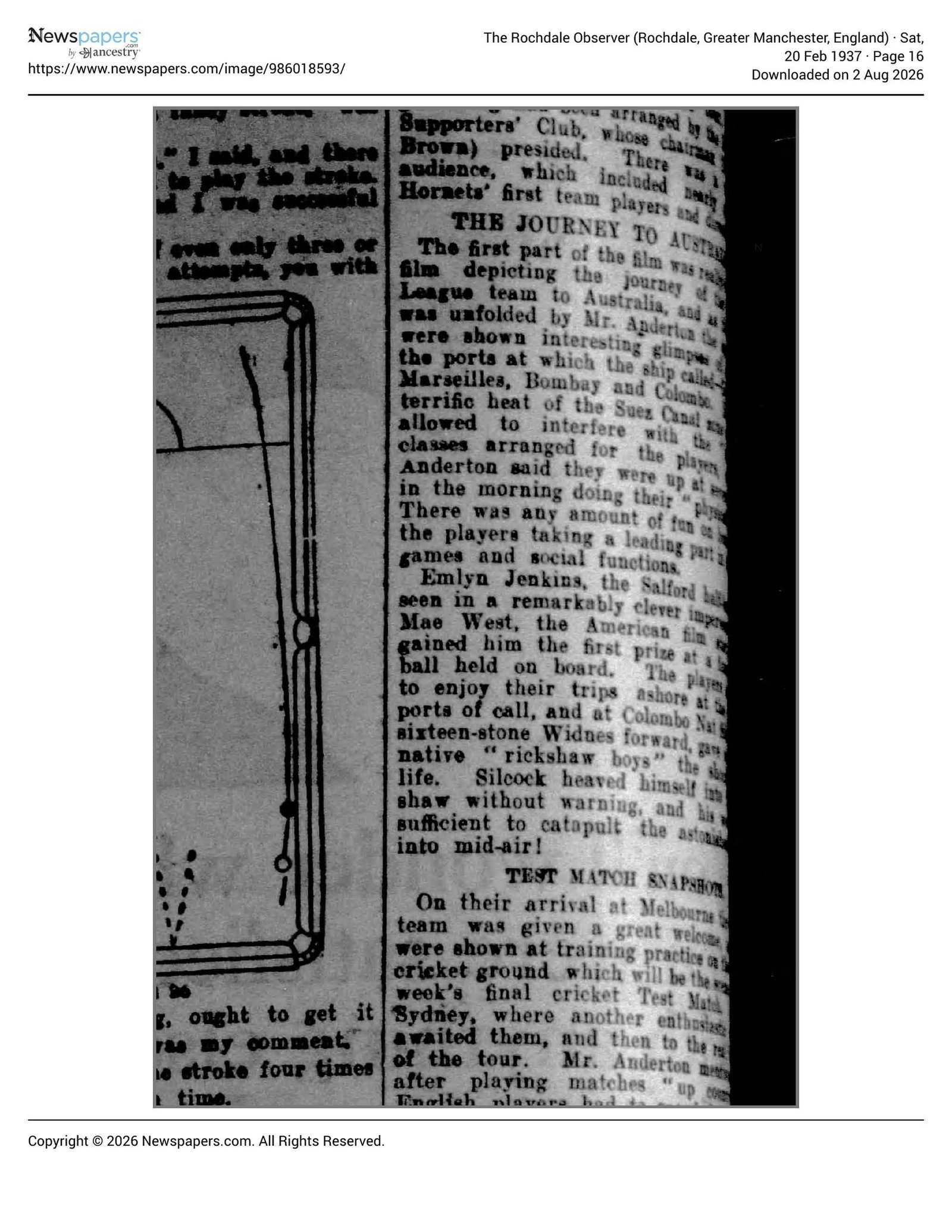
The fancy dress ball on board
A report of an evening held by the Rochdale Hornets supporters' club, at which the 1936 tour manager Bob Anderton showed his film of the voyage to Australia and talked the audience through it: the ports where the ship called at Marseilles, Bombay and Colombo, the heat of the Suez Canal, the classes and training kept up on board. Then this: Emlyn was seen in a remarkably clever impersonation of the American film star Mae West, which won him first prize at a fancy dress ball held on board. The same passage has the sixteen-stone Widnes forward Nat Silcock flattening a rickshaw at Colombo.
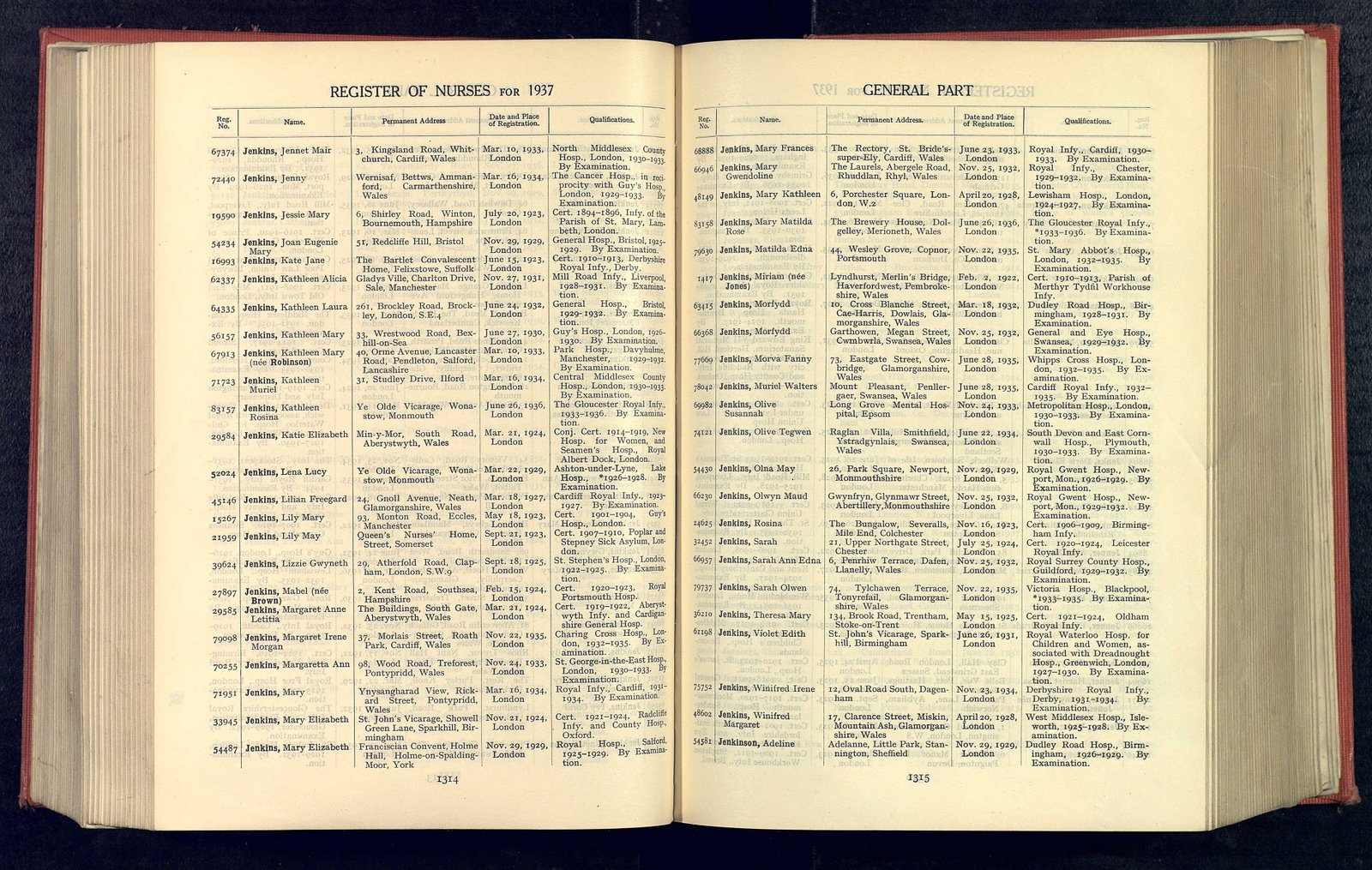
Register of Nurses, 1937: Kathleen Mary Jenkins
Kathleen's own professional record, printed by the state. The entry reads: Jenkins, Kathleen Mary (née Robinson), registration number 67913, of 40 Orme Avenue, Lancaster Road, Pendleton, Salford, Lancashire; registered 10 March 1933 in London; qualified at Park Hospital, Davyhulme, Manchester, 1929 to 1932, by examination.
Three things follow from it. First, it confirms Wendy Jenkins's correction to the family story from an official source, and names the hospital exactly: Park Hospital, Davyhulme. Second, the training dates place her at Davyhulme from 1929, which is over a year before Emlyn arrived in Salford in December 1930, so she was a nurse there throughout the period when they met. Third, it gives the couple an address, 40 Orme Avenue in Pendleton, and shows that she kept her registration current after marriage, since the 1937 volume lists her under her married name with her maiden name preserved in brackets.
Park Hospital has a place in national history quite apart from this one. On 5 July 1948 it became the first hospital in the National Health Service, opened by Aneurin Bevan, a miner's son from Tredegar. Kathleen had trained there sixteen years earlier.
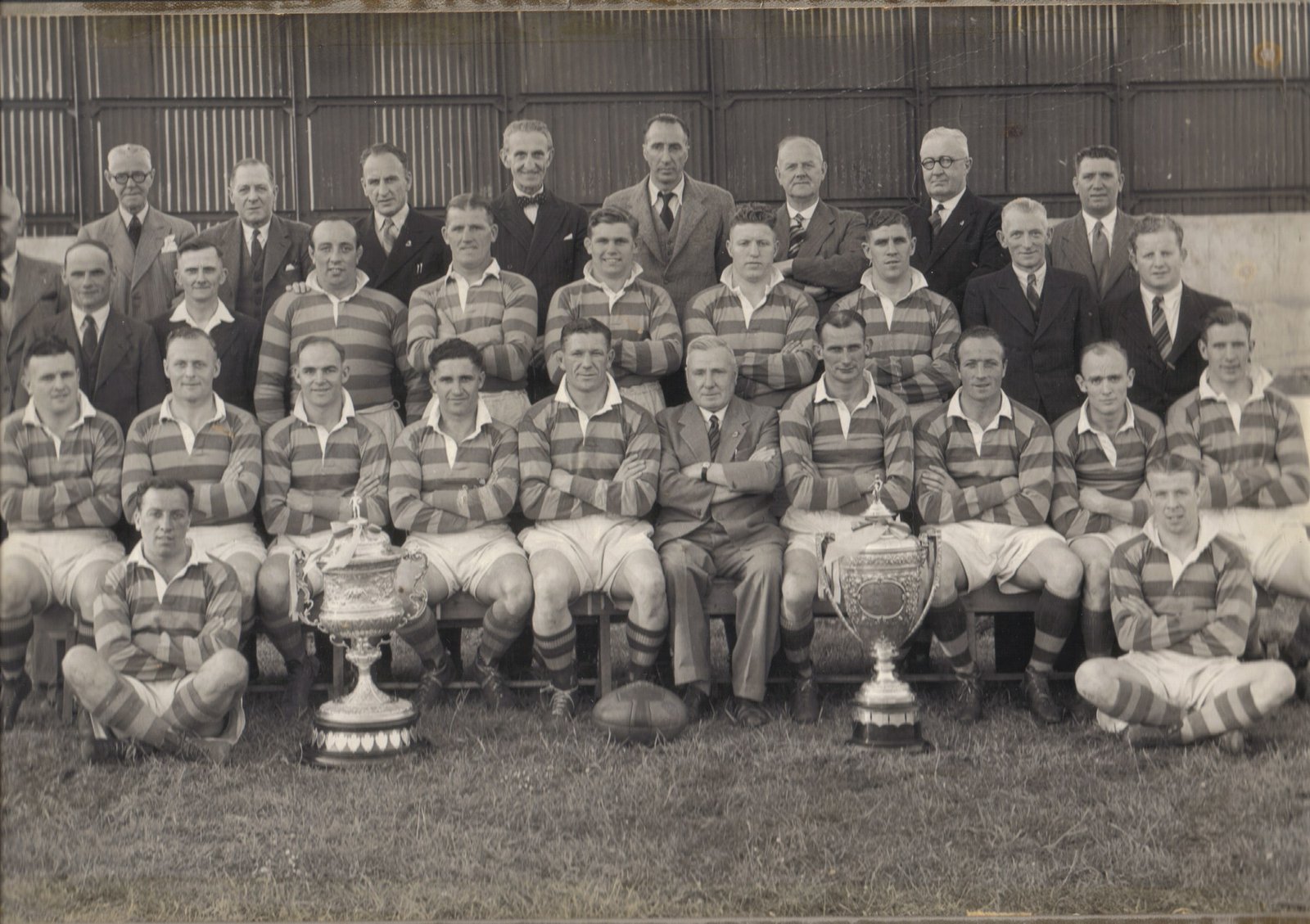
Warrington championship squad, 1948
The full squad, players, directors and officials, photographed with the two trophies won that season, the Championship and the Lancashire League. Emlyn stands at the right-hand end of the first row of standing men, identified by Warrington Wolves Heritage. It is the only photograph found so far of him with a side he had actually built.
View the photograph Warrington Wolves Heritage Used in: Coach
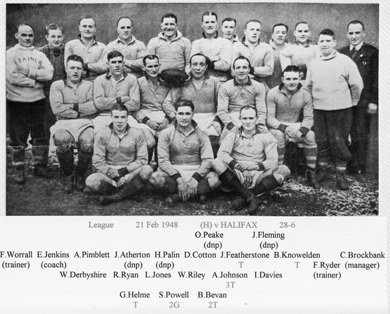
Warrington against Halifax, 21 February 1948
A team group for a single match, and unusually useful because every man in it is named. Back row: F. Worrall (trainer), E. Jenkins (coach), A. Pimblett, J. Atherton, H. Palin, D. Cotton, J. Featherstone, B. Knowelden, C. Brockbank (manager). Middle row: W. Derbyshire, R. Ryan, L. Jones, W. Riley, A. Johnson, I. Davies, F. Ryder (trainer). Front: G. Helme, S. Powell, B. Bevan. O. Peake and J. Fleming are also pictured but did not play.
The scorers are marked on the caption: three tries to Ike Davies, two each to Brian Bevan and Bryn Knowelden, one each to Jack Featherstone and Gerry Helme, and two goals from Sammy Powell. Emlyn stands second from the left in the back row, and this is the only photograph so far found that places him with a named Warrington team on a dated afternoon.
View the photograph Warrington Wolves Heritage Used in: Coach
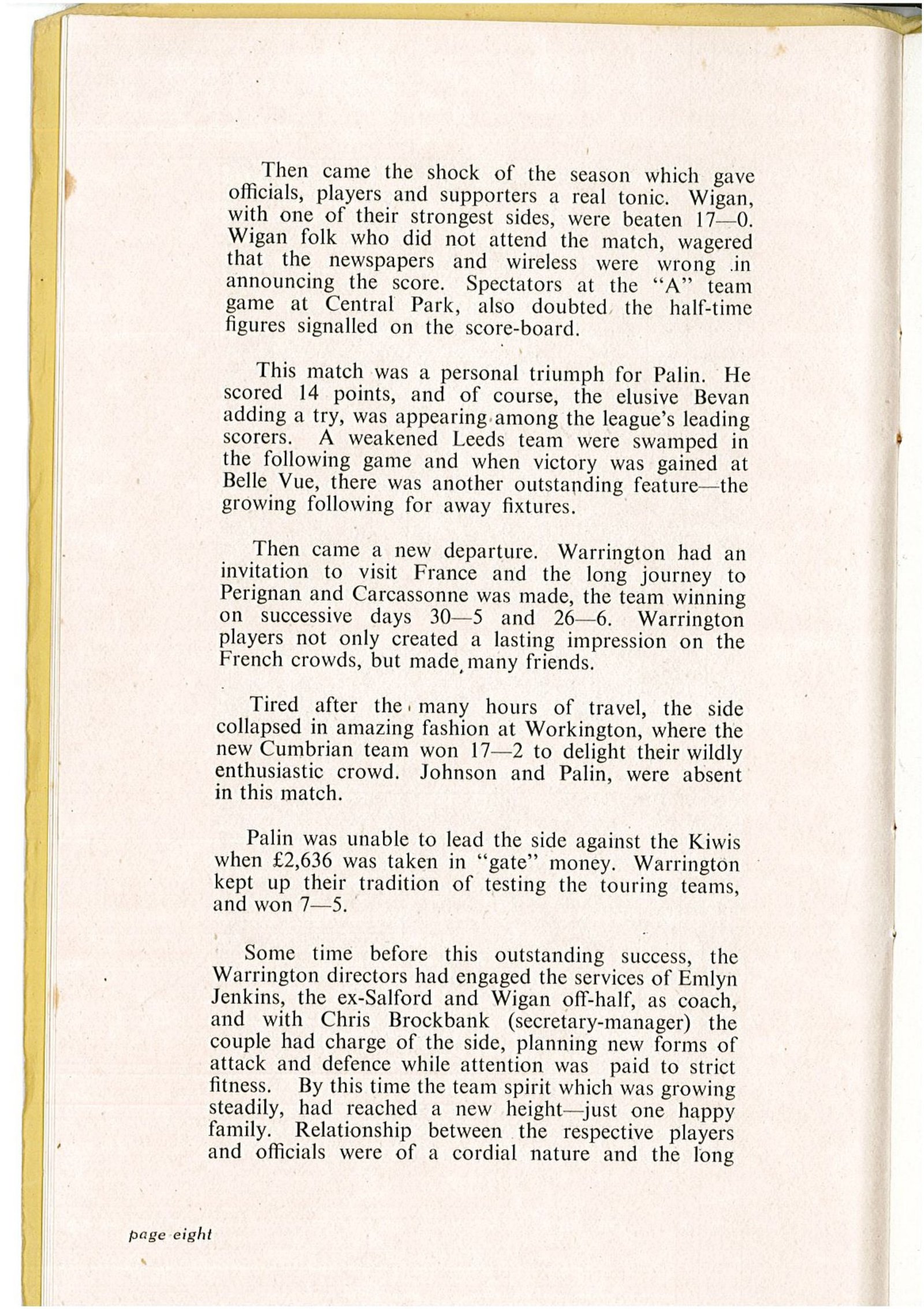
Warrington commemorative book, 1947-48: the appointment
The club's own account of the Championship and Lancashire League season, and of Emlyn's part in it. It records that some time before that success the Warrington directors had engaged his services as coach, describing him as the ex-Salford and Wigan off-half, and that with the secretary-manager Chris Brockbank he had charge of the side, the two of them planning new forms of attack and defence while attention was paid to strict fitness. It notes the team spirit had reached a new height, just one happy family, and that relations between players and officials were cordial.
Two details are useful beyond the narrative. This is independent confirmation from an employer that Wigan belongs in his playing record, and "off-half" is the term Warrington used for his position. The surrounding pages cover the 17-0 defeat of Wigan, the trip to Perpignan and Carcassonne, and the Cup ties against Workington and Gus Risman.
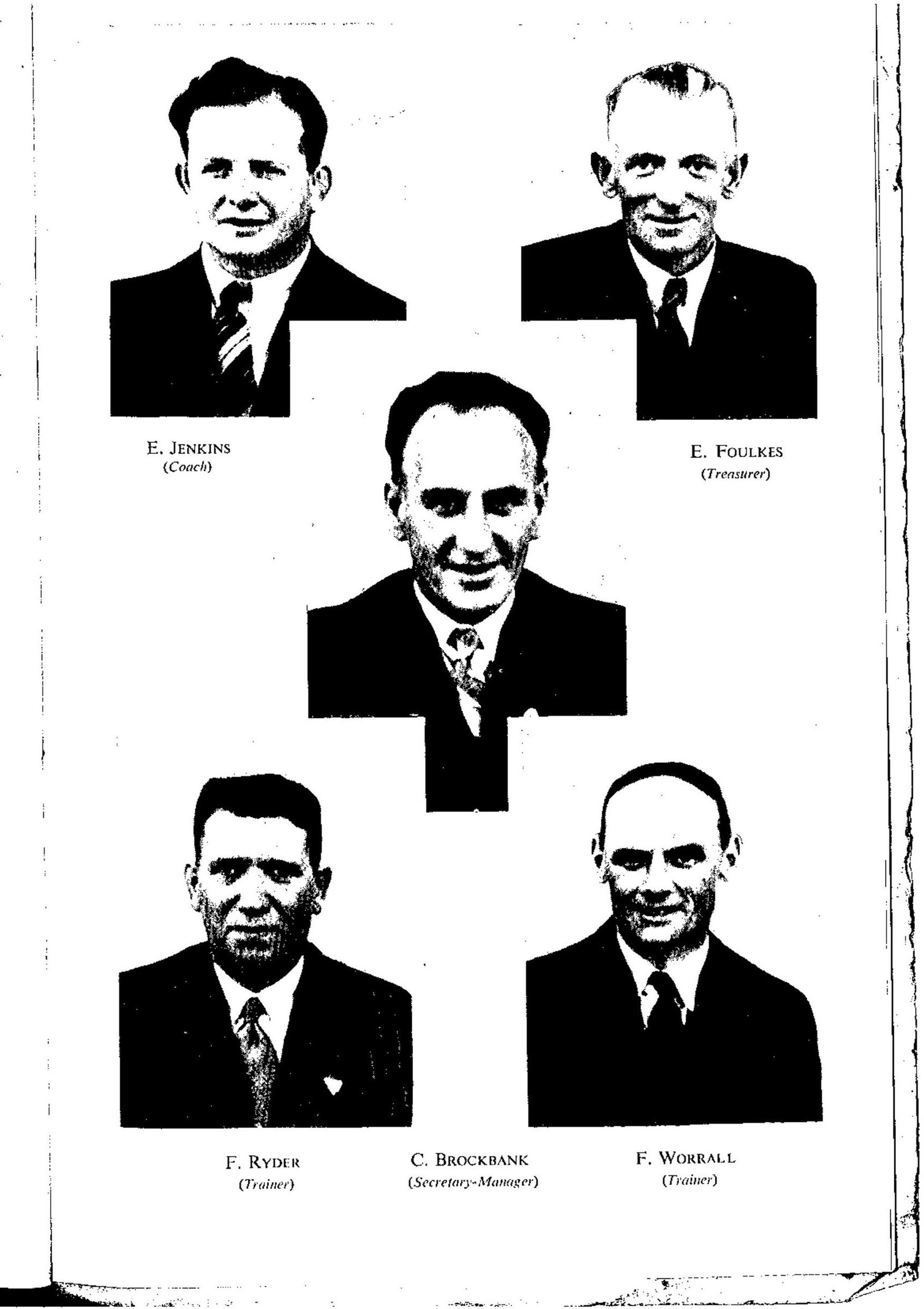
Warrington commemorative book, 1947-48: the officials
A page of portrait photographs of the club's officials, captioned. Emlyn appears at the top left as E. Jenkins (Coach), with E. Foulkes (Treasurer) beside him and, below, F. Ryder (Trainer), C. Brockbank (Secretary-Manager) and F. Worrall (Trainer). It is the only known photograph of him presented formally as an official of a club he worked for, and the only one found so far from the Warrington year.
register
·
online
Leigh heritage register: number 584
Leigh have catalogued all 1,564 men who have played a competitive first team game for the club since the start of the Northern Union in 1895. Emlyn is number 584. His line reads: debut 1948, last played 1949, two games, one try, no goals, three points. The register states each season by its first year, so those are the 1948-49 and 1949-50 seasons, both of which fall inside his second spell as the club's coach.
This corrects the family account, which knew of one comeback only, the match in October 1949 in which he scored at not quite thirty-nine. Since the register credits him with a single try across the two games, the earlier appearance, in 1948-49, was a scoreless one and had been entirely forgotten. Jimmy Ledgard, the full-back in the 1949 photograph of Emlyn's tactics talk, is number 574 in the same list, with 334 games and 2,194 points.
Images
·
embedded
Emlyn coaching at Leigh
The only known photograph of Emlyn at work as a coach. The Getty caption describes him as the Leigh rugby football team manager and coach, explaining his game plan to the players Ledgard, Burke, Edden, Davies and Harris. Jimmy Ledgard was the full-back Leigh had signed for a record fee in 1948, who played in the Lancashire Cup final of October 1949, seven weeks before this was taken.
The original publication is given as Picture Post, issue 4942, in a 1949 photo-essay titled A Town Takes Its Team To Heart. That matters for further research: a magazine feature of that kind would have been shot over a day or more and produced many frames, most of them never published, and the Hulton Archive holds the Picture Post collection. Other photographs from the same Leigh assignment by John Chillingworth are likely to exist, and some may show Emlyn.
This image is not held by the family and is not reproduced here. It is shown in Coach using Getty's own embed tool, which keeps the photograph on Getty's servers, displays their caption and credit, and links back to the original. Viewing the full record, or licensing a copy, is possible at gettyimages.com/detail/52149442.
testimony
·
no scan
Wendy Jenkins on how her parents met
Written after reading the first draft of this site, to correct the account of the meeting that had been given here. Wendy sets out three things. Kathleen, known in the family as Robbie, was never a nurse at Hope Hospital: she did all her pre-war nursing at Davyhulme Hospital, Manchester. There was no afternoon tea arranged by Gwenny. And the pink hat belongs to a Saturday evening in a café near the hospital, when Robbie and a colleague went out for a cup of tea rather than spend the evening in the nurses' home, still in uniform with raincoats over the top.
The rest is the story as Kathleen told it to her daughters: the rugby players coming in cheerful after a win and a bonus; one of them, whom she described as a fair-haired twit, pointing across the room and announcing he was going to marry the girl in the pink hat; the lads standing them supper; Robbie's preference for the tall dark handsome one, who then walked her friend home; and Emlyn afterwards loitering outside the hospital asking her out until she relented. She had not wanted to see him again.
This is the source for the account now given in Kathleen, and it supersedes the earlier version, which was drawn from second-hand family memory. Testimony from a daughter repeating what her mother told her directly is the closest this archive comes to hearing Kathleen's own voice.
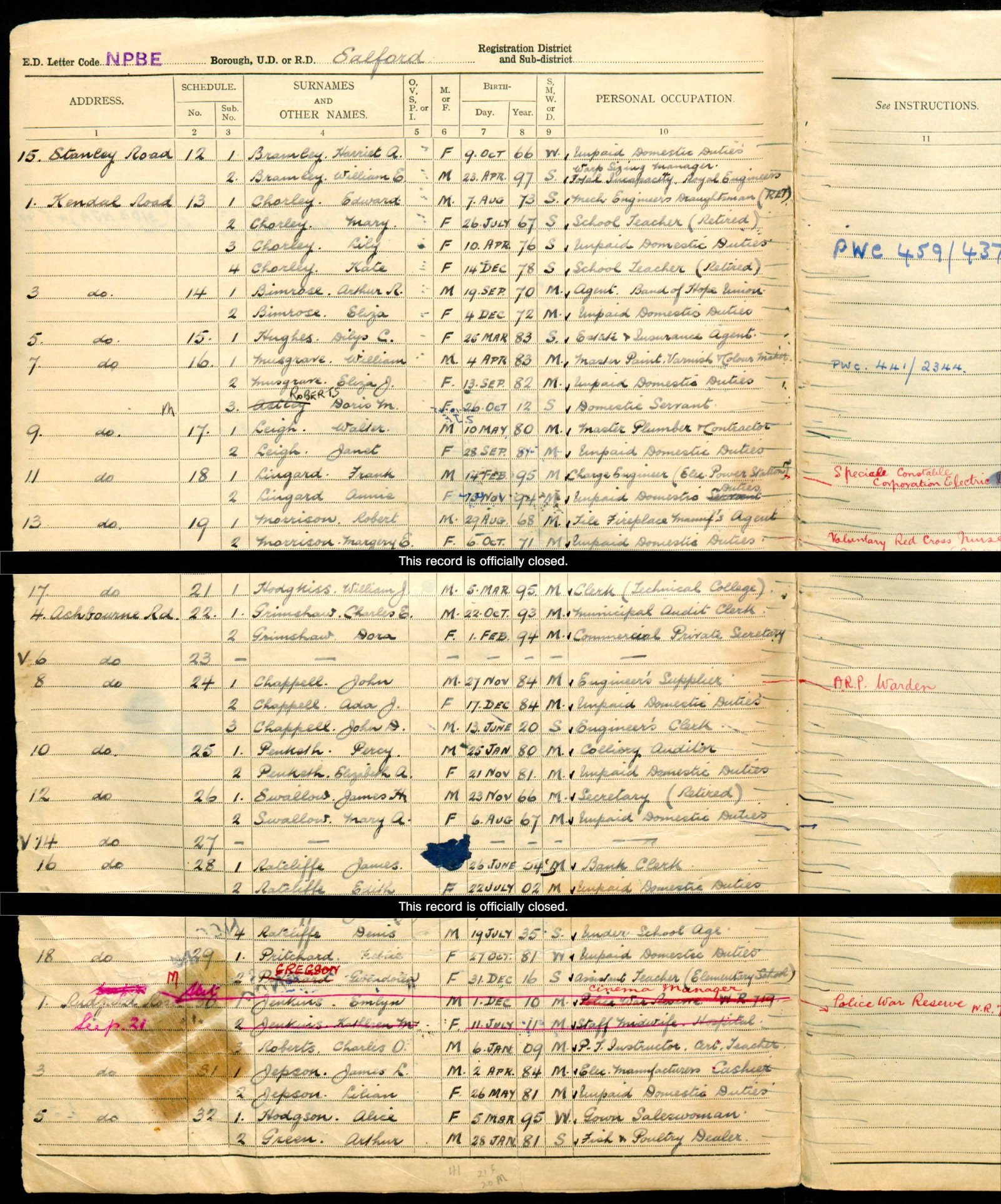
1939 Register: the Jenkins household, Salford
The national register taken three weeks after war was declared, and the single most informative document about the family at that moment. Three people are legible in the household:
Emlyn Jenkins, born 1 December 1910, married. His occupation is given as cinema manager, with Police War Reserve recorded alongside it and a reserve number. This is official confirmation of the career change the Widnes and Manchester papers reported when he retired from rugby ten months earlier, and it places him in the wartime police before his Royal Artillery commission.
Kathleen M. Jenkins, born 11 July 1911, married, staff midwife at a hospital. She had done all her pre-war nursing at Davyhulme Hospital, Manchester, and by 1939 was qualified and in post as a midwife.
Charles O. Roberts, born 6 January 1909, married, physical training instructor and art teacher, living in the same household. Almost certainly the Osborne “Bob” Roberts who married Emlyn's sister Gwenny. The middle initial fits, as does the physical training work.
Patricia, then four years old, does not appear: her line is one of those closed under the hundred year rule, as records of people not proven to have died are withheld. The red annotations across the entries are later amendments made when the register was reused for wartime and NHS administration.
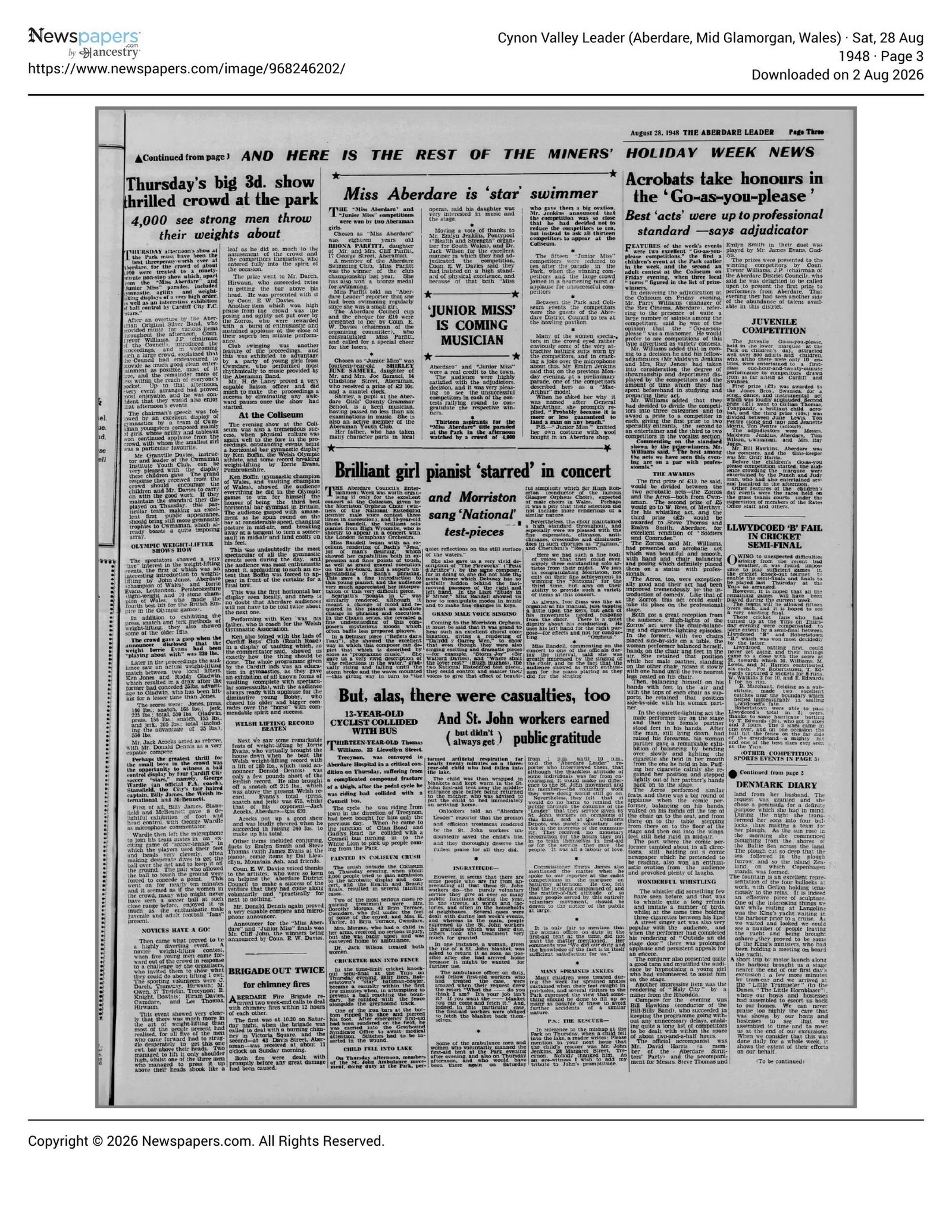
Judging Miss Aberdare
Miners' holiday week at Aberdare Park, and the Miss Aberdare and Junior Miss competitions, watched by a large crowd and won by two Aberaman girls. Emlyn adjudicated, and the paper identifies him by the role rather than the rugby: Mr Emlyn Jenkins, Pontypool, the Health and Strength organiser for South Wales. A vote of thanks was moved to him and to Dr Jack Wilson for the manner in which they judged. He also worked the microphone. Telling the crowd about a preliminary parade the previous Monday evening, he recounted asking a competitor why she called her swimming costume a "MacArthur" model, and she had her answer ready.
The Health and Strength connection runs back twenty years, to the League membership certificate he took out at seventeen from 61 Miskin Street, also in this archive. Note that the paper places him at Pontypool, while in the summer of 1948 he was coaching in Lancashire and training as a teacher at Risley; how the two fitted together is not yet established.
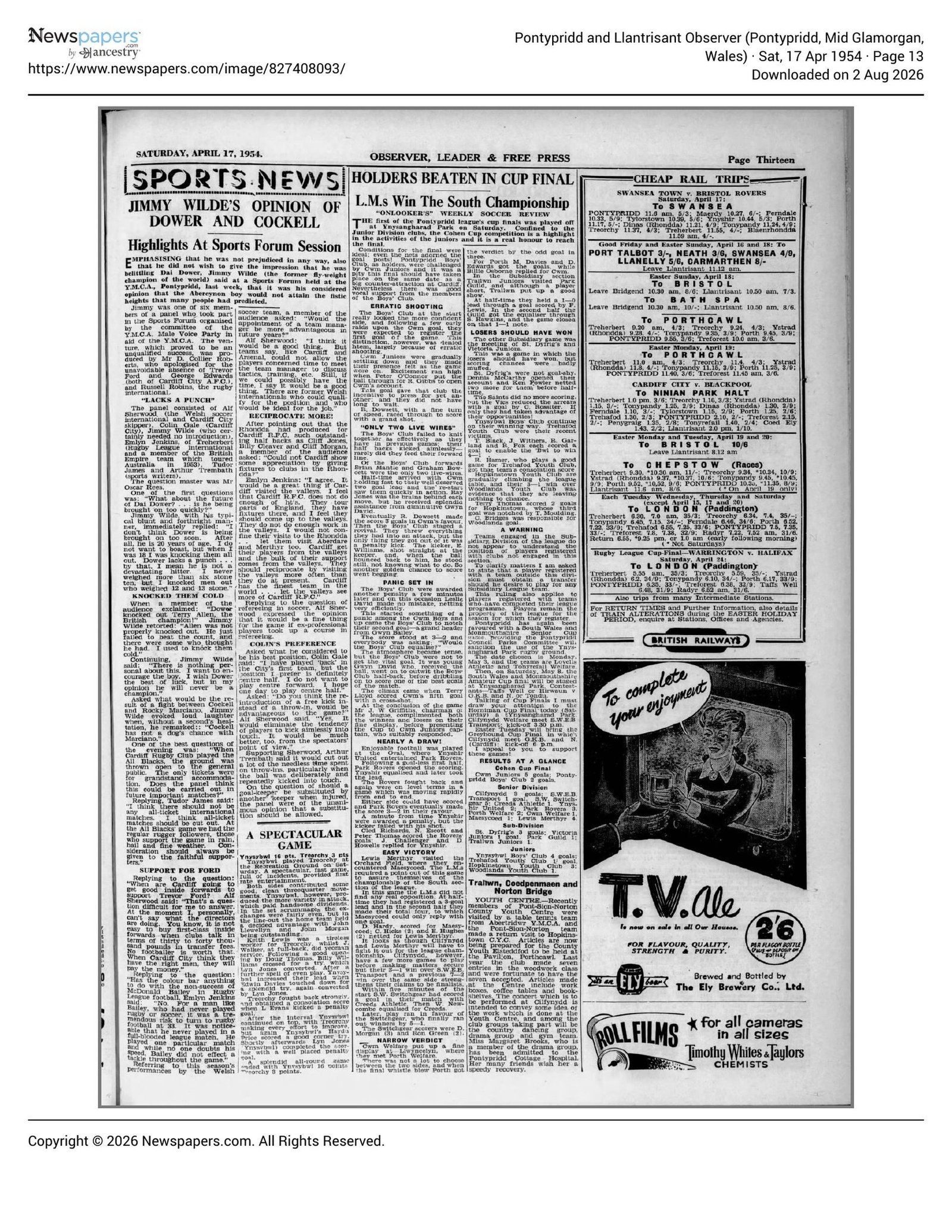
The sports forum at Pontypridd
A public sports forum at the Pontypridd YMCA, with a panel of the Welsh soccer international Alf Sherwood, Colin Gale of Cardiff City, the former world flyweight boxing champion Jimmy Wilde, the sports writers Tudor James and Arthur Trembath, and Emlyn, introduced as being of Treherbert, a Rugby League international and a member of the touring team that went to Australia in 1936. Asked whether Cardiff RFC should play in the valleys, Emlyn argued that they should: the club toured parts of England and took fixtures there while doing too little in the valleys, and he would not confine the visits to the Rhondda but send them to Aberdare and Merthyr too, since Cardiff drew both its players and the bulk of its support from the valleys. Independent evidence that the family were back in Treherbert by April 1954.
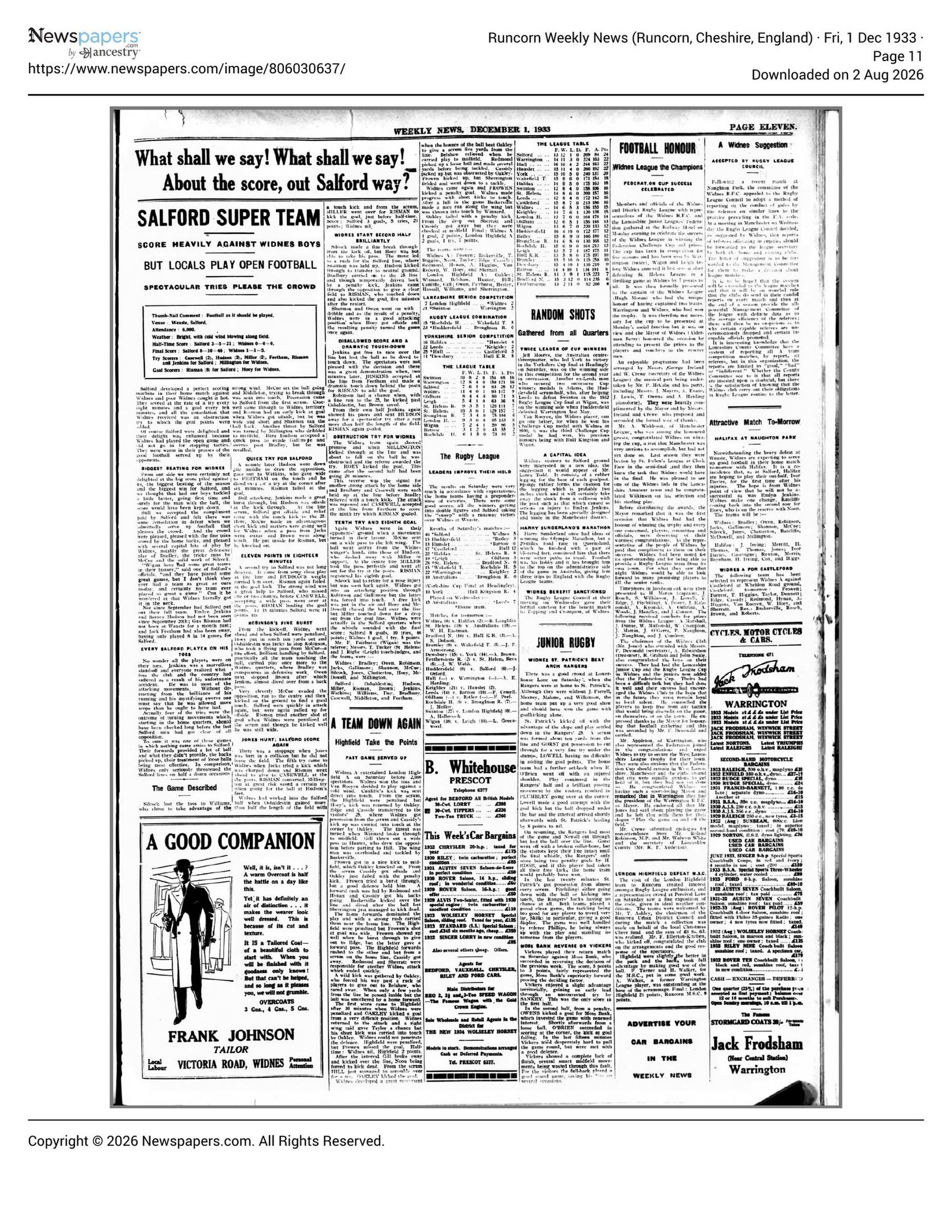
"Salford Super Team": Widnes beaten 46–5
Salford scored ten tries and eight goals against Widnes, and the reporter opens by asking what on earth can be said about the score. The match matters for a different reason: it was the first time since September that Salford had been able to field a full team, with Emlyn back after an injury. He was a marvellous player that afternoon, the paper says, in most of the movements, with a mystifying swerve, and everyone present realised what club and country had been missing while he was out. He scored one of the tries.
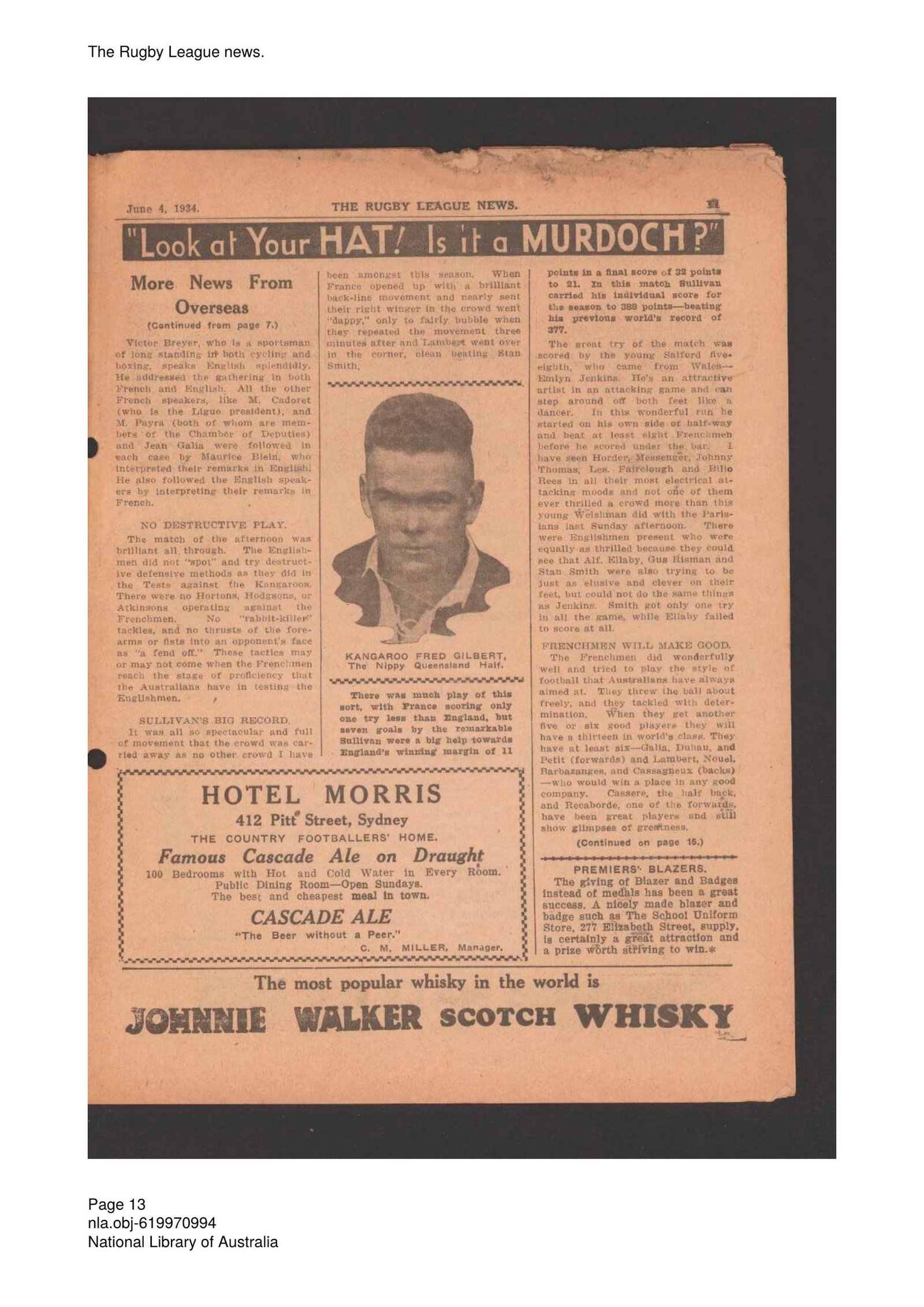
The great try in Paris
An Australian account of France's first international, reprinting a correspondent's report from Paris. It records that the great try of the match was scored by the young Salford five-eighth from Wales, describes Emlyn as an attractive artist in an attacking game who can step off both feet like a dancer, and sets out the run itself: he started on his own side of half-way and beat at least eight Frenchmen before scoring under the bar. It notes that England scored one try fewer than France but won 32–21 on Jim Sullivan's seven goals, and that Sullivan's individual total for the season reached 388 points, a world record. The same column ranks Emlyn's elusiveness with Alf Ellaby, Gus Risman and Stan Smith.
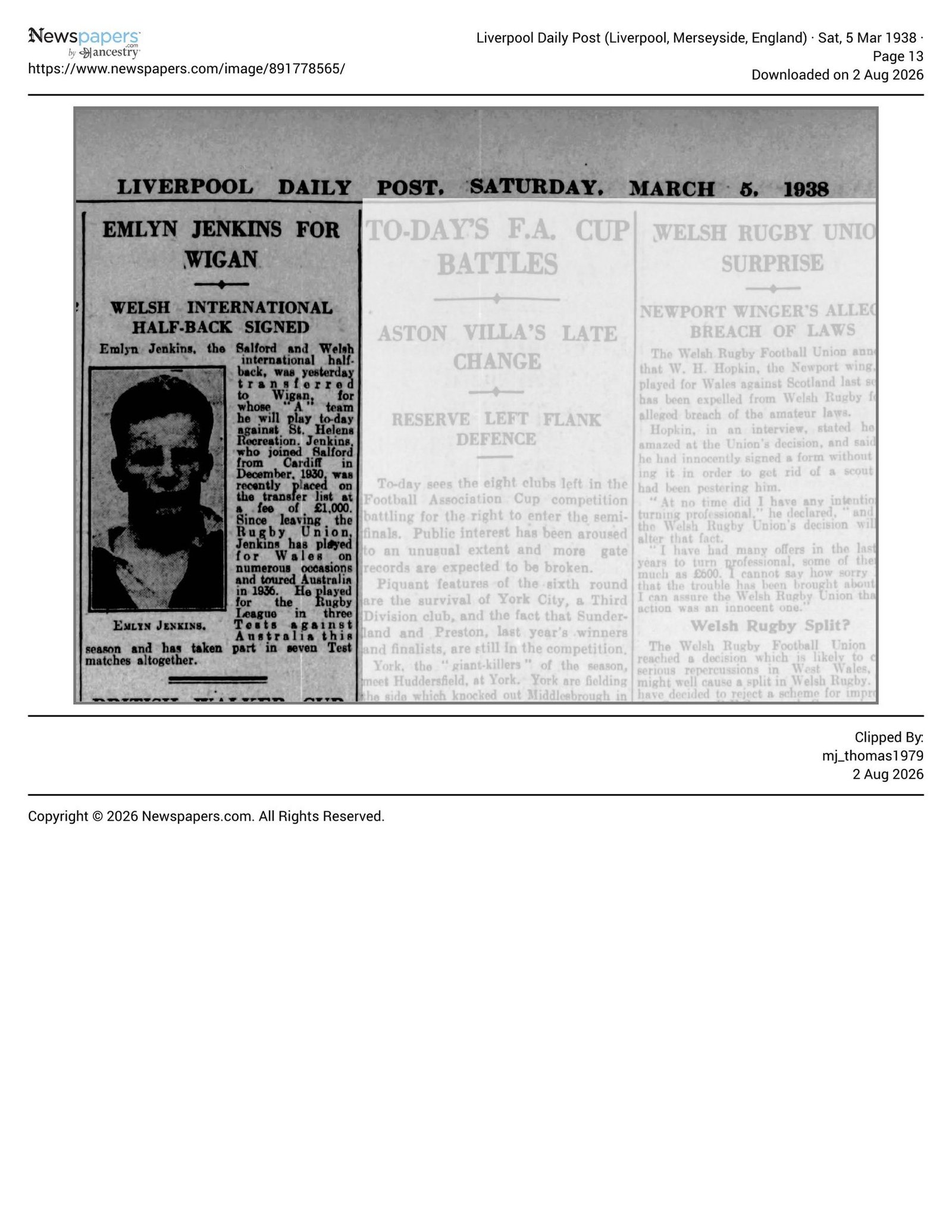
"Emlyn Jenkins for Wigan"
The transfer reported the day after it happened, with a portrait photograph. Emlyn was transferred to Wigan on Friday 4 March 1938 and turned out for their A team that same afternoon against St Helens Recreation. The report states he had recently been placed on the transfer list at a fee of £1,000, that he joined Salford from Cardiff in December 1930, that he had played for Wales on numerous occasions and toured Australia in 1936, and that he had played in three Tests against Australia that season and seven Test matches altogether. Two Welsh papers carried the same news the same day.
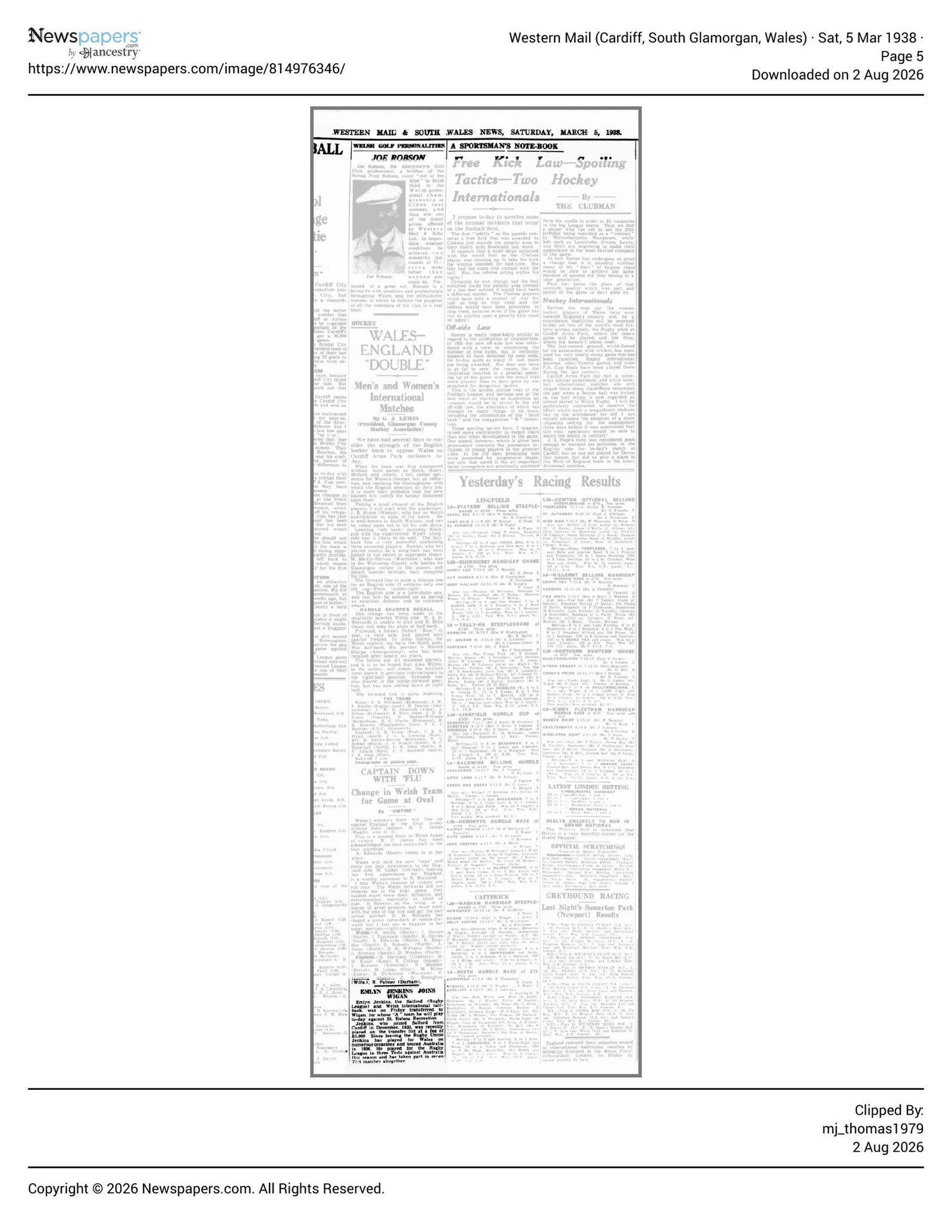
"Emlyn Jenkins Joins Wigan"
The Welsh notice of the Wigan transfer, in the paper that had reported his departure for Salford seven years earlier. Same details: the £1,000 listing, the move from Cardiff in December 1930, the Wales appearances, the 1936 Australian tour, and the three Tests against Australia that season.
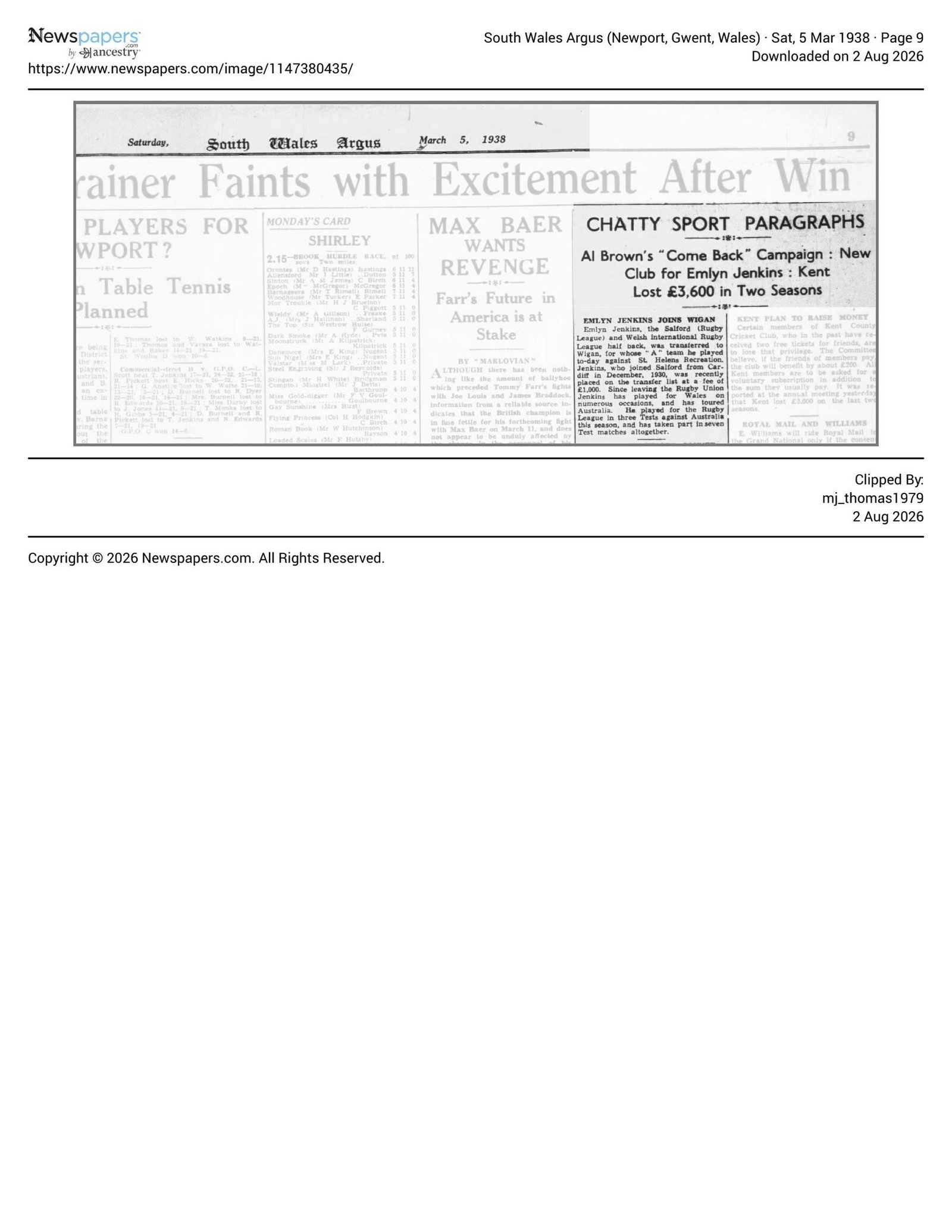
"New Club for Emlyn Jenkins"
The third Welsh or English paper to carry the Wigan move on the same Saturday, in a column of sporting paragraphs, confirming the £1,000 transfer listing and the seven Test matches.
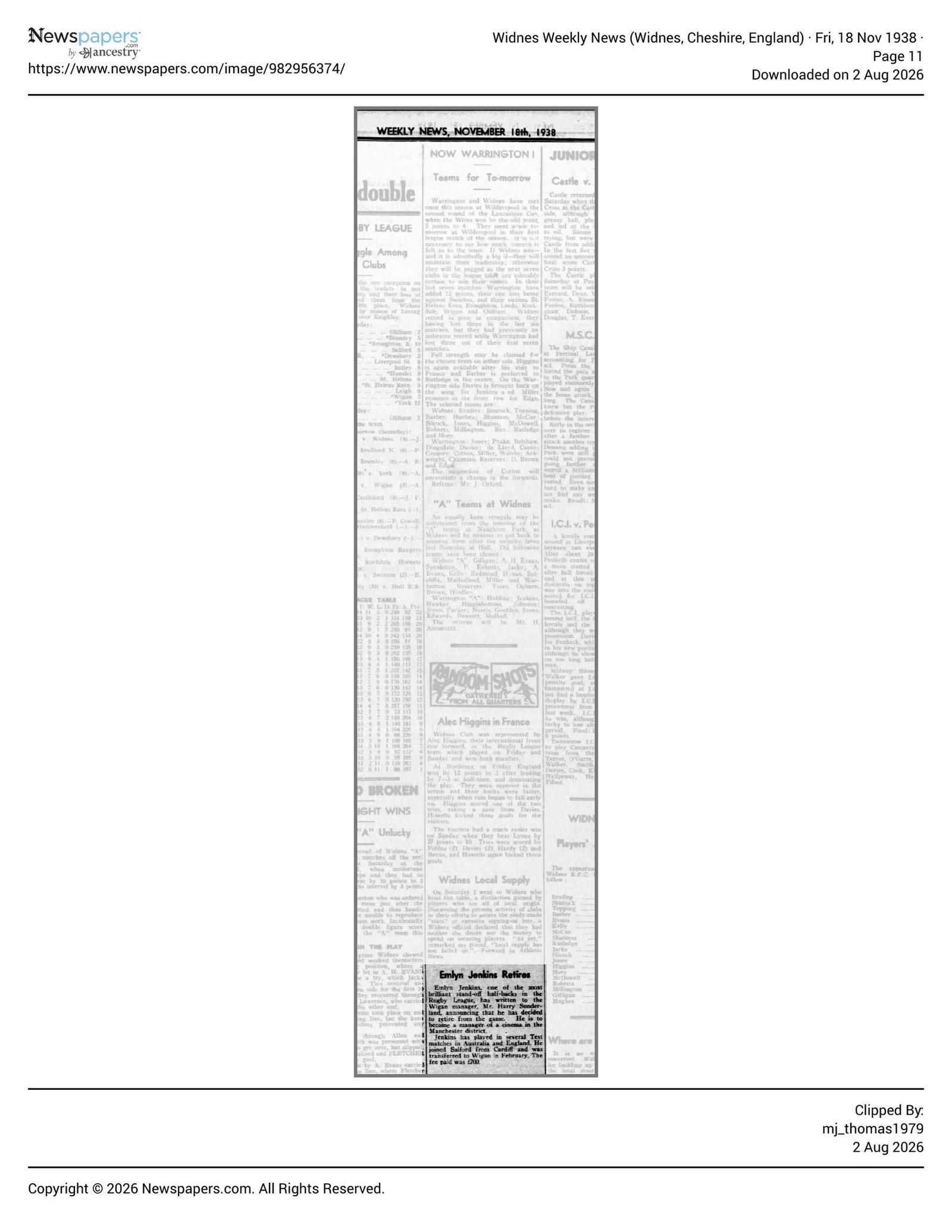
"Emlyn Jenkins Retires"
A short paragraph that closes his playing career. Emlyn, described as one of the most brilliant stand-off halves in the Rugby League, had written to the Wigan manager Harry Sunderland announcing that he had decided to retire from the game, and was to become the manager of a cinema in the Manchester district. It records the fee Wigan actually paid Salford for him as £700, against the £1,000 he had been listed at. He was not yet twenty-eight.
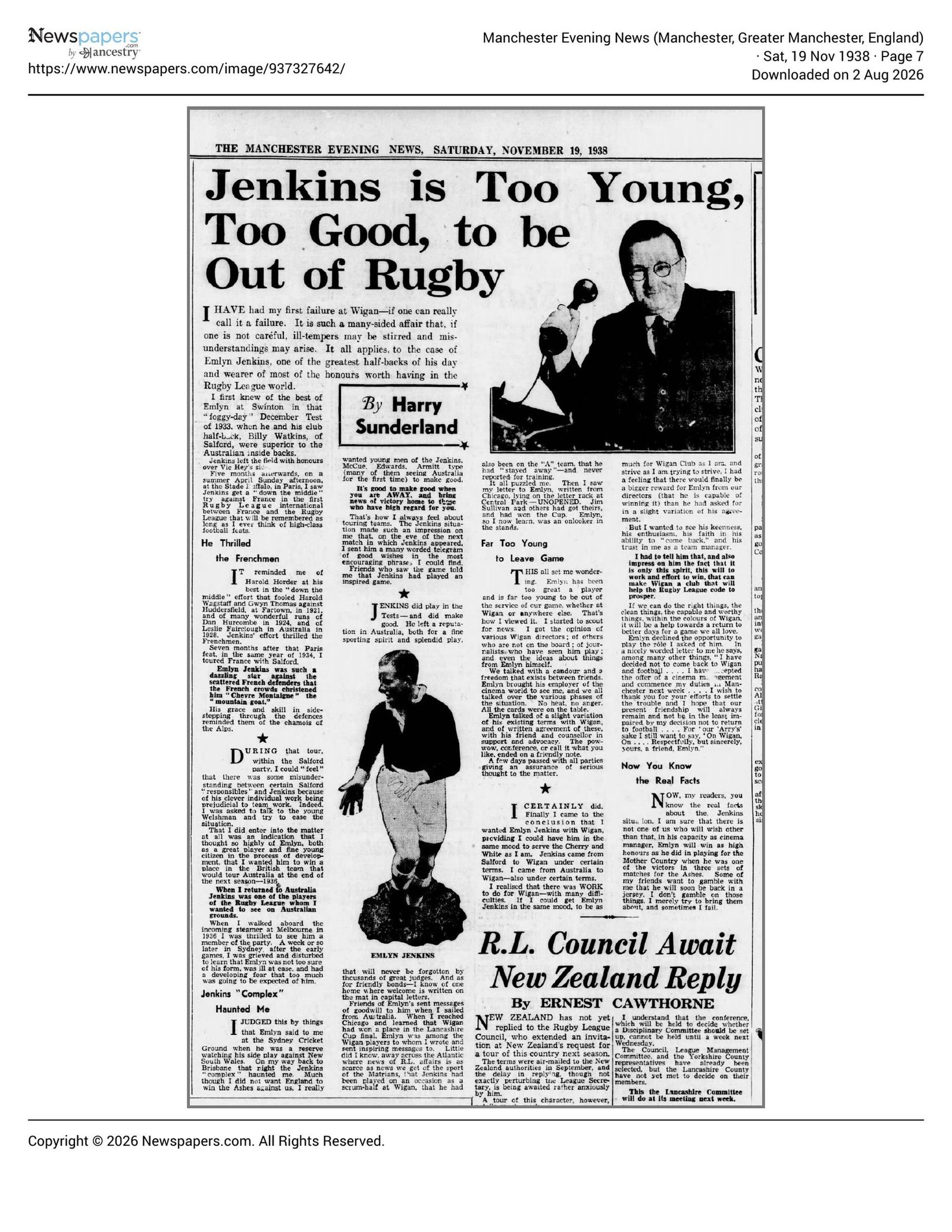
"Jenkins is Too Young, Too Good, to be Out of Rugby"
Harry Sunderland's response to the retirement, printed the day after the news broke, running most of a page under two photographs of Emlyn. Sunderland, by then the Wigan manager, calls it his first failure at Wigan and traces their acquaintance from the beginning: the foggy December Test at Swinton in 1933, where Emlyn and Billy Watkins were superior to the Australian inside backs; the first France against England international at the Stade Buffalo in April 1934, where Emlyn scored a down-the-middle try that Sunderland ranked among the finest football feats he had seen. Seven months after Paris, on Salford's own tour of France, Emlyn was such a dazzling star against the scattered French defenders that the crowds christened him Chèvre Montaigne, the mountain goat, his sidestepping reminding them of the chamois of the Alps. This is the fullest of Sunderland's three accounts of the nickname and the one that dates it. He also describes a misunderstanding within the Salford club, where some thought Emlyn's individual brilliance came at the cost of team play, and admits he had been asked to talk to the young Welshman about it. The piece closes with Sunderland's plea that at twenty-seven Emlyn was too good and far too young to leave the game, and his failure to talk him out of the cinema job.
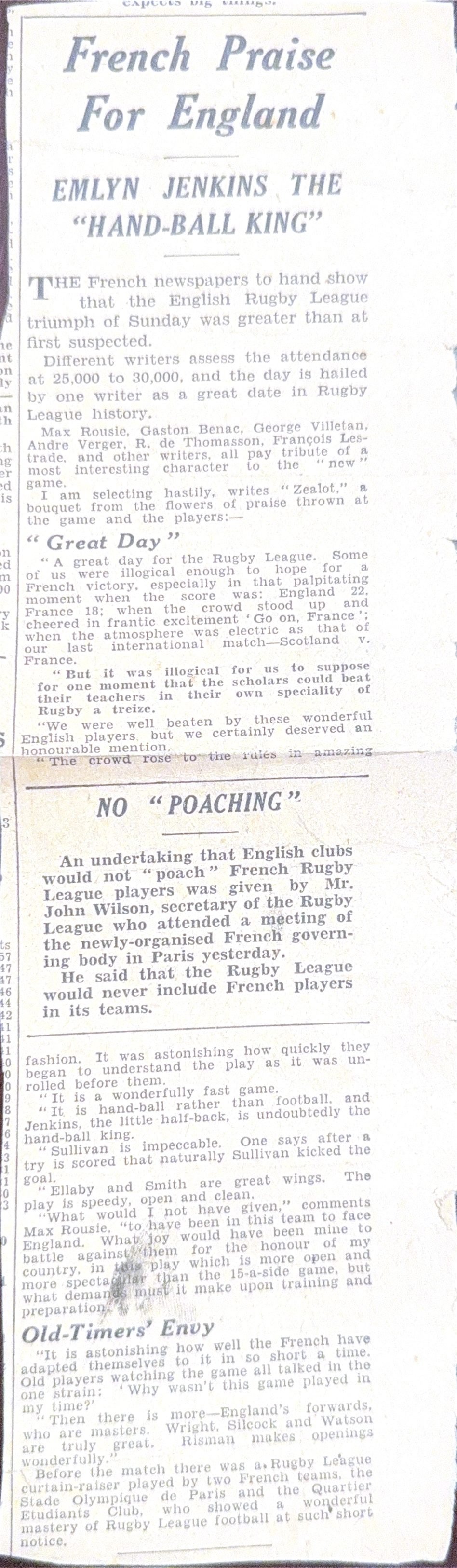
“French Praise For England: Emlyn Jenkins the Hand-Ball King”
Reports on France’s first ever international rugby league match, at the Stade Buffalo in Paris on 15 April 1934. Gathers the reaction of the French sporting press, including the line that gives the cutting its headline. A separate item alongside records an undertaking that English clubs would not poach French players.
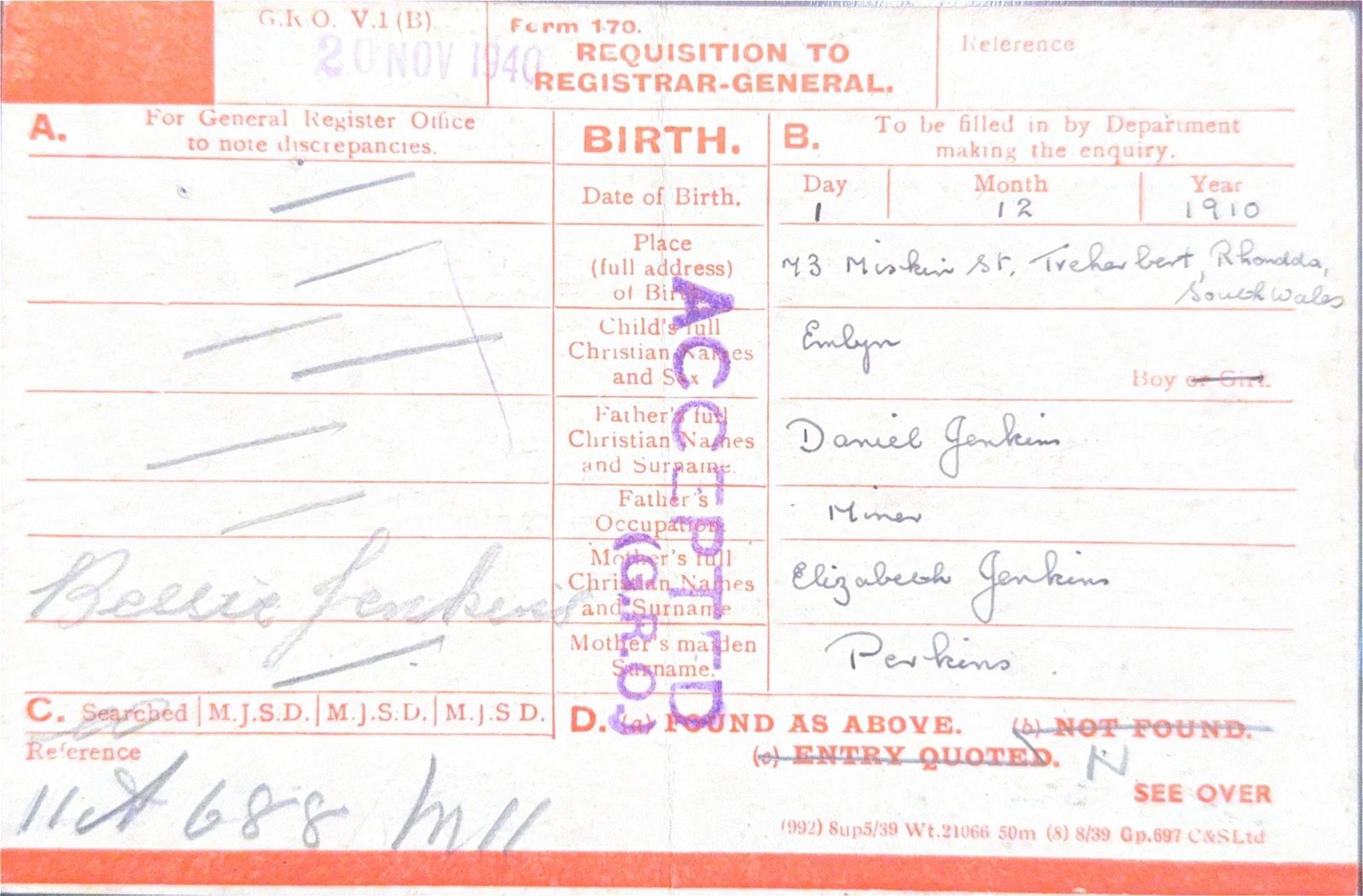
Requisition to the Registrar-General
A wartime government check of Emlyn’s birth entry, stamped accepted and found as above. The date and parents match his birth certificate exactly. It gives his place of birth as 73 Miskin Street, since confirmed by May's 1911 memorial card, which prints the same address. The family were living at 61 Miskin Street by 1928, so they moved along the street at some point between 1911 and then.
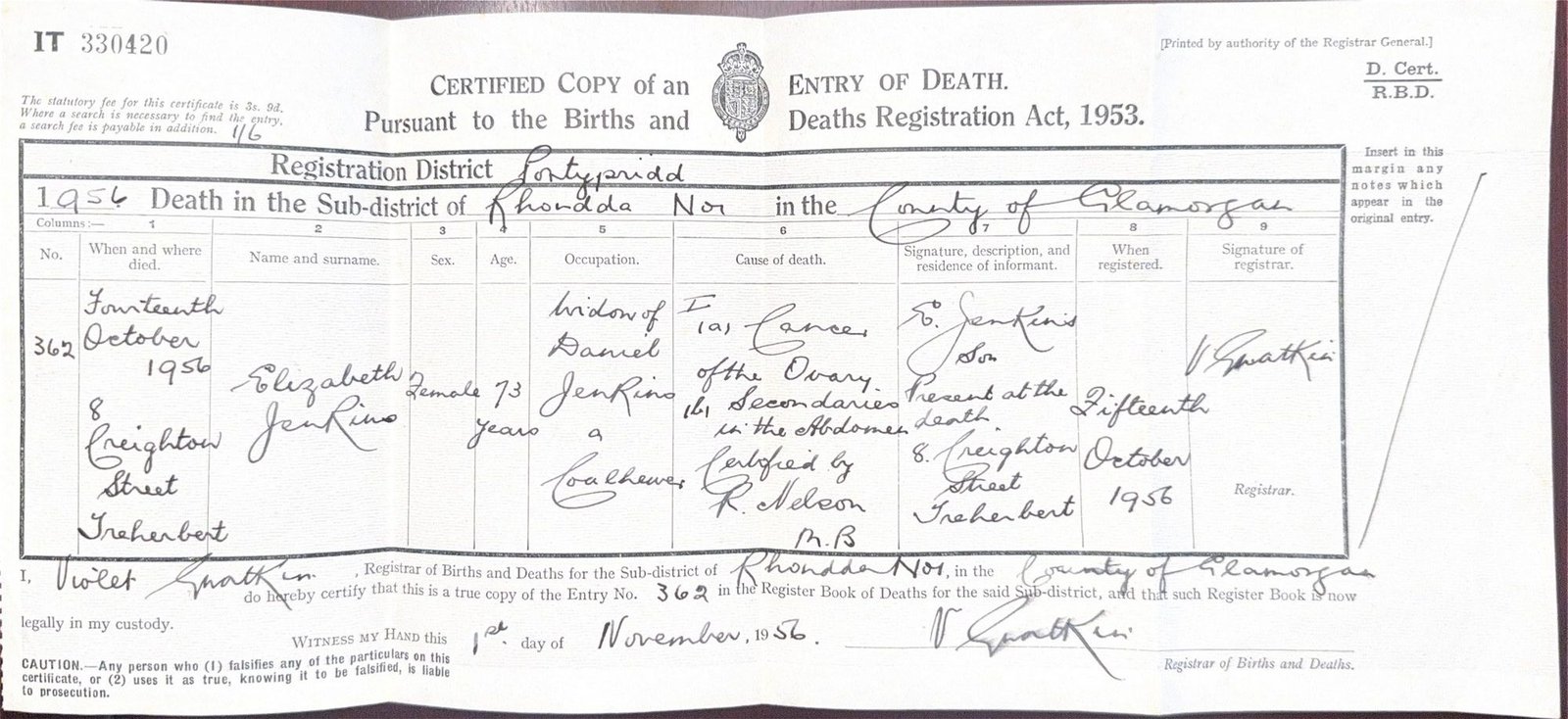
Death of Elizabeth Jenkins
Bessie died of ovarian cancer aged seventy-three, at her son’s house rather than her own. Emlyn was present at the death and was the informant, as he had been for his father twenty-three years earlier.
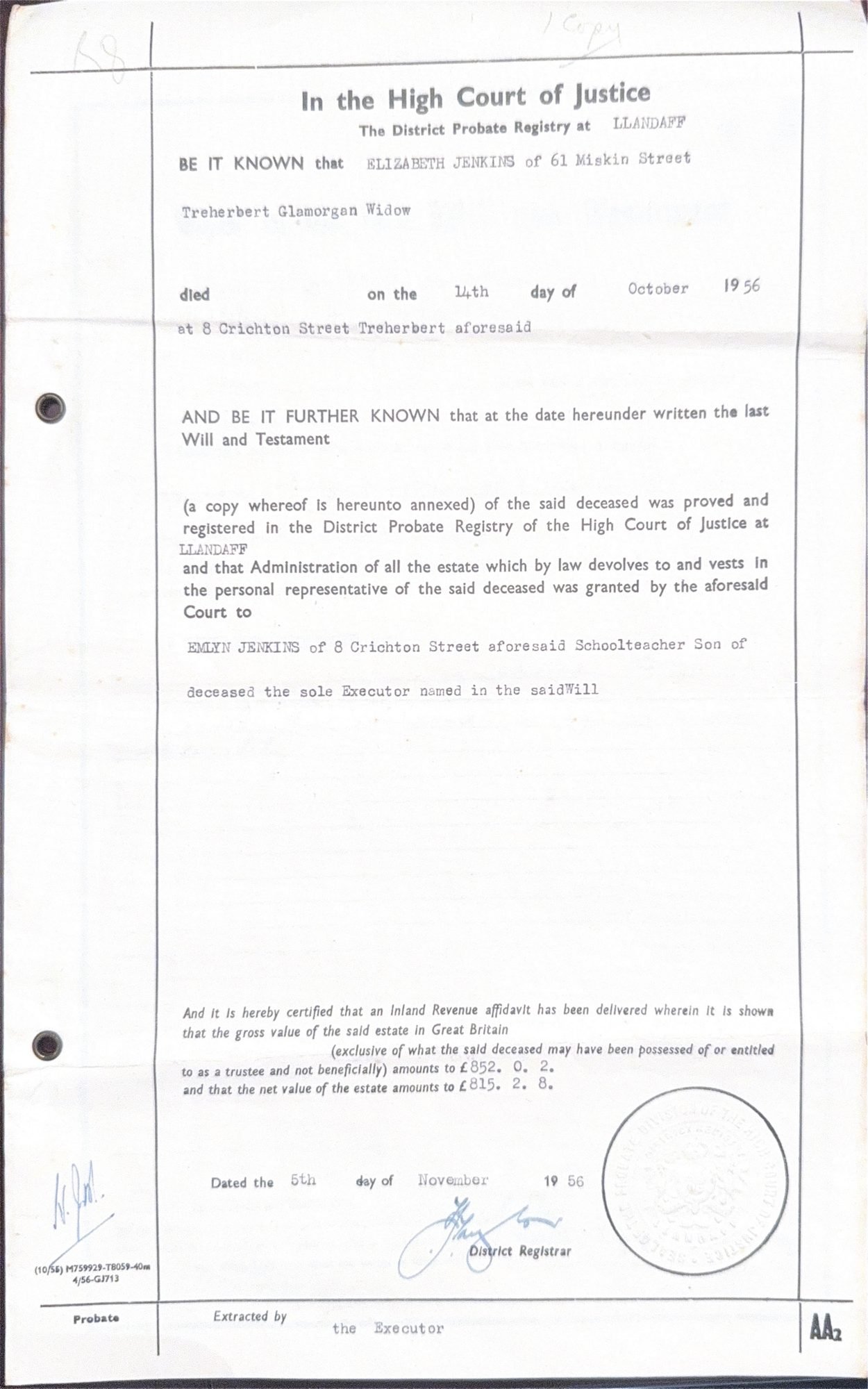
Will and probate of Elizabeth Jenkins
Bessie left everything in equal shares to her three surviving children, Emlyn, Gwenny and Danny, and named Emlyn as her sole executor, describing him as a schoolteacher of 8 Crichton Street. The estate came to £852. A memorandum on the final page records the leasehold of 61 Miskin Street being assigned away that December, closing the family’s time in the house.
View full scan Used in: Treherbert
Pages: p1 p2 p3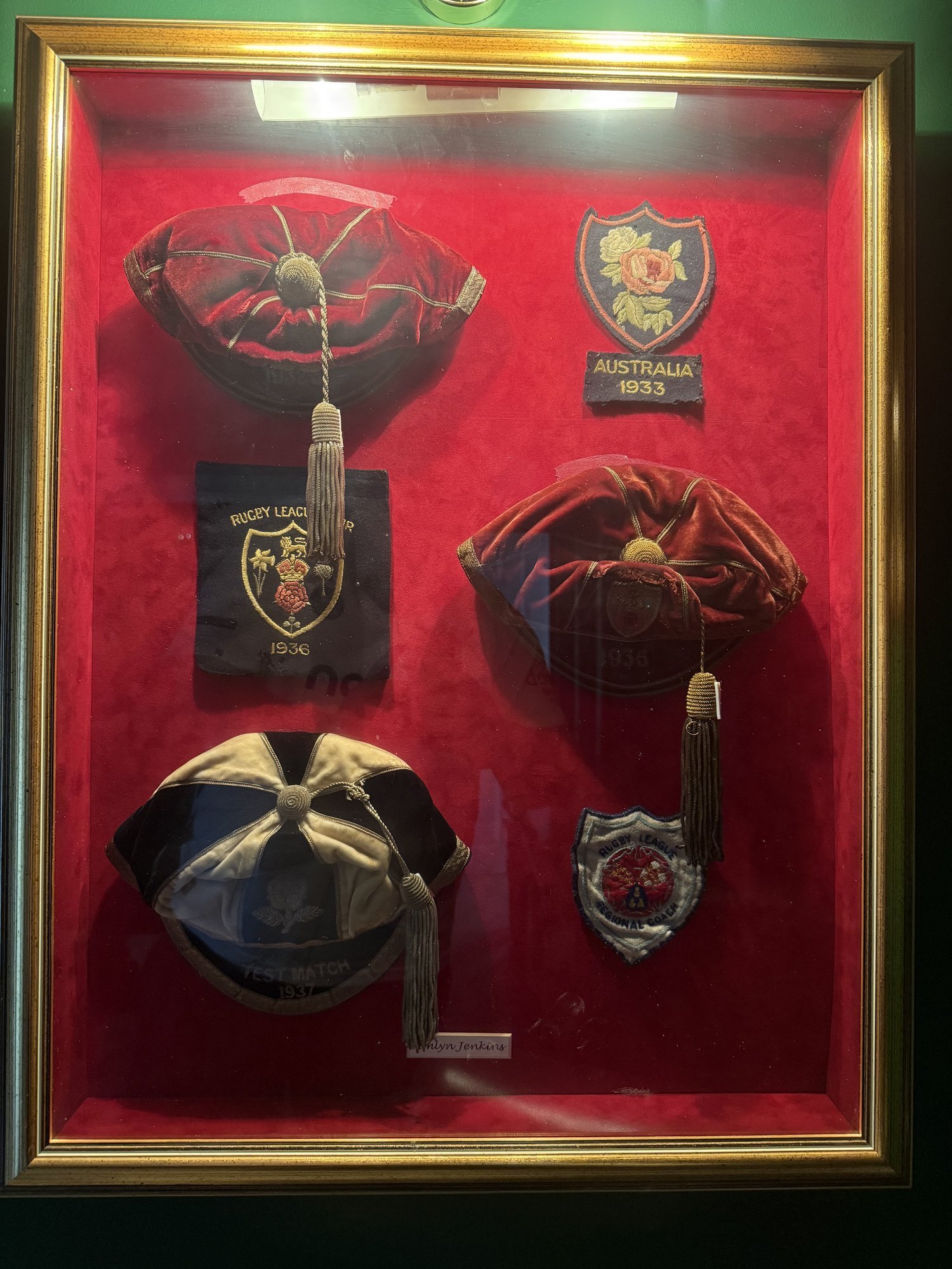
Framed caps and badges
The surviving portion of Emlyn's playing honours, after he gave most of his caps and medals to pupils at Tylney Hall. Visible: a badge marked Australia 1933, most likely a Test cap badge for facing the touring Australians that year rather than a tour cap; a maroon touring cap, probably from the 1936 tour itself; a black and cream cap marked Test Match 1937; and a Rugby League Regional Coach badge from his later coaching career.
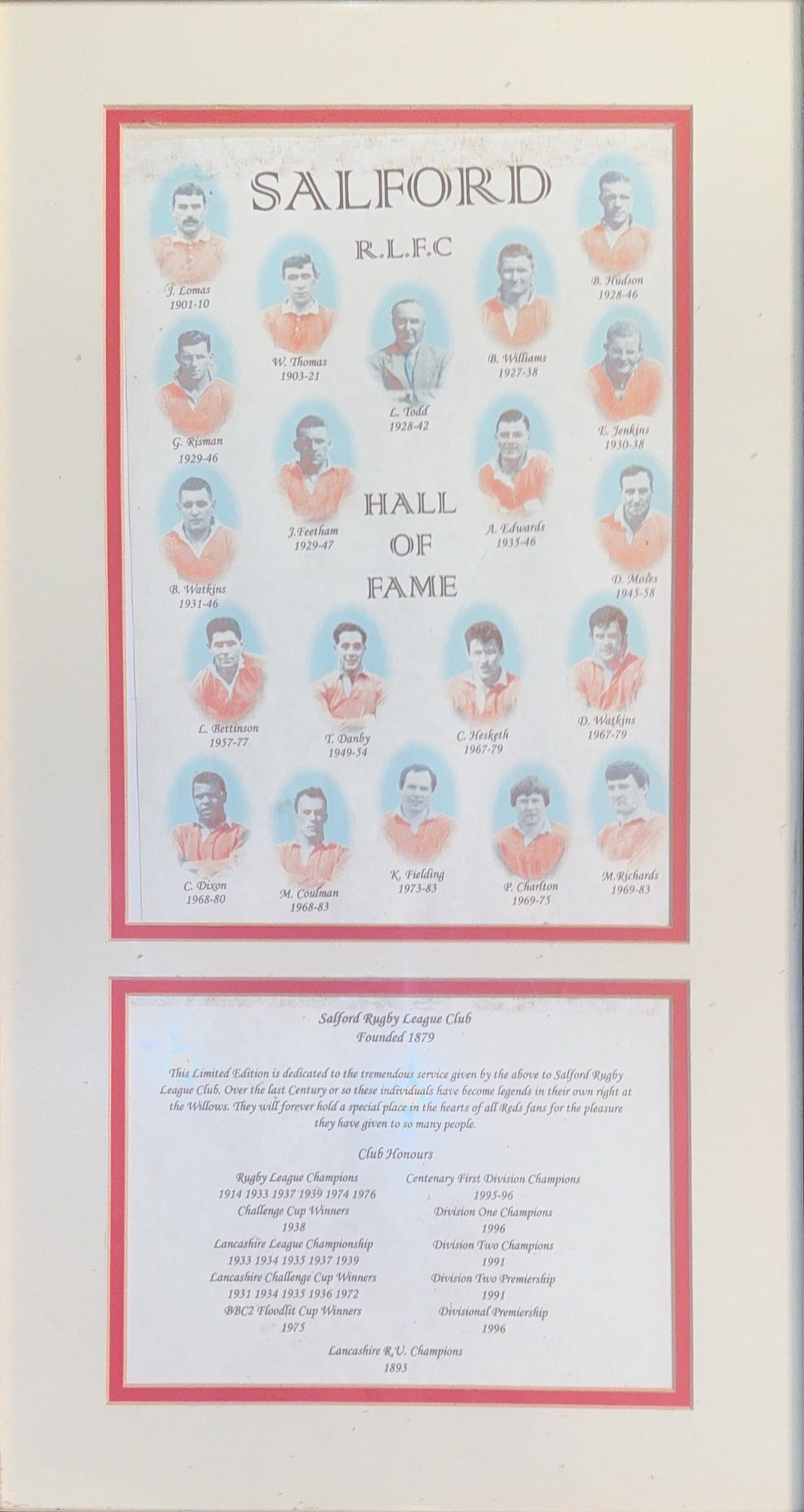
Salford RLFC Hall of Fame print
A limited-edition print naming Emlyn among Salford's all-time greats, 1930–38, alongside Gus Risman, Barney Hudson, Lance Todd and others. Lists the club's honours, including the 1938 Challenge Cup win that came two months after Emlyn had already left for Wigan.
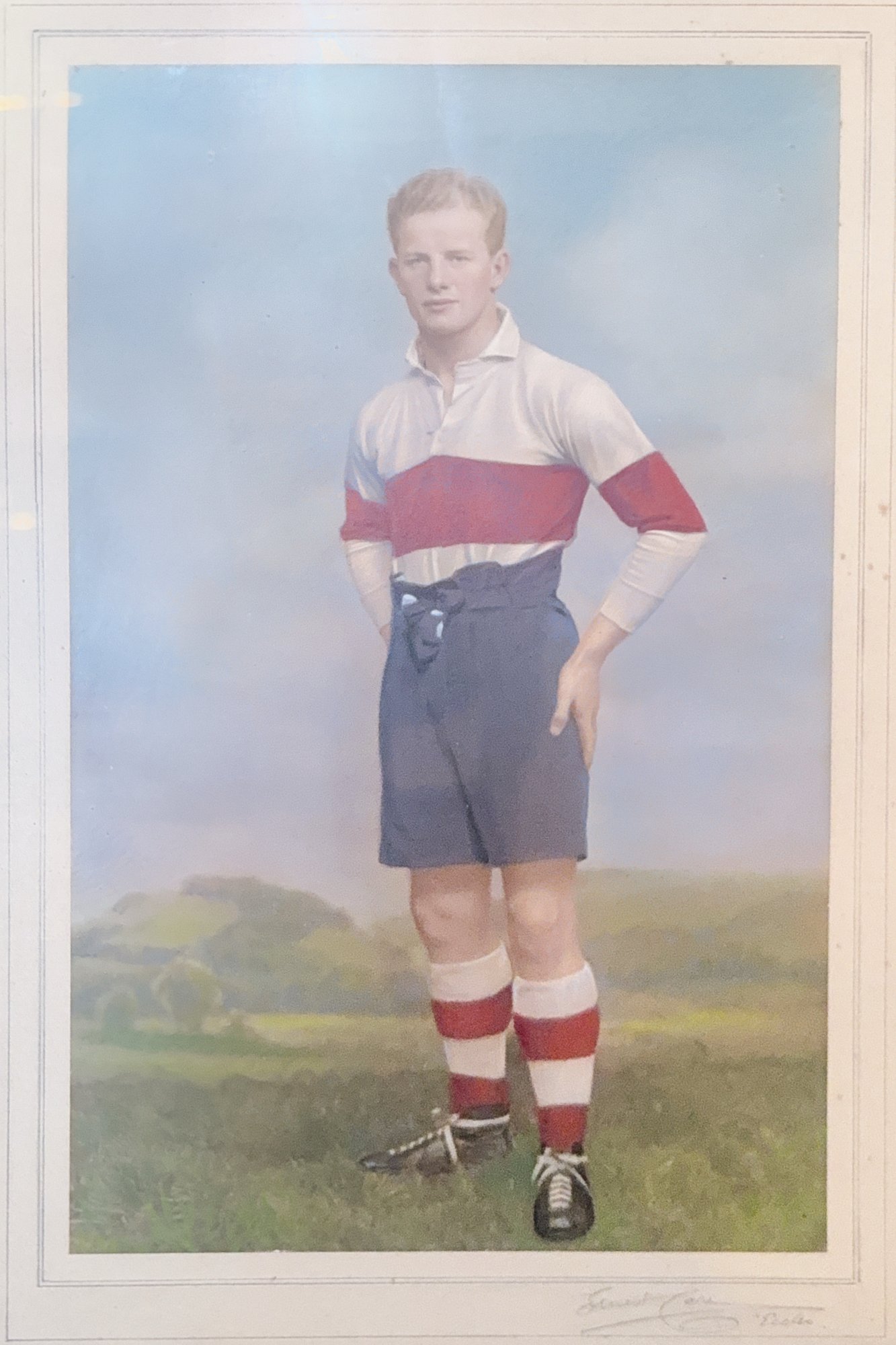
Studio portrait in rugby kit
A studio portrait, hand-tinted in the style common to the era. The family believes this shows Emlyn in Glamorgan county colours, in the last stretch of his amateur career before he turned to rugby league.
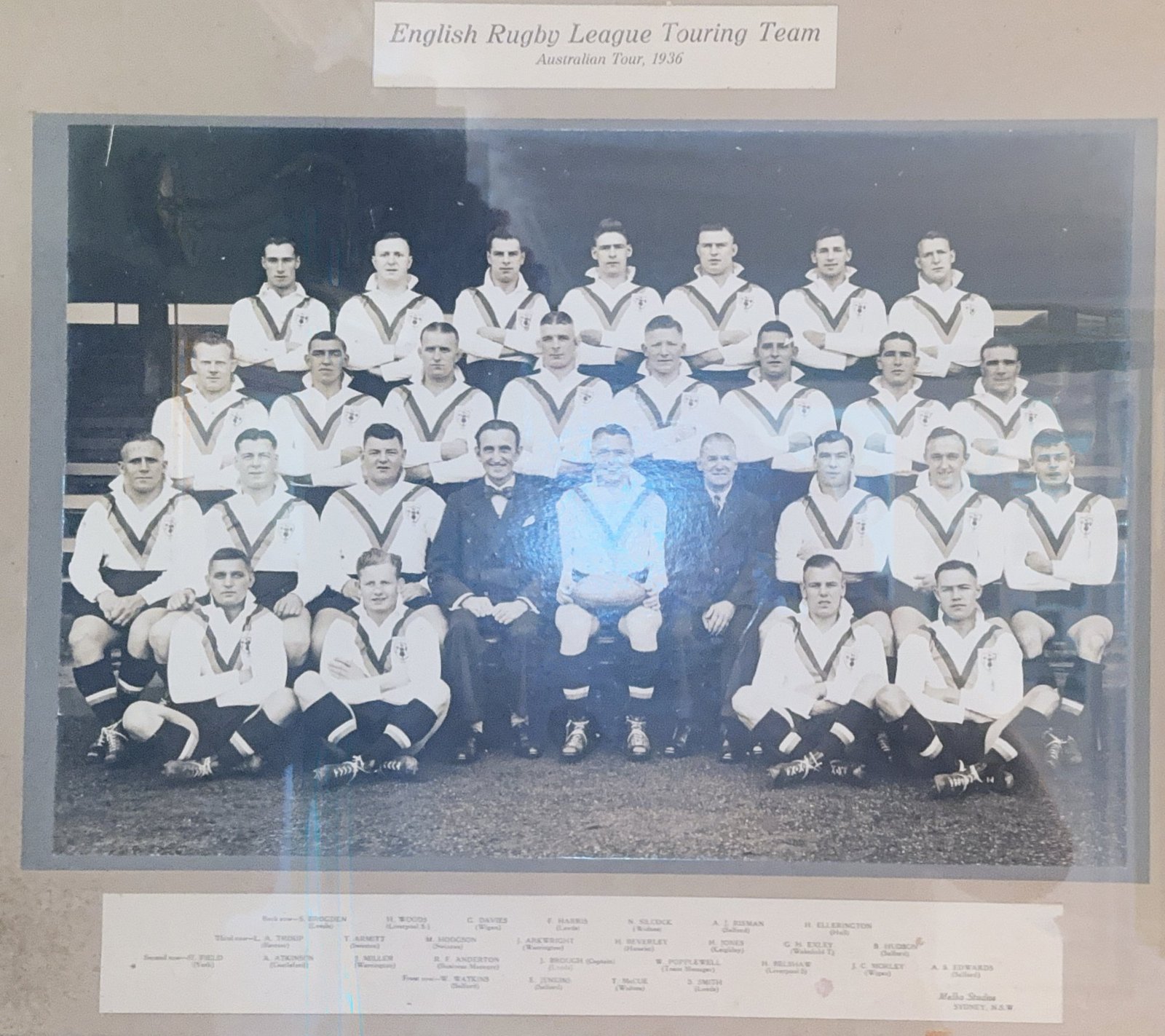
1936 touring team photograph
The full touring party for the 1936 Great Britain tour of Australia and New Zealand, with a printed list of every player and official beneath the photograph. Emlyn and his Salford half-back partner Billy Watkins sit together in the front row. The first photograph to fill what had been an empty placeholder on this site since it launched.
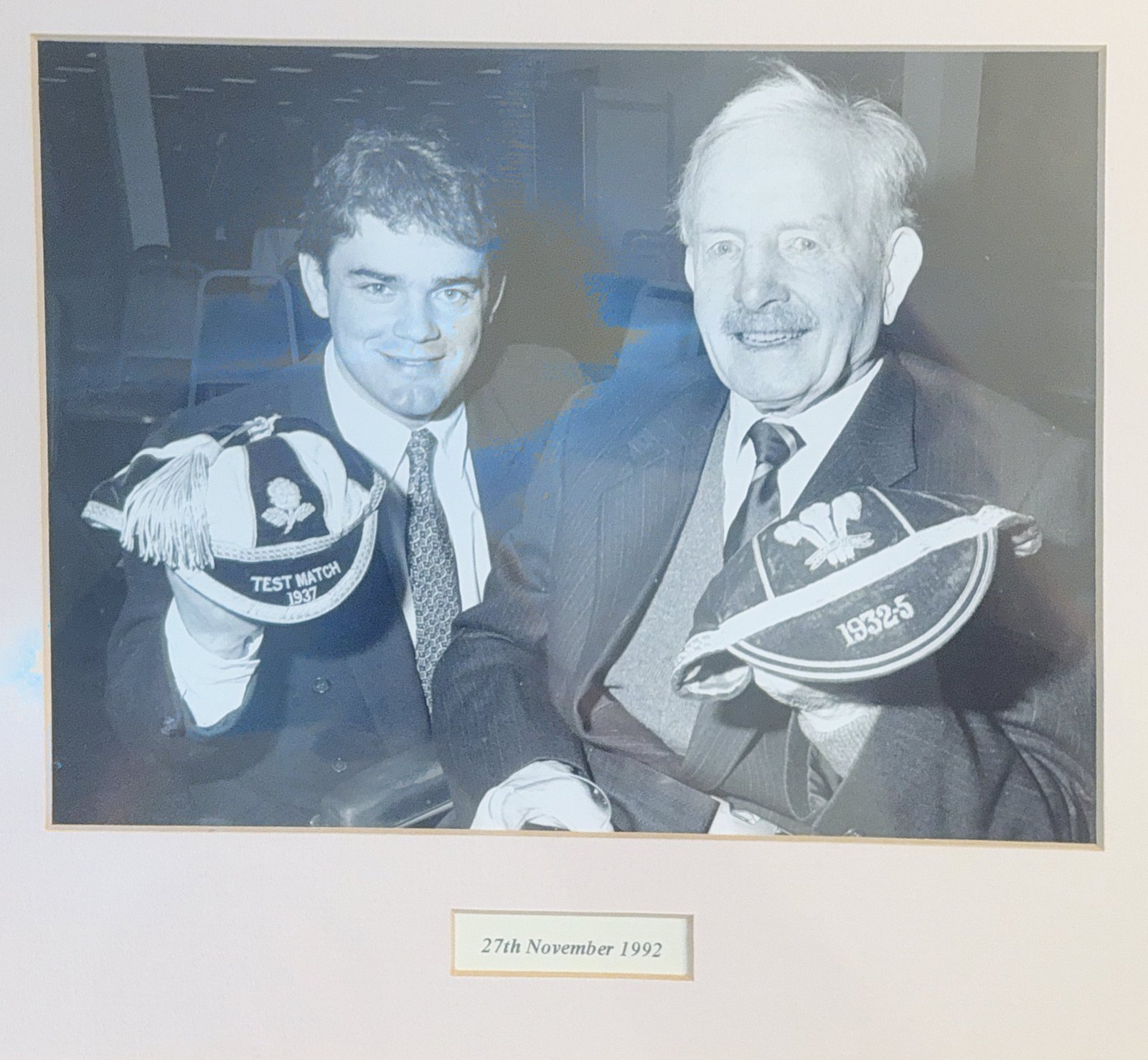
Andover RFC, 27 November 1992
Emlyn pictured with Will Carling, the England captain of the day, at an event Carling hosted at Andover Rugby Football Club, not quite a year before Emlyn died. Each man holds one of Emlyn's own caps for the photograph: a 1932–5 Wales cap and a 1937 Test Match cap.
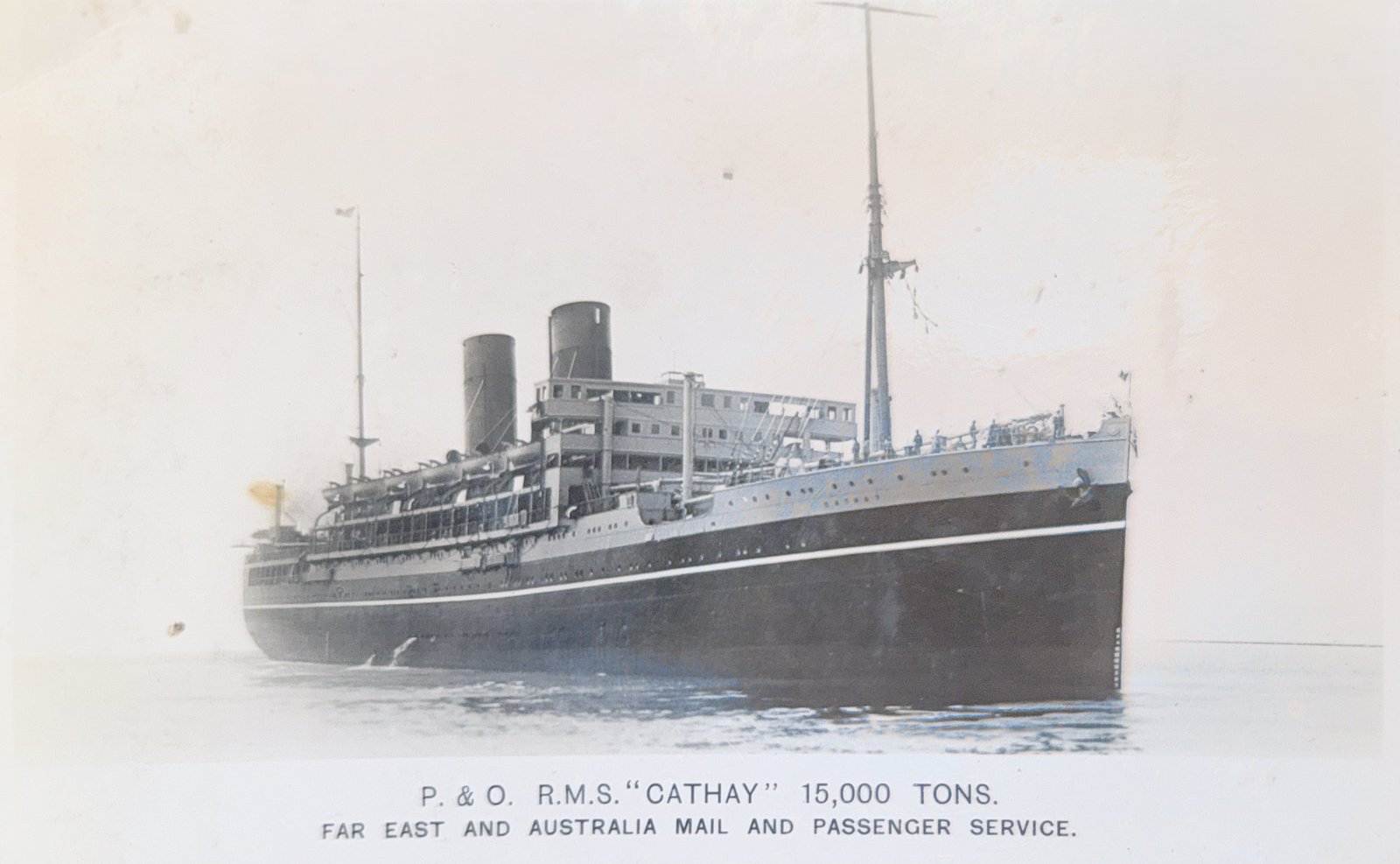
Postcard of the P&O R.M.S. Cathay
Kept by Emlyn from the 1936 tour. Most of the touring party sailed from Tilbury on 17 April 1936 aboard the Cathay, arriving in Melbourne on 25 May.
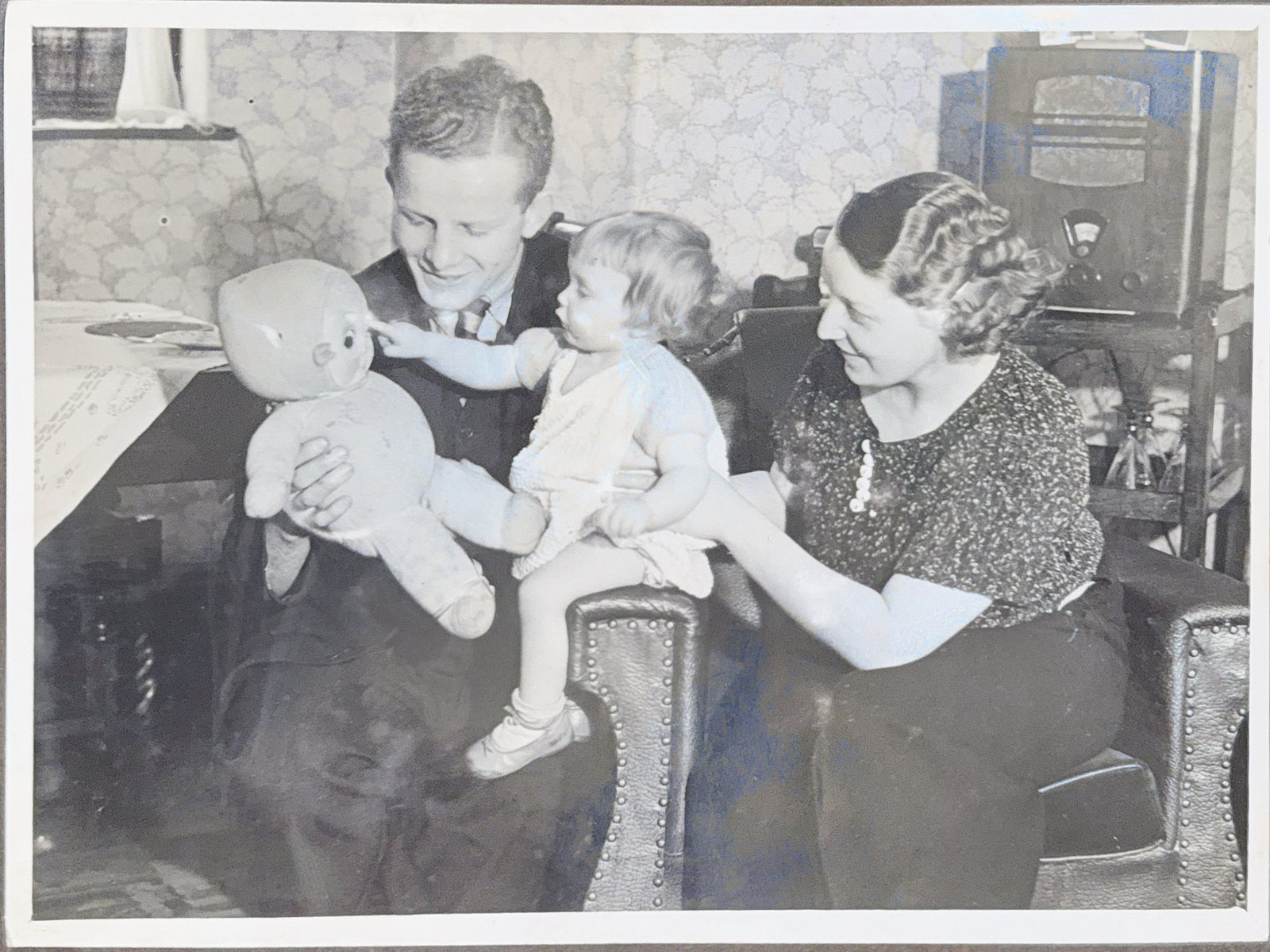
Emlyn, Kathleen and baby Patricia
Taken, the family says, on the day Emlyn learned he'd been selected for the 1936 tour. Patricia, known as Pat, was Emlyn and Kathleen's eldest daughter.
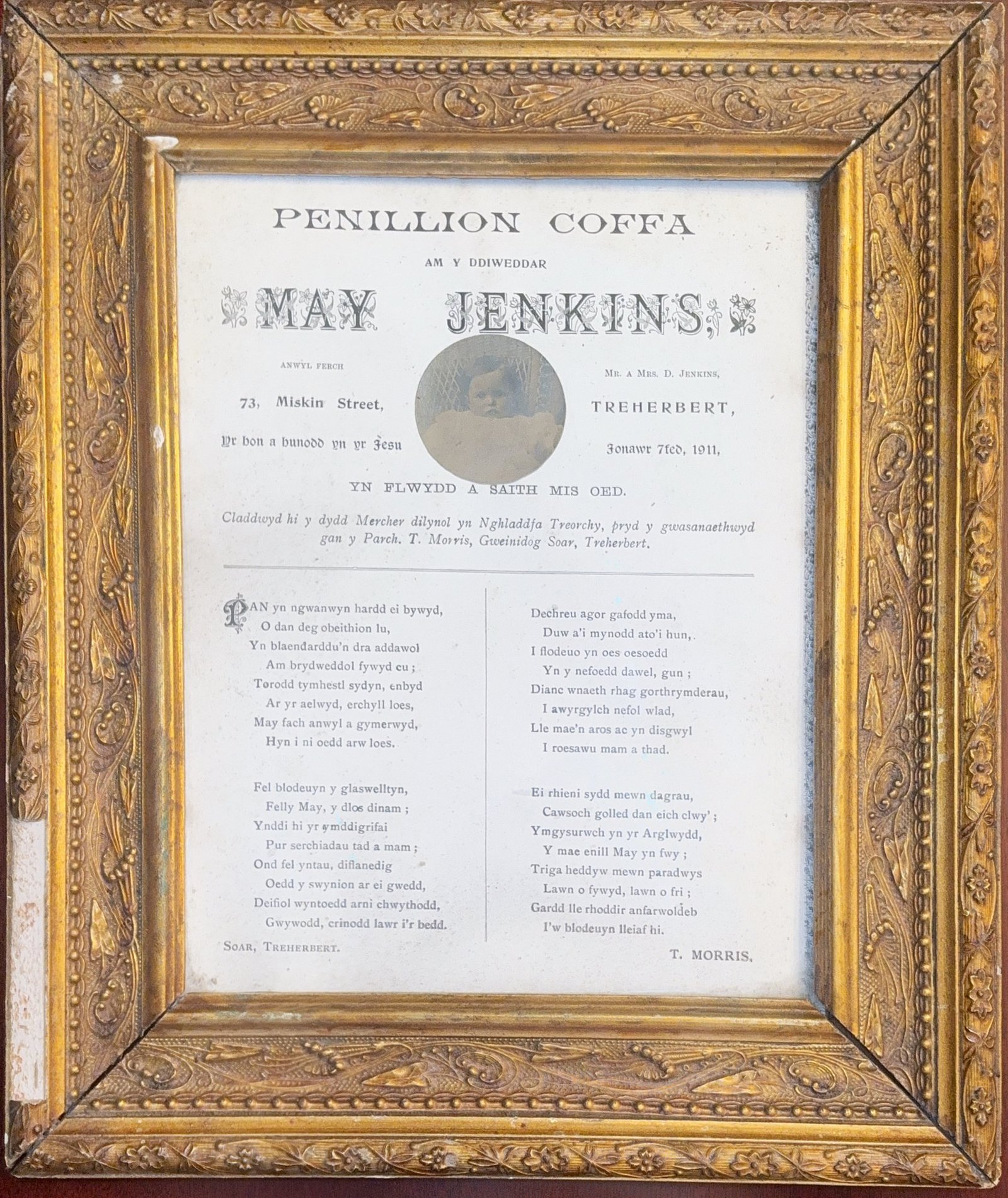
May Jenkins's memorial card
Confirms May died on 7 January 1911, aged one year and seven months, buried at Treorchy Cemetery, service by the Reverend T. Morris of Soar chapel. Corrects the long-held family account that she died just before Emlyn was born; she in fact died about five weeks after. Also confirms the family's address at the time as 73 Miskin Street.
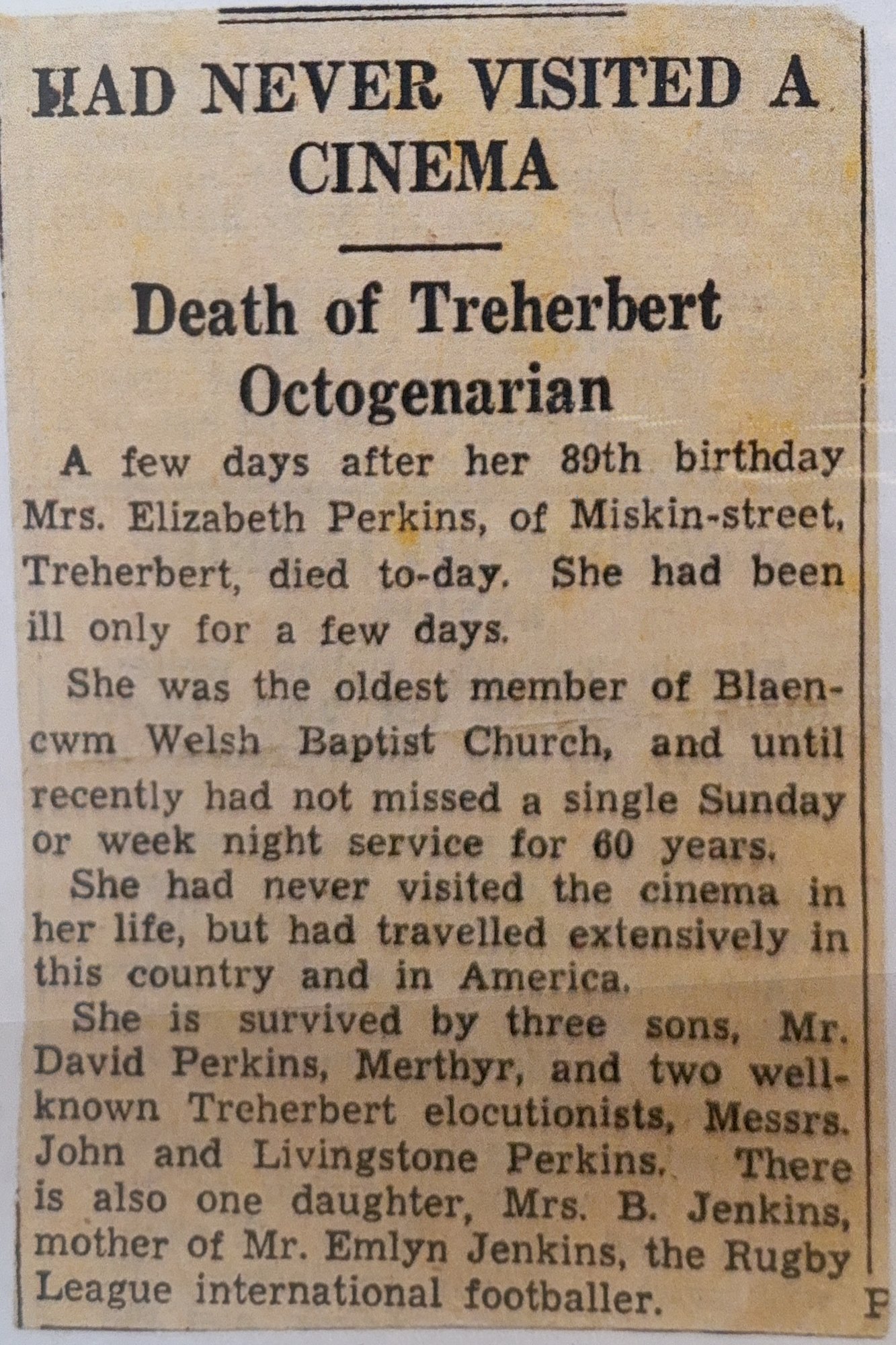
"Had Never Visited a Cinema": obituary of Elizabeth Perkins
Confirms Elizabeth Perkins of Miskin Street, Treherbert, died aged 89, mother of "Mrs. B. Jenkins," Bessie, and so Emlyn's grandmother. Names three surviving sons, David (Merthyr), John, and Livingstone, the latter two well-known local elocutionists. Never visited a cinema in her life, but had travelled widely in Britain and America, and had attended chapel every week for sixty years.
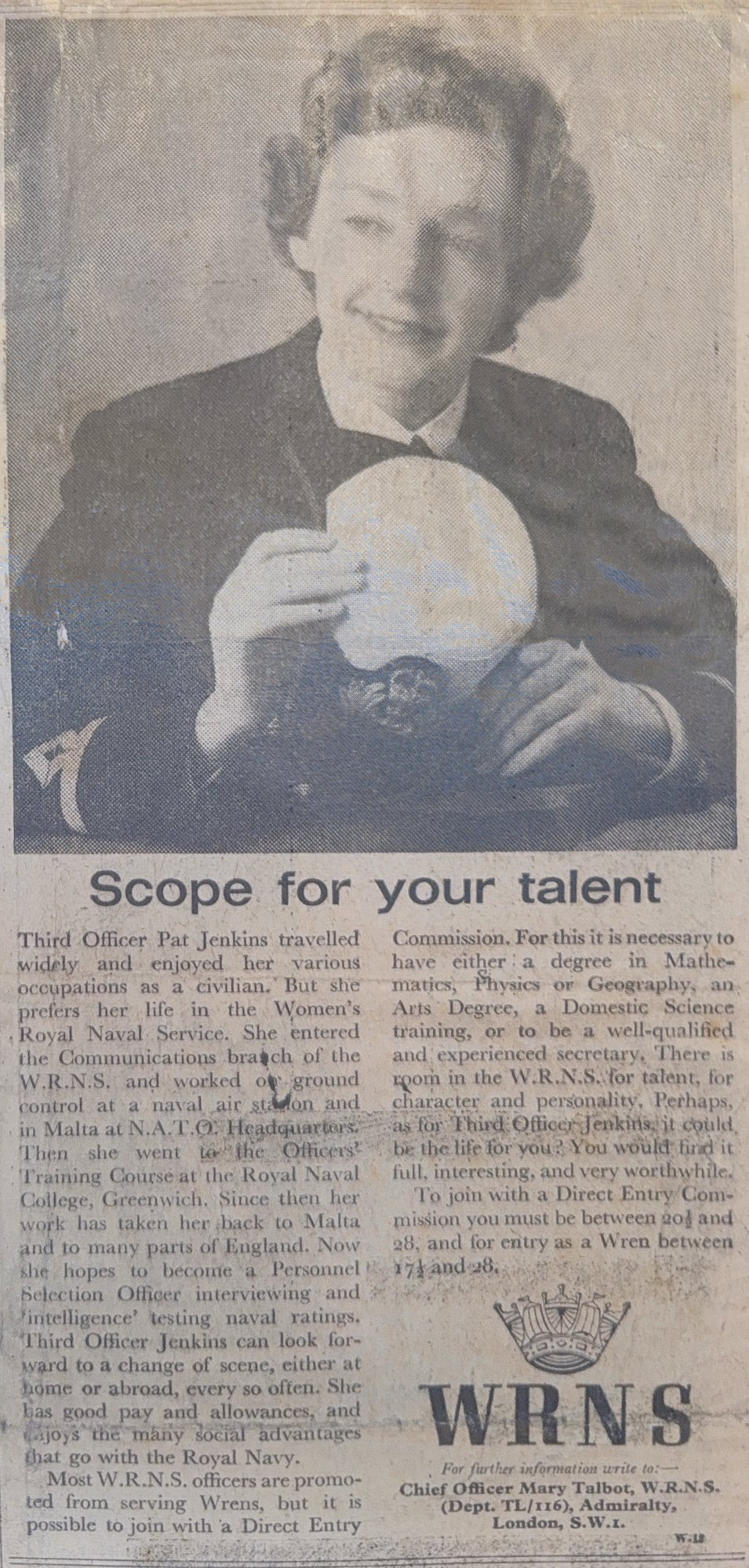
"Scope for your talent": WRNS advertisement
Third Officer Pat Jenkins, Emlyn's eldest daughter, used as the example in a national WRNS recruitment advertisement. Describes her service in the Communications branch, ground control at a naval air station, a posting to NATO Headquarters in Malta, and officer training at the Royal Naval College, Greenwich.
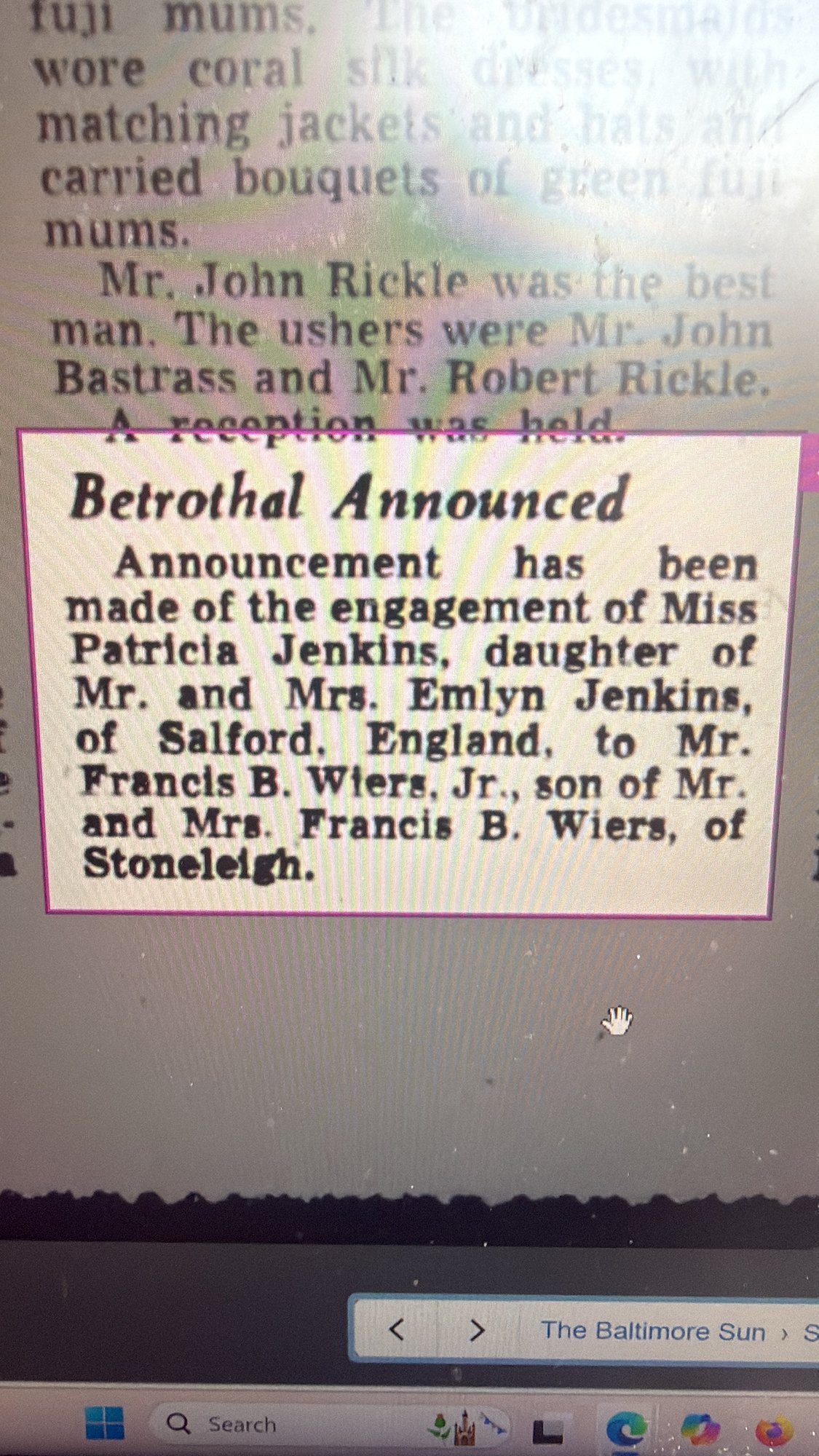
Betrothal announcement
Announces the engagement of Patricia Jenkins, daughter of Mr. and Mrs. Emlyn Jenkins, to Francis B. Wiers, Jr., son of Mr. and Mrs. Francis B. Wiers of Stoneleigh. The marriage never took place; Pat never married. Her WRNS career likely brought her into contact with American service circles.
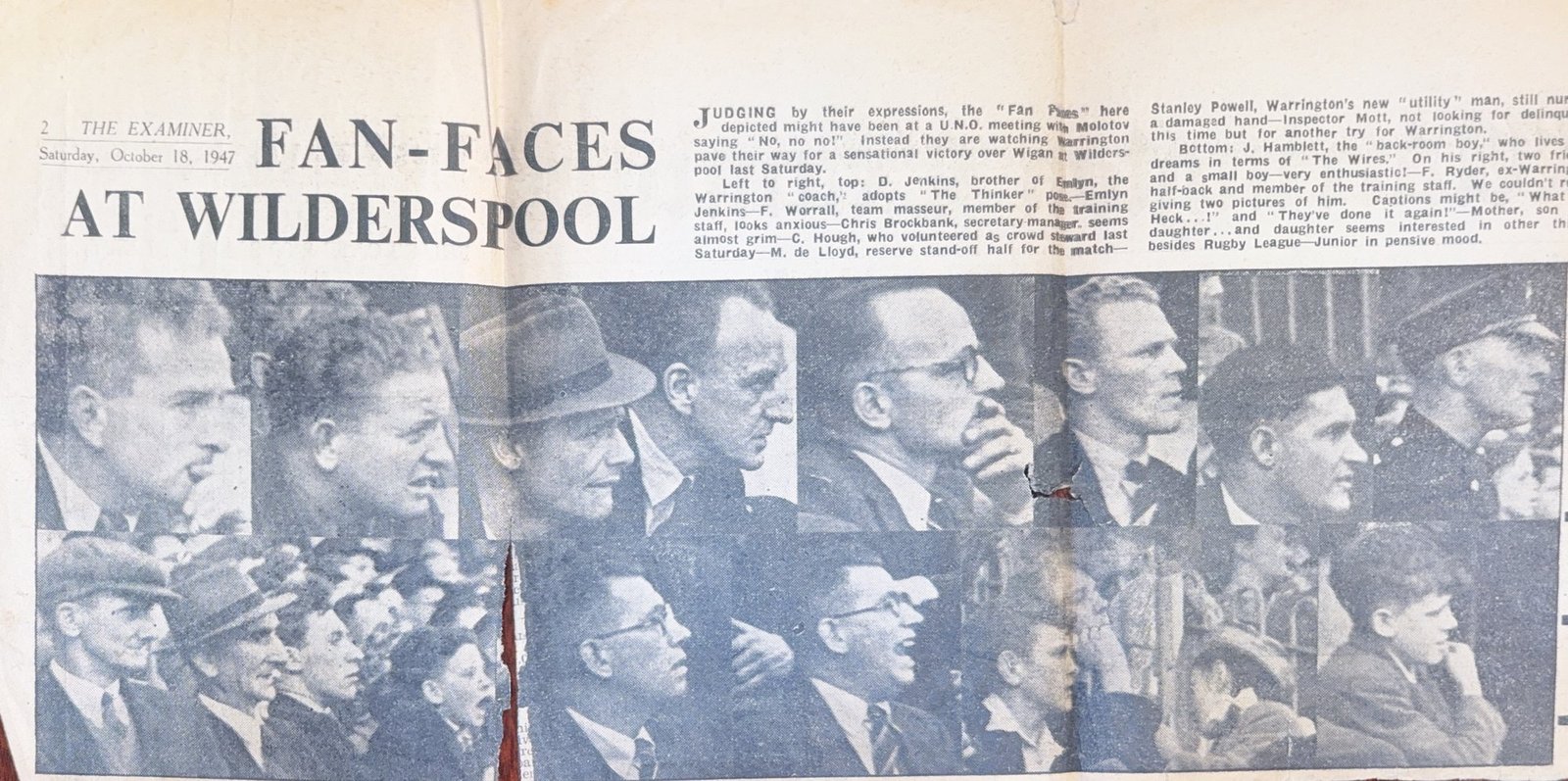
"Fan-Faces at Wilderspool"
A lighthearted feature photographing spectators at Warrington's win over Wigan. Captures Emlyn, by then Warrington's coach, and identifies the man beside him in print as "D. Jenkins, brother of Emlyn," the only newspaper sighting of Danny found so far.
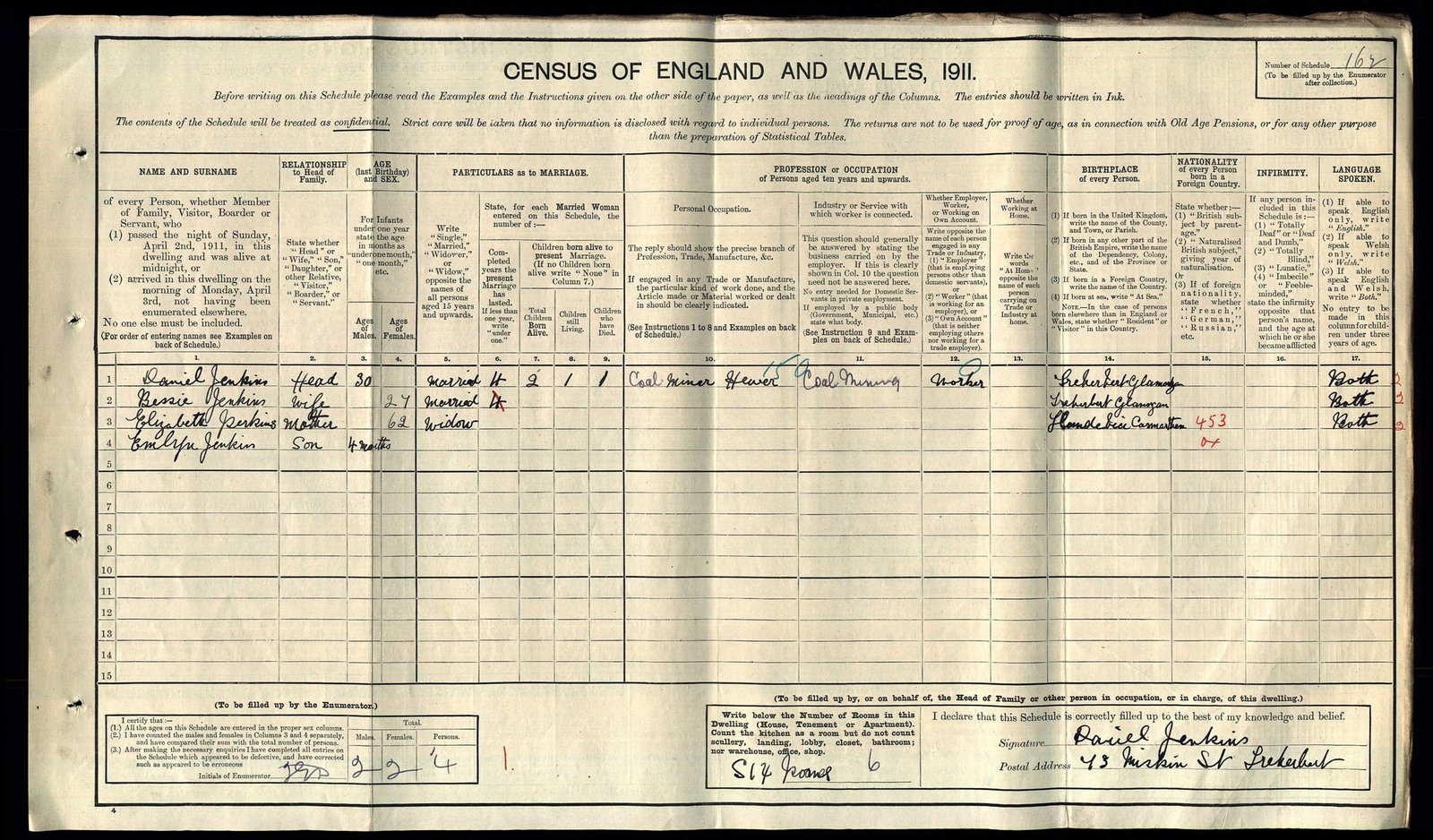
1911 Census: the Jenkins household
Taken 2 April 1911, three months after Emlyn's birth and signed by Daniel himself. Records the household as Daniel (30), Bessie (27), Elizabeth Perkins (62, widow, Bessie's mother, born Llandybie, Carmarthenshire), and Emlyn (4 months). The marriage is recorded as four years old, with two children born and one already died, matching May exactly. This is the strongest evidence yet that Elizabeth Perkins was the Welsh-speaking grandmother the family remembers as Gu.
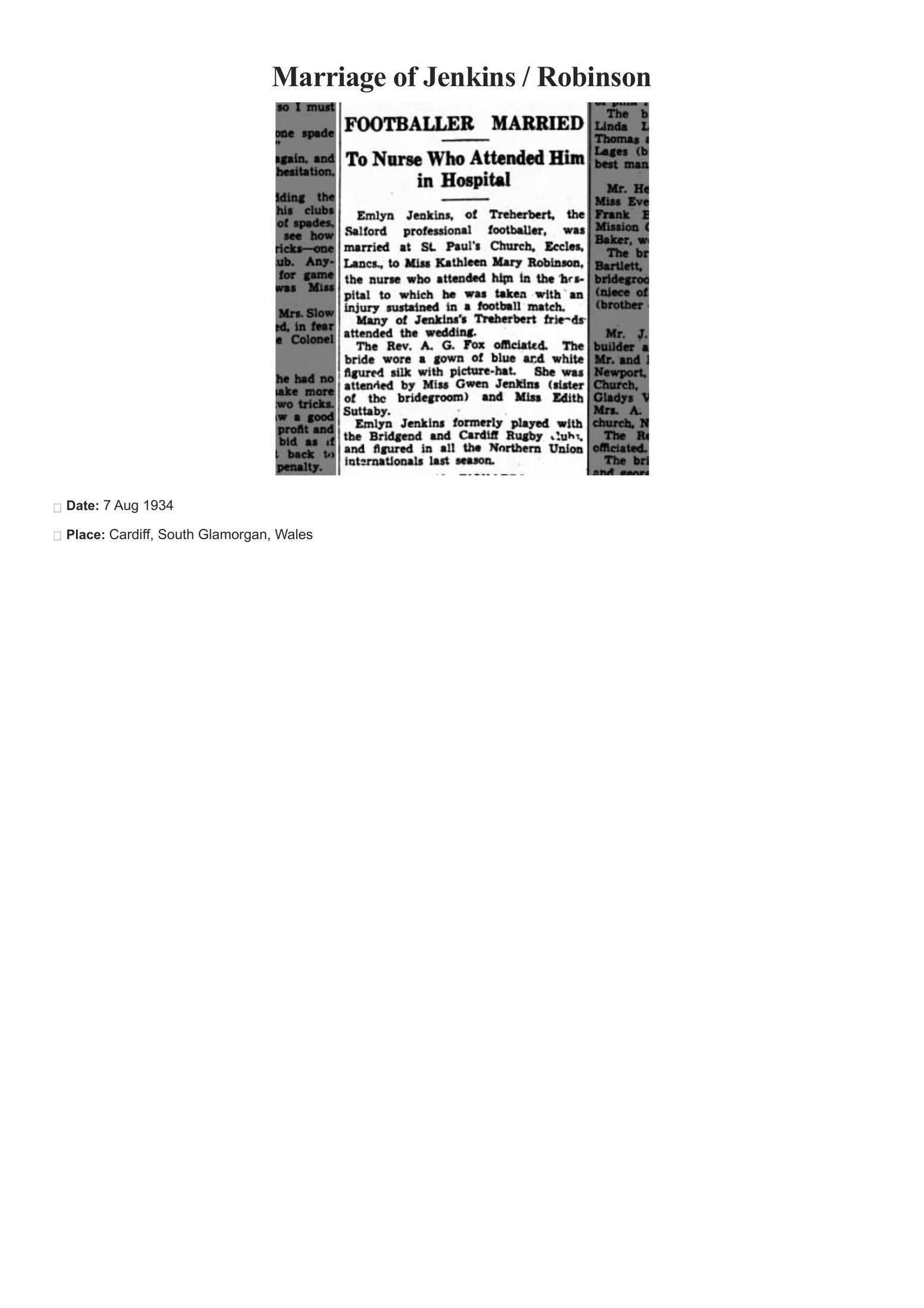
"Footballer Married": the wedding announcement
Confirms the marriage date and venue precisely: 7 August 1934, St Paul's Church, Eccles, Lancashire. Gives a different account of how they met than family memory does, that Kathleen was the nurse who treated a football injury of Emlyn's in hospital, rather than the pink-hat afternoon tea. Names a second bridesmaid, Edith Suttaby, not yet otherwise identified, alongside Gwenny.
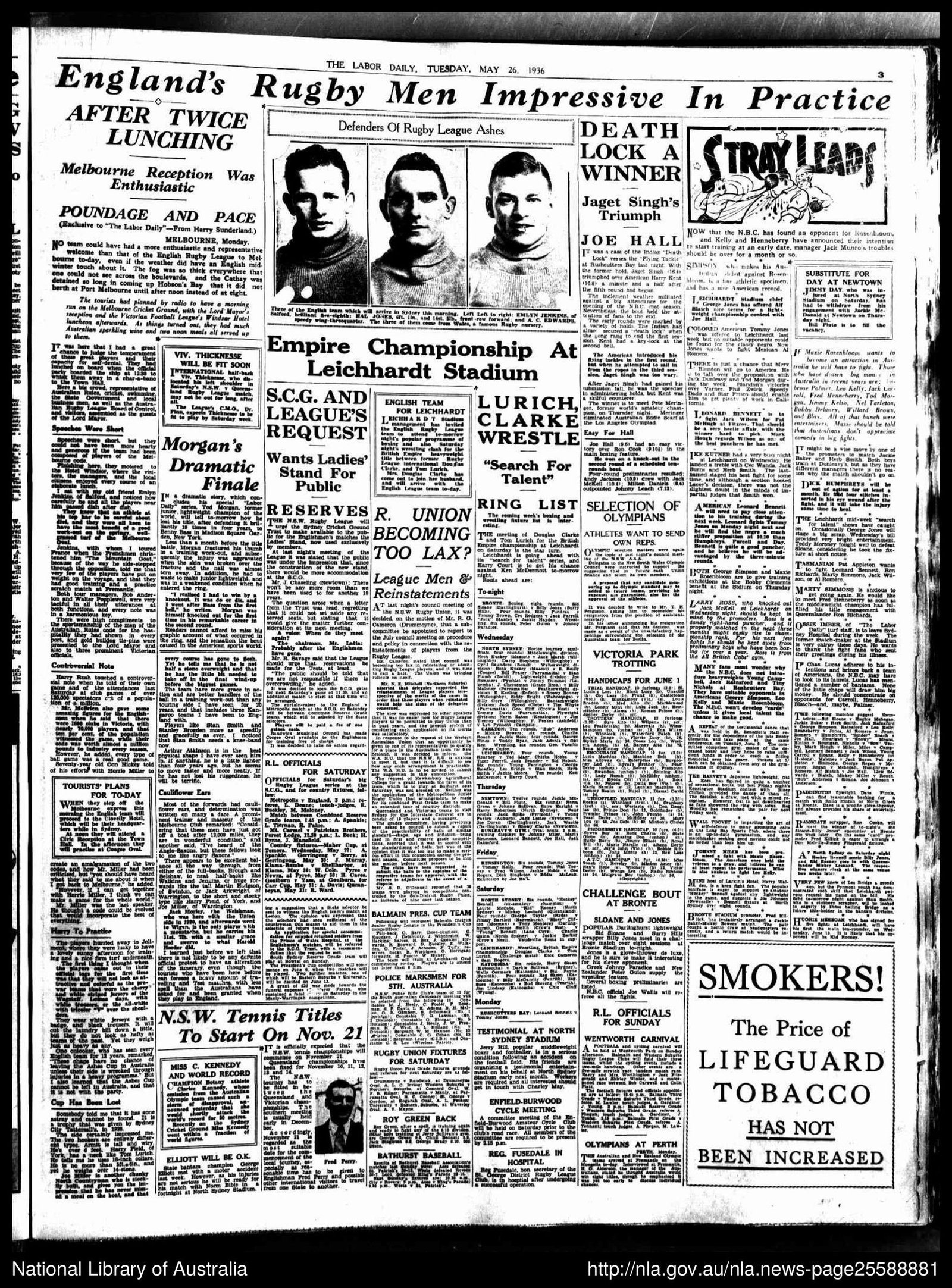
"England's Rugby Men Impressive in Practice": arrival in Melbourne
Harry Sunderland's despatch from Melbourne on the touring party's arrival aboard the Cathay, delayed by fog so thick on Hobson's Bay that she did not berth at Port Melbourne until after noon instead of eight. This is the article that records where the Mountain Goat nickname came from: Sunderland writes of "my old friend Emlyn Jenkins, of Salford," with whom he toured France "when the Frenchmen christened him 'The Mountain Goat', because of the way he side-stepped through the opposition." It also catches Emlyn's discipline at the Lord Mayor's lunch, carefully passing dish after dish, and reports his verdict that very few of the players had put on weight on the voyage. Emlyn is one of three players photographed at the head of the page.
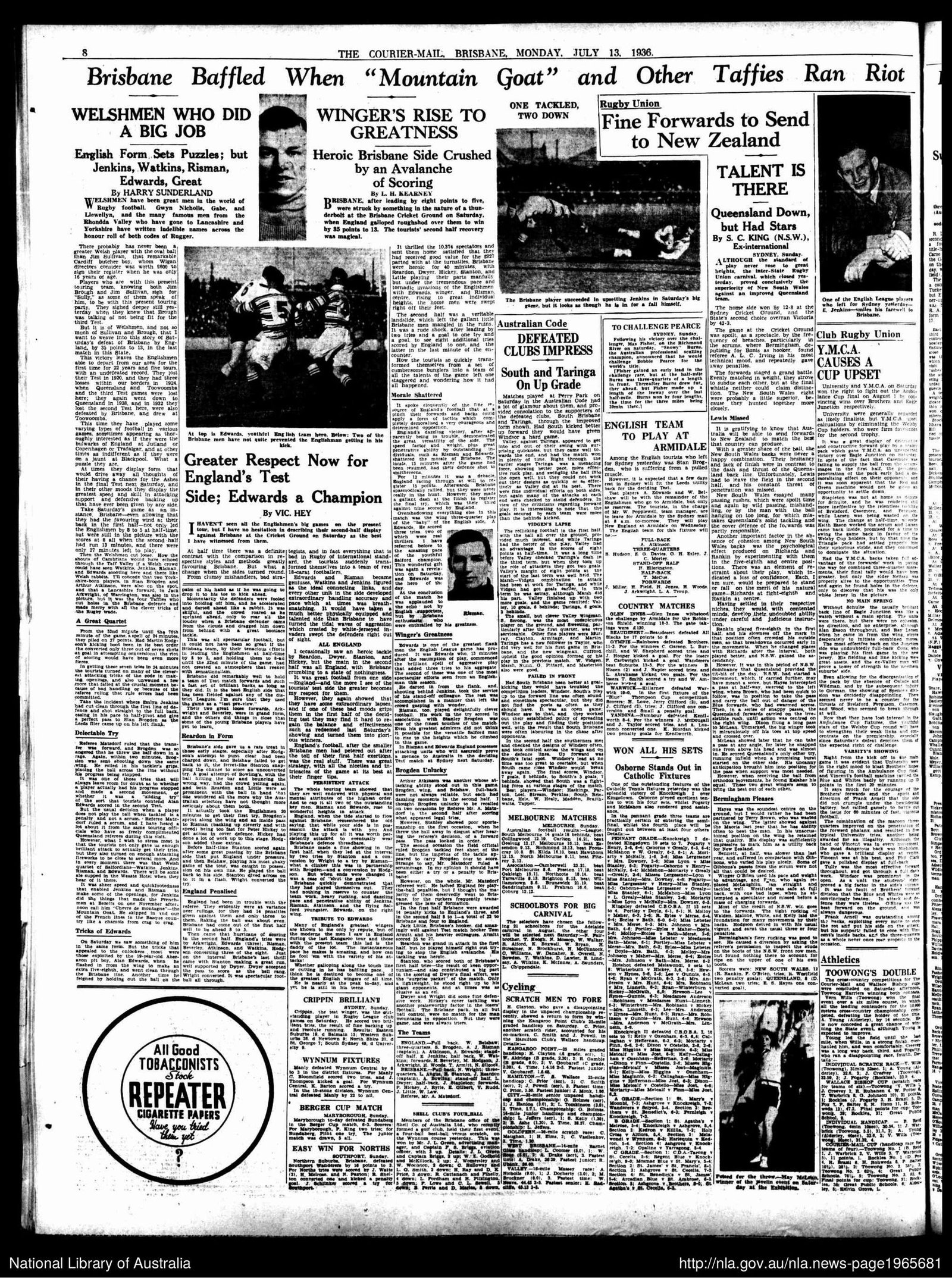
"Brisbane Baffled When 'Mountain Goat' and Other Taffies Ran Riot"
Three reports on England's 35–13 win over Brisbane on Saturday 11 July 1936, when the tourists scored 27 points in 24 minutes after trailing at half time. Harry Sunderland credits the four Taffies, Watkins, Jenkins, Risman and Edwards, with cutting the holes in the Brisbane defence, and pins down the Mountain Goat nickname more precisely still: the Frenchmen at Béziers, on one November afternoon, called him "Chevre de montagne" for the way he "skipped in and out of the French lines like a chamois from crag to crag." The Australian Test five-eighth Vic Hey contributes his own signed column. The page carries two photographs of Emlyn: an action shot captioned "One tackled, two down," and the portrait of him smiling his farewell to Brisbane as the team left for Sydney.
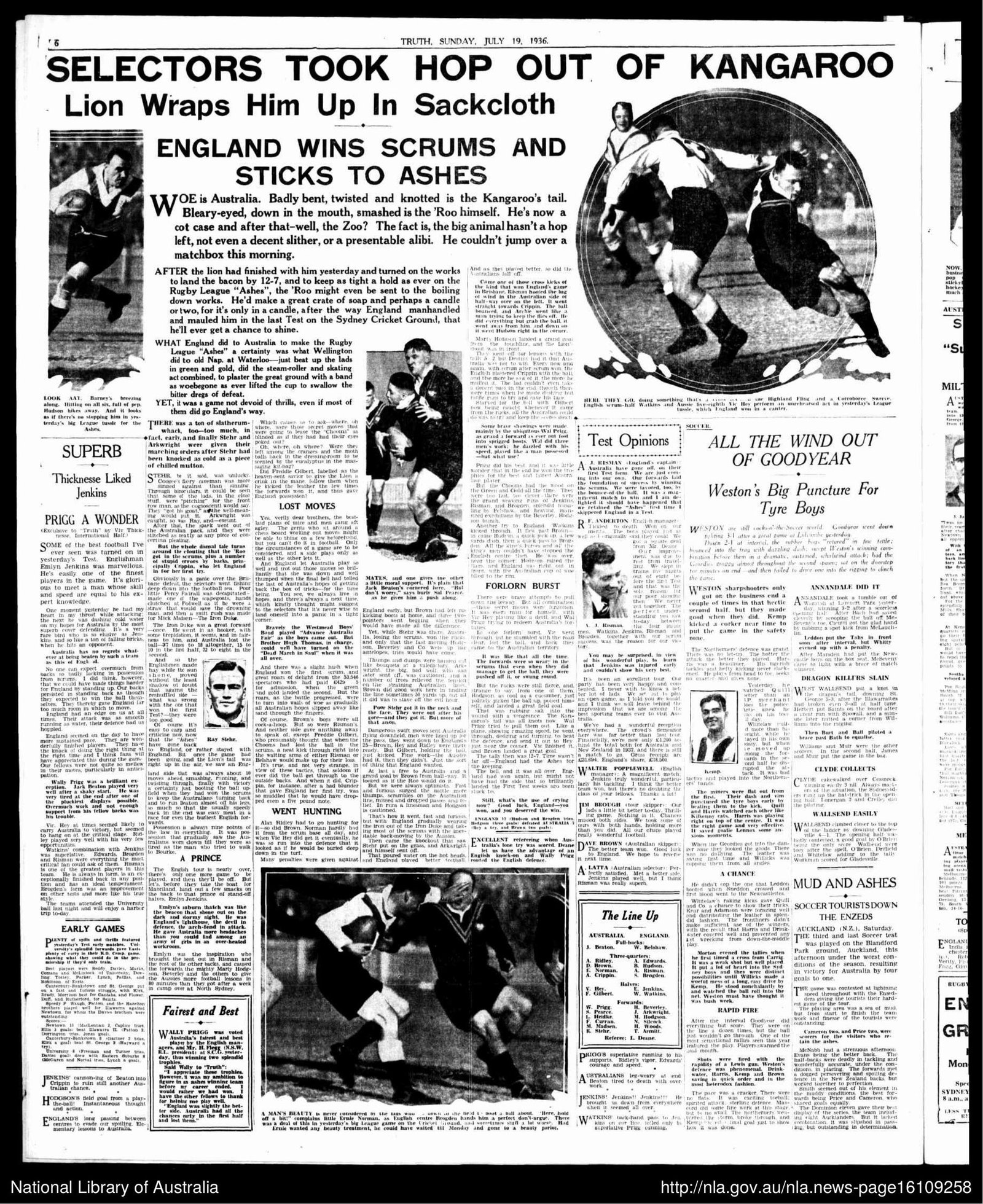
"Selectors Took Hop Out of Kangaroo": the deciding Test
Two full pages on the third Ashes Test at the Sydney Cricket Ground the day before, which England won 12–7 before 53,546 people to keep the Ashes. Emlyn appears three separate times: in the main report, which calls him the prince of stand-off halves and England's lighthouse; in a signed column by the Australian international half Viv Thicknesse; and in the post-match verdicts, where England's manager reveals he had been injured early in the game and still played as he did. Page 7 runs the paper's parallel account under the heading "Ashes for England, Sackcloth for Australia," with the sub-heading that the Taffies, Risman and Jenkins, scintillated. Also gives the full line-up, the gate receipts, and the sending-off of Stehr and Arkwright.
View full page On Trove Used in: The Ashes
Pages: p6 p7 · p7 on Trove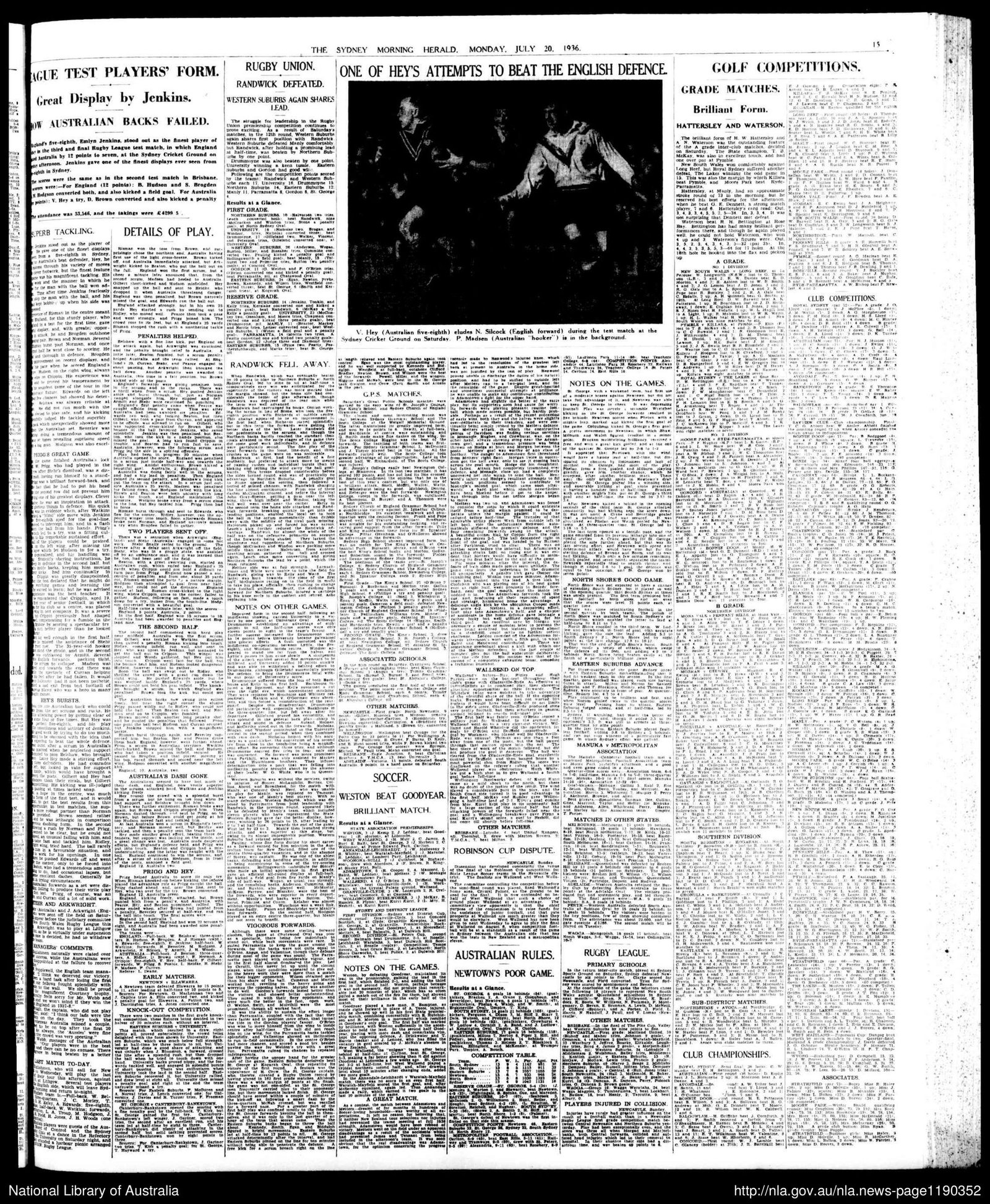
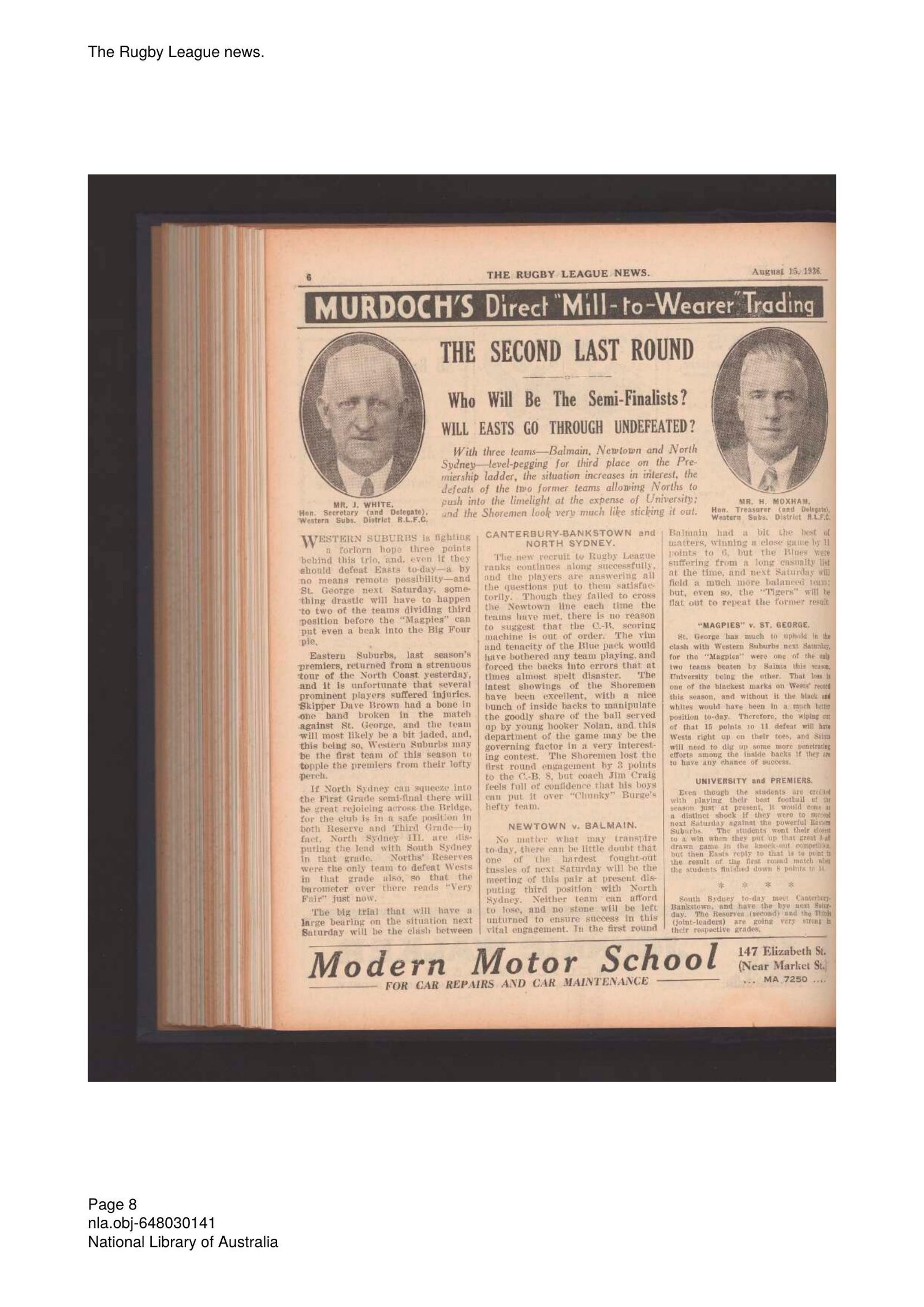
"Great Display by Jenkins": the Herald's verdict
The most authoritative account of the deciding Test, from Sydney's broadsheet of record, and it puts Emlyn's name in the headline. Its opening line: "England's five-eighth, Emlyn Jenkins, stood out as the finest player of the third and final Rugby League test match," and further, that he "gave one of the finest displays ever seen from a five-eighth in Sydney." A section headed Superb Tackling describes him time after time fearlessly dashing in to stop the man with the ball. Confirms the attendance of 53,546 and takings of £4,299, and carries a running account of the whole match.
"England Wins First New Zealand Test"
Reports the first Test of the New Zealand leg, at Auckland, which England won 10–8 after a hard struggle with the New Zealand forwards. The report records that "Emlyn Jenkins, who had performed brilliantly throughout, then scored a try with a brilliant solo effort, and the effort was much appreciated." Scorers: England 10, tries to Edwards and Jenkins with two goals from Hodgson; New Zealand 8. The same issue notes there were only two Tests in the itinerary, so the win meant England could not lose the Courtney Goodwill Trophy, and that the team sailed for home after the second.
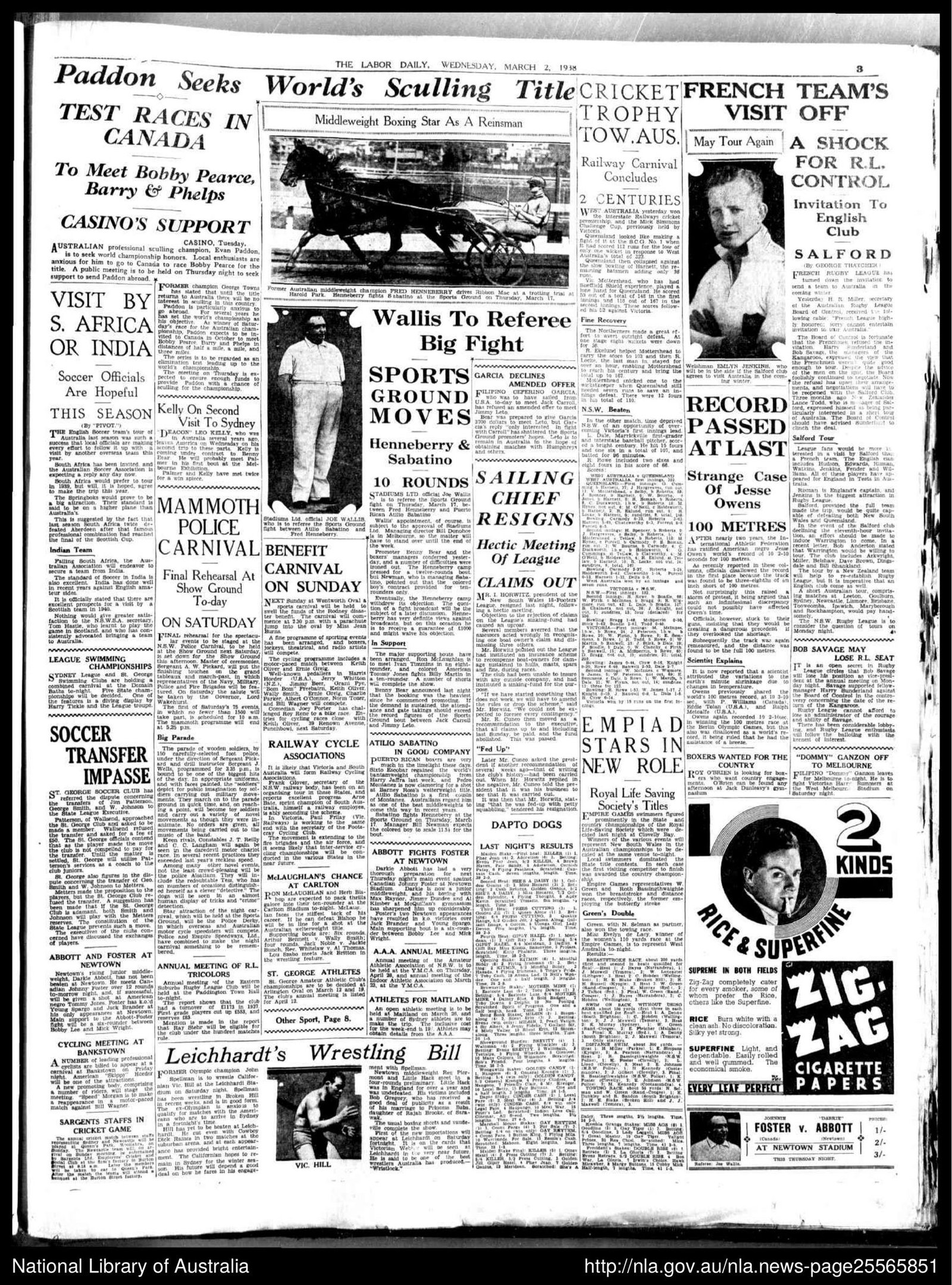
"The biggest attraction in Rugby League": the Salford tour that never was
Reports that the French League had declined an invitation to tour Australia, and urges the Australian Board of Control to invite Salford instead, naming Hudson, Edwards, Risman, Watkins and Jenkins among the players who would come. Then the line that measures where Emlyn's reputation stood eighteen months after the Ashes tour: "Risman is England's captain, and Jenkins is the biggest attraction in Rugby League." A captioned photograph of Emlyn appears under the heading May Tour Again. The tour never happened, and within the month Emlyn had left Salford for Wigan.
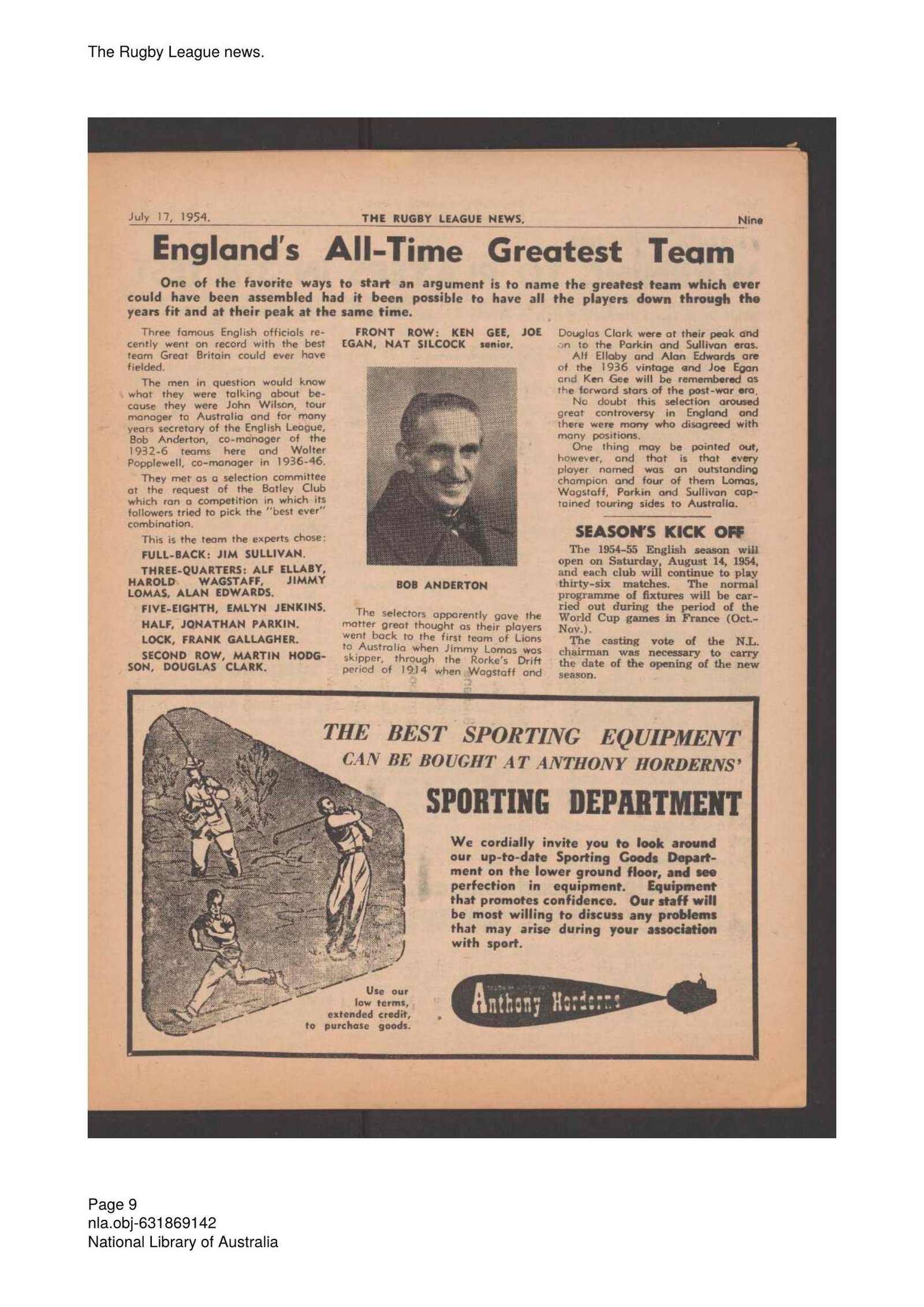
"England's All-Time Greatest Team"
Three senior English officials sat as a selection committee, at the request of the Batley club, to name the best team Great Britain could ever have fielded: John Wilson, secretary of the English League for many years and a tour manager to Australia, with Bob Anderton and Walter Popplewell, co-managers of the touring teams of 1932 to 1946. Emlyn was their choice at five-eighth. The full side: Jim Sullivan at full-back; Alf Ellaby, Harold Wagstaff, Jimmy Lomas and Alan Edwards in the three-quarters; Emlyn Jenkins at five-eighth and Jonathan Parkin at half; Frank Gallagher at lock; Martin Hodgson and Douglas Clark in the second row; Ken Gee, Joe Egan and Nat Silcock senior in the front row. Anderton and Popplewell had managed Emlyn on the 1936 tour and both praised him publicly in Sydney at the time. The page carries a photograph of Anderton.