He was twenty-seven when Salford let him go, and he had been the best stand-off in Britain for most of a decade. On any reasonable expectation he had ten more years in him. What actually happened was that he played out one season at Wigan, wrote a letter announcing that he was finished with the game, and then unretired within the week. What followed was another decade of not quite stopping: Keighley, a wartime jersey or two, and finally a coach in his late thirties putting his own name on the team sheet.
Wigan, March 1938
Salford placed him on the transfer list at £1,000, and on Friday 4 March Wigan took him, for a fee of £700. There was no ceremony about it: he played for Wigan's A team the following afternoon, away against St Helens Recreation. Three papers carried the news that Saturday, in Liverpool, Cardiff and Newport, and all three totted up the same account of him: Wales on numerous occasions, the Australian tour of 1936, three Tests against Australia that season, seven Test matches in all.
Sources: Liverpool Daily Post, Western Mail and South Wales Argus, all 5 March 1938, and Widnes Weekly News, 18 November 1938, for the fee actually paid. All in the Archive.
November 1938: the cinema
He did not last a year at Wigan. In the third week of November 1938 he wrote to the club's manager to say he was finished with the game, and was going to manage a cinema in the Manchester district instead. The Widnes paper carried it in a few lines: one of the most brilliant stand-off halves in the Rugby League had decided to retire. He was twenty-seven years old.
It sounds like a whim, and it was not. He had been building the second career for at least eighteen months while still playing Test rugby. In June 1937 a Stockport paper reported that the manager of the Plaza Cinema was taking a week's holiday and his duties would be covered by Mr Emlyn Jenkins, the famous Rugby League international who plays for Salford, adding that in addition to his football career he is training to be a cinema manager, and is Assistant-Manager at the Ambassador Cinema, Pendleton. The same paragraph notes that the people of Treherbert had just presented him with a handsome clock and a wristlet watch to mark the Australian tour and their pride in his bringing fame to the town.
Source: Stockport County Express, 10 June 1937, in the Archive.
The manager he wrote to was Harry Sunderland, the same Australian who had followed him from the foggy Test at Swinton in 1933 to Paris in 1934 to the tour of 1936, and who had christened his nickname into print. Sunderland took the news badly enough to give most of a page of the Manchester Evening News to it the next day, under a headline that reads as a plea: "Jenkins is Too Young, Too Good, to be Out of Rugby." He called it his first failure at Wigan. He had wanted Emlyn there, had gone to the trouble of getting him, and had now lost him to a cinema.
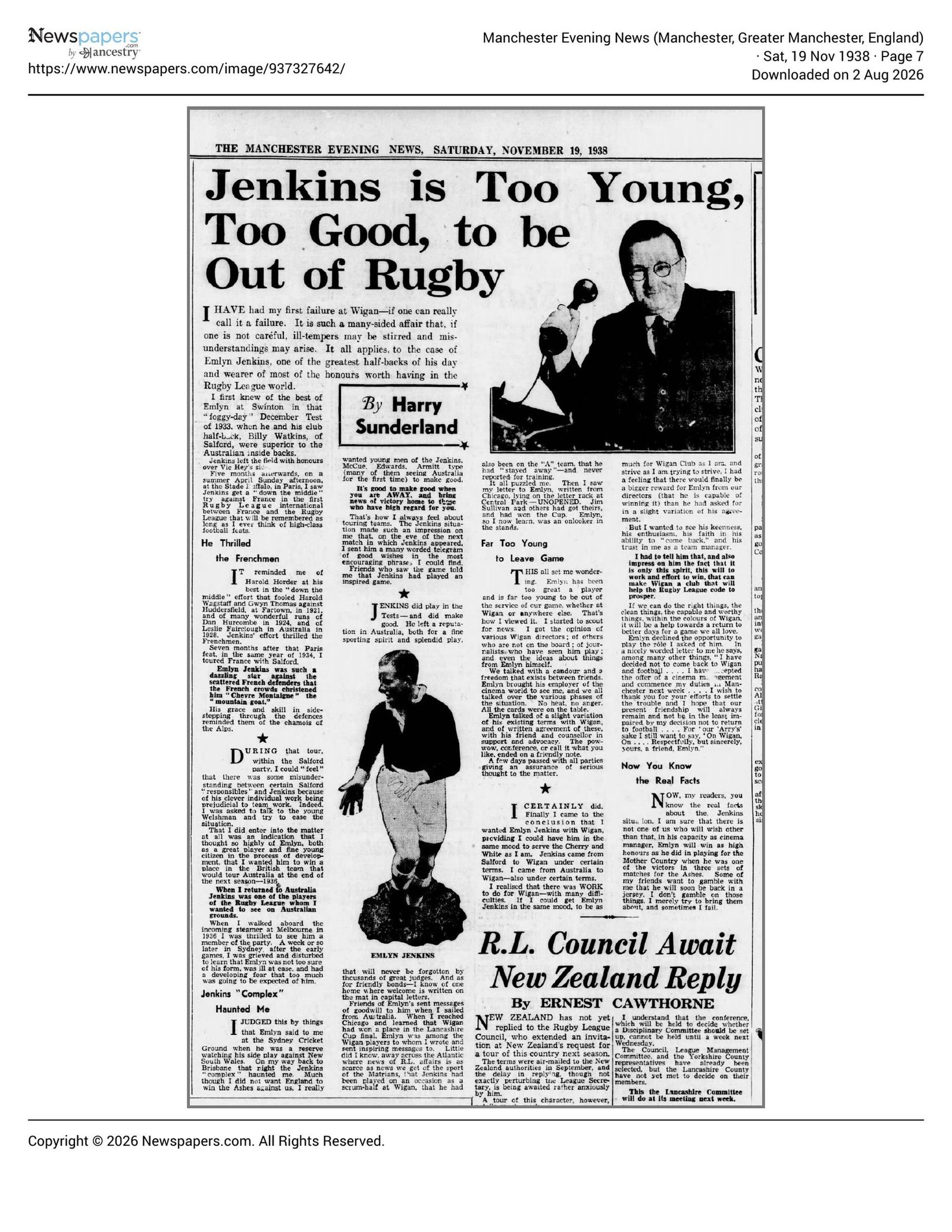
Manchester Evening News, 19 November 1938. Harry Sunderland's piece, with two photographs of Emlyn. Click to read the full page.
The article is candid in a way that press tributes rarely are, and it is worth reading whole. Sunderland sets down the misunderstanding that had grown up at Salford, where some at the club thought Emlyn's individual brilliance came at the expense of team play, and admits he was asked at the time to have a word with the young Welshman about it. He had done so because he thought so highly of him, both as a player and as a young man coming on in the world. Now, at twenty-seven, Emlyn was in his judgement too good and far too young to be lost to the game, and nothing Sunderland could say had changed his mind.
Sources: Widnes Weekly News, 18 November 1938, and Manchester Evening News, 19 November 1938, both in the Archive.
Five days
The retirement lasted less than a week.
On the Saturday after Sunderland's article appeared, Emlyn was spotted in the stand at Lawkholme Lane, watching Keighley. By the Wednesday night the Keighley chairman Sam Slater and his secretary-director Percy Beadman had him in a room in Manchester with a pen, and on Thursday 24 November 1938 the Leeds Mercury announced "Keighley's Big Capture". The paper called it one of the biggest deals in the club's history, allowed itself the observation that it was remarkable in view of the recent announcement that Jenkins had decided not to return to football, and described him as one of the greatest backs in the game. He wanted to play centre for his new club. Sunderland, asked about the fee, said only that the deal was very satisfactory from Wigan's point of view.
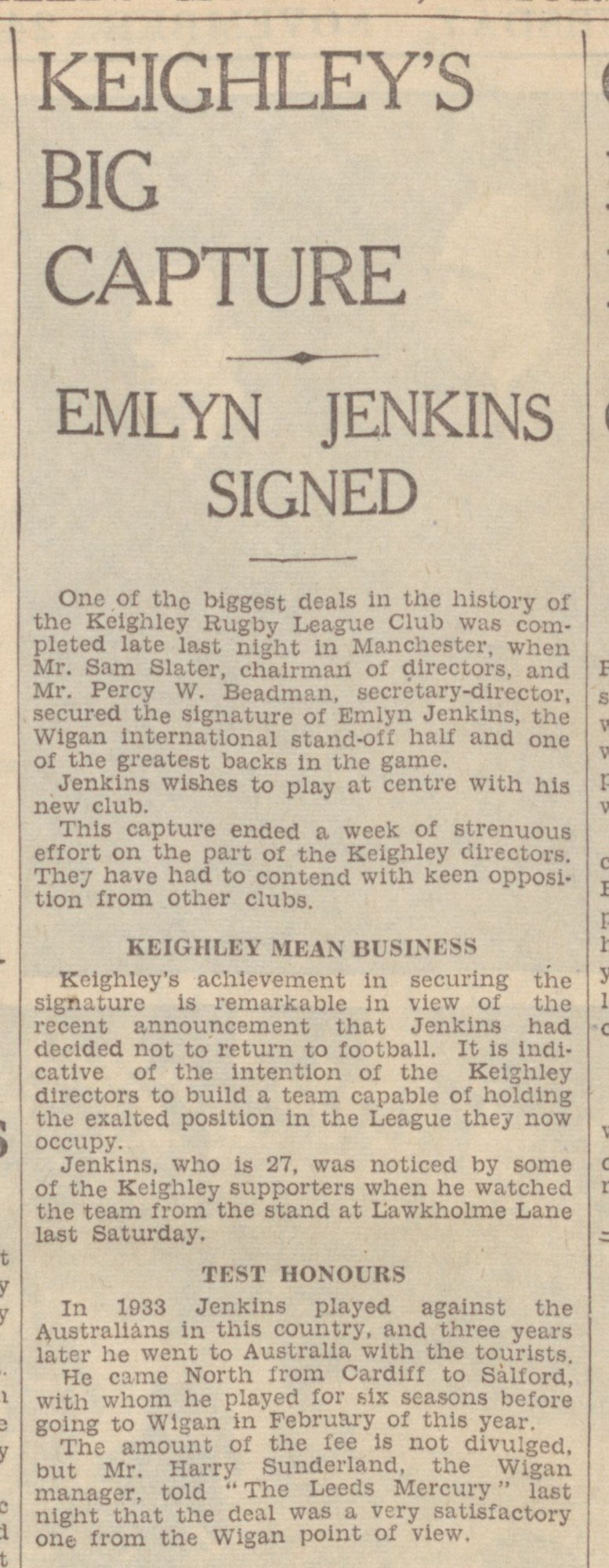
Leeds Mercury, 24 November 1938, five days after the retirement was announced.
So the cinema job and the game turned out not to be alternatives after all. He played on at Keighley through 1939. In April that year, against Hull Kingston Rovers, an injury to a teammate forced a reshuffle and the report notes that it caused Emlyn Jenkins to resume his old position at stand-off half, whereupon Keighley contributed many bright efforts. The Welshman, it says, was at the head of a move which produced one of the best tries of the game. He was twenty-eight, and back where he belonged.
Sources: Leeds Mercury, 24 November 1938 and 18 April 1939, both in the Archive.
The war
Then the game stopped, or very nearly. Wartime rugby league was a makeshift business of ten shillings a match, fixtures arranged a week at a time, and players guesting wherever they happened to be stationed. On 30 September 1939, three weeks into the war, the Liverpool Daily Post ran a paragraph about the mess and, in a list of that afternoon's South-West Lancashire fixtures, recorded that in the game at Warrington Emlyn Jenkins, the ex-Salford player, had been granted permission to play for Broughton Rangers. It was the day after the national register had written him down at home in Salford as a cinema manager and a wartime policeman.
A later summary of his career, printed when St Helens appointed him in 1951, lists him as the former Salford, Wigan, Keighley and Bradford Northern international half back. Nothing else in this archive corroborates the Bradford connection, and the likeliest explanation is a wartime guest spell of the same kind as the Broughton Rangers one. It is on the list of things still to be established.
Sources: Liverpool Daily Post, 30 September 1939, and Bradford Observer, 17 January 1951, both in the Archive. What he did for the rest of the war is in Ubique.
The last two
He was thirty-five when the war ended and the game restarted, and he came back to it as a coach rather than a player. That should have been that. It was not.
The club's own heritage register settles it. Leigh have catalogued every one of the 1,564 men who have played for them in a competitive first team game since 1895, and Emlyn is heritage number 584. The entry reads: debut 1948-49, last played 1949-50, two games, one try, three points.
Two games, not one. He was thirty-seven or thirty-eight at the first of them and not quite thirty-nine at the second.
Source: Leigh Leopards, "They Played For Leigh", the club's complete heritage register, number 584. The register states seasons by their first year, so 1948 is the 1948-49 season.
The one the family remembered is the October match, because there is a try attached to it and a story about a man of nearly thirty-nine putting himself on and scoring. The other had disappeared completely. It is a small thing to have lost, but it is the kind of thing that only a club's own ledger keeps: a coach short of a player, or unable to help himself, writing his own name on the team sheet on an ordinary Saturday in 1948 or 1949, and never mentioning it again.
The rule he was breaking
The professional game was not the only one he went on playing. While training as a teacher at Risley, near Warrington, he turned out at rugby union well into his forties, and he did it quietly, because he had to. Union enforced a strict amateur code that banned for life anyone who had ever played the professional game. There was no route back and no expiry: having signed for Salford in 1930, he was barred from union for the rest of his life, and the rule stood until union itself finally turned professional in 1995, two years after he died.
Put together, the record is of a man who could not be told. He announced his retirement at twenty-seven and signed for another club inside a week. He kept playing through the first weeks of a war in whatever jersey would have him. He put himself on a Leigh team sheet twice in his late thirties, once without his family ever finding out. And he played union into his forties knowing that the penalty, had anyone reported him, was a ban he was already serving for life. He gave the game up once, formally, in writing, in November 1938. It took him another twenty years to actually manage it.
Source: History of the amateurism rule and its 1995 repeal, Wikipedia, "History of rugby union". His coaching career is in Coach.